

TL;DR:
- Checkout optimization improves authorization rates, reduces transaction costs, and recovers revenue through UX and backend enhancements. Implementing intelligent routing, tokenization, and modern pricing models like Network Offset Pricing can significantly lower processing costs and boost revenue. Ongoing testing and measurement ensure continuous improvement in payment performance and merchant profitability.
Checkout optimization is the payments performance engine that raises authorization rates, cuts processed cost, and recovers revenue that would otherwise disappear at the final step. Three outcomes follow directly from getting it right:
- Higher authorization rates through intelligent routing, network tokenization via Visa Token Service (VTS) and Mastercard Digital Enablement Service (MDES), and soft-decline recovery paths
- Lower per-transaction cost via routing to lower-interchange acquirers and modern pricing models such as Network Offset Pricing
- Recovered revenue from UX fixes (guest checkout, field reduction) and backend retry logic that handles recoverable declines instead of treating them as permanent losses
PCI DSS compliance and Paysec's merchant infrastructure sit underneath all of it, making the gains durable and auditable.
Table of Contents
- Why does checkout optimization matter for merchant economics?
- How does payment infrastructure change authorization and cost outcomes?
- What UX and trust signals reduce abandonment and improve authorization?
- What pricing models and tactics cut U.S. merchant processing costs?
- How do you measure and A/B test checkout and payment changes?
- What does a phase-by-phase implementation checklist look like?
- Key Takeaways
- Payments are not an ops line item
- Paysec cuts processing costs for U.S. merchants across 18+ industries
- FAQ
Why does checkout optimization matter for merchant economics?
Small lifts in checkout conversion and authorization compound quickly, increasing annual revenue without additional traffic or ad spend. That math applies at every volume level.
Stat to know: Reducing checkout steps from five or more to two or fewer has shown an average conversion lift of 41.3% in controlled testing.
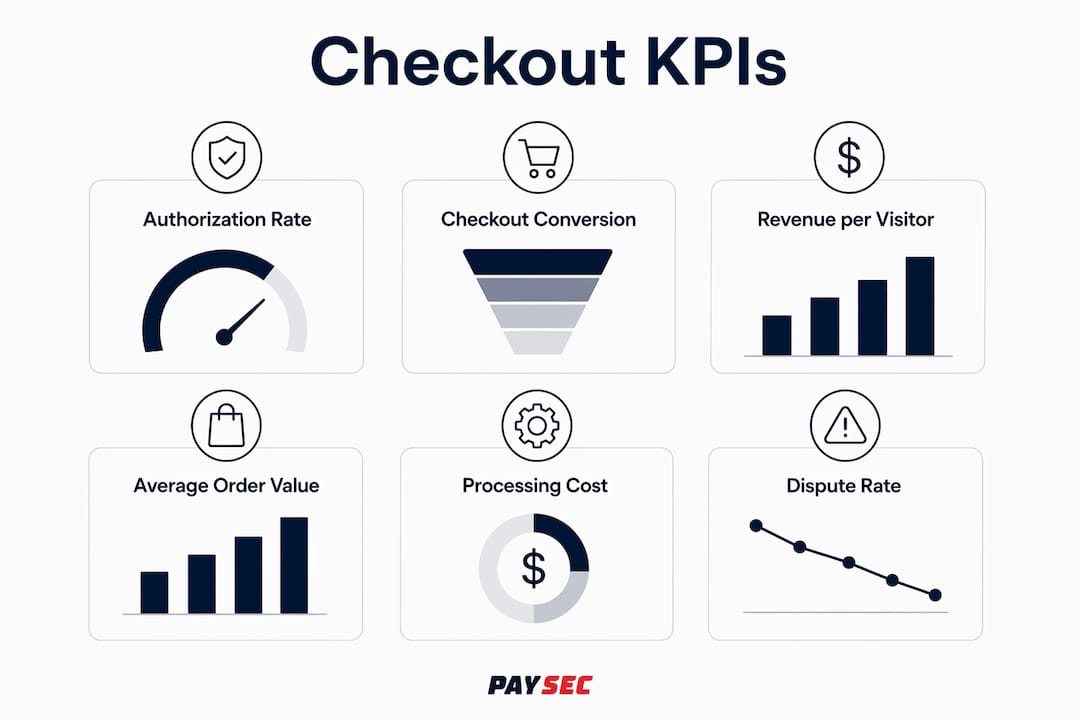
The KPIs that actually matter here are authorization rate, checkout conversion, revenue per visitor, average order value (AOV), processed cost per dollar, involuntary churn (for subscriptions), and dispute rate. Revenue per visitor is the most honest of the group because it captures both conversion and AOV in one number.
Processors, interchange categories, and pricing models determine how much of each recovered transaction you keep. Network Offset Pricing aligns your effective rate with wholesale interchange, which means optimization on the UX side and optimization on the pricing side compound together.
How does payment infrastructure change authorization and cost outcomes?
Orchestration and intelligent routing are the infrastructure levers that most directly move authorization rates and reduce cost. Most merchants treat checkout optimization as a UX project. The largest gains come from backend engineering: intelligent routing and soft-decline recovery typically yield 3–8% more completed transactions compared with UX-only fixes.
The core components:
- Payment gateway vs. orchestration layer: A gateway handles a single processor connection. An orchestration layer sits above multiple processors and routes each transaction to the best acquirer based on BIN, card type, geography, and cost.
- Network tokenization (VTS/MDES): Replaces raw card data with a network-issued token, improving issuer trust and authorization rates while reducing PCI DSS scope.
- Soft-decline recovery: 40–60% of soft declines are recoverable with differentiated retry logic, alternative payment method prompts, and card updater services.
- Hosted vs. embedded elements: Redirecting buyers to a hosted payment page reduces conversion by 8–15%. Embedded elements (Stripe Elements, Braintree Drop-in UI, Adyen Web Components) keep the buyer on your domain throughout.
Payment orchestration centralizes routing, tokenization, failover, and cross-provider analytics so merchants can change routing logic without a development project. That turns provider additions into a configuration task.
Pro Tip: Prioritize high-volume BINs and issuer patterns first when building routing rules. Routing the top 20% of your BIN volume to the best-performing acquirer for that issuer typically captures most of the authorization-rate gain before you touch the long tail.

What UX and trust signals reduce abandonment and improve authorization?
UX and trust reduce abandonment by presenting the right information at the right moment. Unexpected costs cause ~48% of checkout abandonment, and forced account creation accounts for roughly 24% more. Both are fixable without a full redesign.
Key UX levers:
- Guest checkout as the default path, with optional account creation at order confirmation
- Shipping cost and tax shown on the cart page, not revealed at the payment step
- Inline field validation so errors surface immediately, not on submit
- Wallet buttons (Apple Pay, Google Pay) displayed first on mobile
- Saved credentials for returning customers to skip re-entry
- Clear order summary visible on the payment screen
- Security badges and return policy placed near the payment button, not in the footer
Stat to know: Displaying precise estimated delivery dates at checkout reduces cart abandonment and increases conversions by reducing customer uncertainty about when orders will arrive.
Logistics certainty is now a payment conversion variable. Integrating a delivery-date widget that pulls real carrier data removes a late-stage doubt that no payment method can fix. Paysec's logistics payment infrastructure supports merchants who need to connect fulfillment data directly to the checkout experience.
What pricing models and tactics cut U.S. merchant processing costs?
Cost reduction combines pricing model choice, transaction routing, and operational recovery. The right mix depends on your volume, industry, and card mix.
| Lever | Expected Impact (Range) |
|---|---|
| Intelligent routing to lower-interchange acquirers | 0.10%–0.40% effective rate reduction |
| Network Offset Pricing (wholesale interchange alignment) | 30–60% reduction in processing costs |
| Network tokenization (VTS/MDES) | Measurable authorization lift; reduces involuntary churn |
| Soft-decline retry logic | 40–60% of soft declines recovered |
| Card updater service | Reduces involuntary subscription churn |
| Settlement and dispute reporting | Identifies downgrade categories and chargeback patterns |
Common pricing models for U.S. merchants: blended-rate pricing is simple but hides interchange variance; interchange-plus (pass-through) exposes the real cost structure and rewards optimization; Network Offset Pricing goes further by aligning your rate with wholesale interchange so the merchant retains full revenue while offering customers flexible payment options.
Tactical priorities: route debit transactions through the lowest-cost network available, use network tokenization to improve issuer trust on card-present and card-not-present transactions, and run a billing-cadence review for subscription merchants to reduce failed payment cycles. For a deeper look at payment flexibility strategies, multi-provider approaches consistently outperform single-processor setups at scale.
How do you measure and A/B test checkout and payment changes?
Measure revenue per visitor and authorization rate as your primary metrics. Step-level funnel instrumentation is what makes attribution accurate.
Instrumentation checklist:
- Event-level funnel steps: cart view, shipping selection, payment submit, authorization result, order confirmation
- Decline code capture by type (hard vs. soft) and by BIN/acquirer
- Settlement cost per transaction (not just nominal processor rate)
- Revenue per variant in every A/B test
Testing guidance: run one change at a time, give each test enough traffic to reach statistical significance before reading results, and set guardrail metrics (AOV, dispute rate, refund rate, error rate) before launch. A test that lifts conversion but drops AOV is a loss. Checkout optimization must measure commercial outcomes, not just completion rate.
Pro Tip: Track net settled amounts at the settlement level, not just the nominal processor fee rate. Real savings show up in what actually lands in your bank account after interchange, network fees, and assessments.
Paysec's real-time reporting dashboards give merchants the transaction-level visibility needed to run this kind of instrumentation without building a custom analytics stack.
What does a phase-by-phase implementation checklist look like?
Start with measurement and quick UX wins, then implement infrastructure changes, then pricing negotiation and continuous testing.
Phase 0–2 weeks (quick wins):
- Show shipping costs in the cart before checkout begins
- Enable guest checkout as the default
- Trim form fields to the minimum required for fulfillment
- Fix inline validation so errors appear field-by-field
- Move wallet buttons to the top of the payment options list on mobile
Phase 3–8 weeks (infrastructure):
- Enable network tokenization (VTS/MDES) for stored credentials
- Implement soft-decline recovery paths with differentiated error messages
- Add routing rules for your top-volume BINs
- Integrate a delivery-date widget if you ship physical goods
- Set up event-level funnel instrumentation and revenue-per-visitor tracking
Phase 2–4 months (strategic):
- Onboard an orchestration layer or configure multi-acquirer routing
- Negotiate Network Offset Pricing with your payment provider
- Launch revenue-per-visitor A/B experiments on payment option order and checkout step structure
- Build a quarterly review cadence for routing performance and interchange categories
Sample ROI: a merchant processing $500,000/month who achieves a 42% reduction in processing costs through Network Offset Pricing and routing optimization saves roughly $2,000+ per month in fees alone, before counting recovered soft declines.
Key Takeaways
Checkout optimization is a continuous performance discipline: merchants who combine UX fixes, backend routing, and modern pricing models like Network Offset Pricing consistently achieve the largest and most durable gains.
| Point | Details |
|---|---|
| Measure revenue per visitor | Use it as the primary guardrail metric across every checkout test, not just conversion rate. |
| Fix UX leaks first | Guest checkout and upfront shipping costs address the majority of abandonment causes with minimal engineering. |
| Prioritize routing and tokenization | Backend changes yield 3–8% more completed transactions compared with UX-only fixes. |
| Test with guardrails | Set AOV, dispute rate, and error rate as guardrail metrics before any A/B test goes live. |
| Use Paysec for vendor support | Paysec delivers 30–60% processing cost reductions via Network Offset Pricing, multi-acquirer routing, and real-time reporting across 18+ industries. |
Payments are not an ops line item
The merchants who grow fastest treat their payment stack the same way they treat their marketing stack: as a measurable, testable performance system. Every authorization that fails, every soft decline with no retry path, and every checkout step that surprises a buyer with a fee is a revenue leak with a known fix.
Optimization here is iterative. The merchants who see the biggest gains run a structured program: measure first, fix the highest-impact leaks, then layer in infrastructure changes and pricing model improvements. Measurable savings are achievable without adding friction for customers or complexity for your team.
Paysec cuts processing costs for U.S. merchants across 18+ industries
Merchants processing $500,000 or more per month are leaving real money on the table with blended-rate pricing and single-processor setups. Paysec's Network Offset Pricing aligns your effective rate with wholesale interchange, delivering 30–60% reductions in processing costs with no hidden fees and no long-term contracts.
Paysec gives merchants multi-acquirer routing, embedded tokenization, and real-time reporting dashboards in one platform. Retail merchants using Paysec's retail payment processing solution have reported savings of $2,000+ per month. The same infrastructure applies across SaaS, restaurants, eCommerce, healthcare, and CBD retail.
No minimums. No long-term contracts. Transparent pricing from day one. Request a cost analysis to see exactly what your current processing fees are costing you and what Network Offset Pricing would save.
FAQ
What is checkout optimization in payments?
Checkout optimization is the practice of improving every decision point between cart and order confirmation to raise authorization rates, reduce processing costs, and recover lost revenue. It covers UX, backend routing, tokenization, and pricing model choices.
How much can checkout optimization reduce processing costs?
With Network Offset Pricing and intelligent routing, U.S. merchants typically achieve 30–60% reductions in processing costs. Backend engineering changes alone, such as soft-decline recovery and routing, yield 3–8% more completed transactions.
What is Network Offset Pricing?
Network Offset Pricing aligns a merchant's effective processing rate with wholesale interchange, eliminating the markup that blended-rate pricing hides. Paysec offers this model with no hidden fees and no long-term contracts.
What KPIs should merchants track for checkout performance?
Track authorization rate, checkout conversion, revenue per visitor, AOV, processed cost per dollar, and dispute rate. Revenue per visitor is the most reliable single metric because it captures both conversion and order value.
How long does checkout optimization take to show results?
Quick UX wins (guest checkout, upfront shipping costs, wallet buttons) typically show measurable results within a few weeks. Infrastructure changes like routing and tokenization produce compounding gains over a 2–4 month implementation window.