

TL;DR:
- Payment processing costs include fixed fees like interchange and assessments, along with negotiable processor markups and gateway charges. Businesses can significantly reduce expenses by understanding fixed versus negotiable costs, shifting high-volume transactions to ACH, and negotiating fees with providers. Calculating the effective rate reflects true expenses, enabling better cost management and potential savings of 30% or more.
Payment processing costs are the fees businesses pay to accept, authorize, and settle digital transactions, typically ranging from 1.5% to 3.5% per card transaction plus flat per-transaction charges. For financial managers running online operations, that range is just the starting point. The real payment processing cost breakdown online includes interchange fees set by Visa and Mastercard, processor markups from providers like Stripe and PayPal, gateway charges, PCI compliance fees, and chargeback costs that rarely appear in a single line item. Understanding every layer of this fee structure is what separates businesses that accept processing costs as a fixed expense from those that actively reduce them by 30% or more.
What components make up online payment processing fees?
Every online transaction triggers a chain of fees paid to multiple parties simultaneously. Most business owners see only the final blended rate on their statement, which obscures where the money actually goes.
The three core fee layers
Interchange fees are the largest portion of payment processing costs, set by card networks like Visa, Mastercard, and American Express, and paid directly to the card-issuing bank. These are non-negotiable. They vary by card type, transaction method, and industry, and they form the floor beneath every rate you are quoted. A rewards credit card carries a higher interchange rate than a basic debit card, which is why your effective rate fluctuates even when your processor's markup stays constant.

Card network assessment fees sit on top of interchange. Visa, Mastercard, and Amex charge these directly for the use of their networks, typically a fraction of a percent per transaction. They are small individually but add up at volume. Processor markups and gateway fees are layered above both, and this is where pricing models diverge significantly. Flat-rate, interchange-plus, and network offset pricing each produce different total costs depending on your transaction volume and average ticket size.
Additional fees that inflate your effective rate
Beyond the core three, businesses encounter a second tier of charges that rarely get discussed upfront. PCI compliance costs vary widely and can add recurring fixed or penalty fees to a merchant's profit and loss statement. Resolving compliance gaps reduces these fees without touching transaction volume, making PCI remediation one of the highest-return administrative tasks a finance team can prioritize.
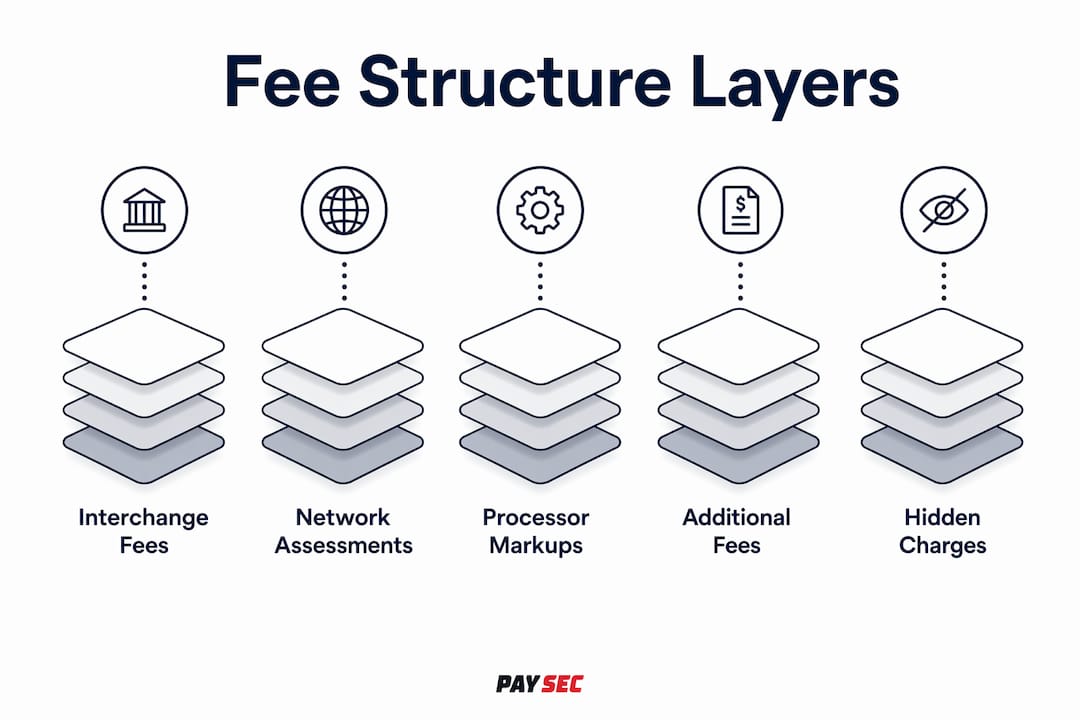
Chargeback fees typically run $15 to $100 per dispute, regardless of outcome. Currency conversion fees apply to international transactions and are often stacked on top of the international card surcharge. Statement fees, batch fees, and monthly minimum fees round out the list. The table below maps each component to its typical range.
| Fee component | Who receives it | Typical range | Negotiable? |
|---|---|---|---|
| Interchange fee | Card-issuing bank | 0.05% to 2.40% + flat | No |
| Network assessment | Visa / Mastercard / Amex | 0.13% to 0.15% | No |
| Processor markup | Payment processor | 0.10% to 0.50% + flat | Yes |
| Gateway fee | Payment gateway | $0.05 to $0.30 per transaction | Yes |
| PCI compliance fee | Processor / compliance vendor | $5 to $30 per month | Partially |
| Chargeback fee | Processor | $15 to $100 per dispute | Partially |
| Currency conversion | Processor / network | 1% to 3% per transaction | Partially |
Understanding this table changes how you read your monthly statement. The fees in the top two rows are fixed costs of doing business with card networks. Every fee below them is a target for negotiation or reduction.
How do payment methods affect your online processing costs?
The payment method your customer chooses determines which fee structure applies, and the cost difference between methods is substantial. This is the most underleveraged variable in most businesses' payment strategy.
Card processing costs by transaction type
Stripe charges US businesses 2.9% plus $0.30 per successful domestic card transaction. International cards add a 1.5% surcharge, and ACH Direct Debit costs 0.8% capped at $5. Run those numbers on a $1,000 transaction: a domestic card costs $29.30, an international card costs $44.30, and ACH costs $5.00. The ACH option saves $24.30 on a single transaction. Multiply that across hundreds of monthly invoices and the annual savings become a meaningful line item.
Card-not-present transactions, which describes every online payment, carry higher interchange rates than card-present transactions. The reason is fraud risk. When a card is physically swiped or tapped, the network has more confidence in the transaction's legitimacy. Online, that confidence drops, and the interchange rate rises to compensate. This structural cost is unavoidable for ecommerce businesses, which makes the case for ACH even stronger when the customer relationship allows for it.
ACH and bank transfer costs
Processing bank payments can cost 20% to 70% less than processing card payments. That figure is not a rounding error. It reflects the fundamental difference between a flat-fee bank transfer and a percentage-based card transaction. For a SaaS company billing $500 per month per customer, shifting 200 customers from card to ACH could reduce processing costs by thousands of dollars annually without changing the product or the price.
ACH processors typically charge flat fees between $0.20 and $1.50 per transfer, making ACH cost-effective for large or recurring transactions compared with percentage-based card processing. The flat fee structure means ACH becomes proportionally cheaper as transaction size increases. At $50, the math is close. At $500 or $5,000, ACH wins decisively.
| Payment method | Fee structure | Cost on $100 | Cost on $1,000 | Best use case |
|---|---|---|---|---|
| Domestic credit card (Stripe) | 2.9% + $0.30 | $3.20 | $29.30 | Low-ticket, one-time purchases |
| International credit card (Stripe) | 4.4% + $0.30 | $4.70 | $44.30 | Cross-border ecommerce |
| ACH Direct Debit (Stripe) | 0.8%, capped at $5 | $0.80 | $5.00 | Recurring billing, large invoices |
| Debit card (standard) | 0.05% + $0.22 (regulated) | $0.27 | $0.72 | High-volume, lower-ticket retail |
Pro Tip: If your business collects recurring payments or processes invoices above $200, offer ACH as the default payment method and reserve card options as secondary. The savings compound quickly, and most B2B customers prefer bank transfers anyway.
What are the hidden and negotiable fees in online payment processing?
Businesses commonly overlook gateway and PCI fees in their statements. A detailed contract review exposes cost-saving opportunities that most merchants never pursue because they assume all fees are fixed. They are not.
Fees that hide in plain sight
The 7 hidden fees that appear in credit card processing statements include monthly minimum fees, batch settlement fees, annual fees, statement fees, early termination fees, and non-compliance surcharges. Each is small in isolation. Together, they can add $50 to $200 per month to your processing expenses without any corresponding transaction volume. A business processing $50,000 per month at a stated rate of 2.5% might have an effective rate closer to 3.1% once these charges are factored in.
PCI non-compliance fees deserve special attention. Processors charge these monthly when a merchant has not completed their annual PCI self-assessment questionnaire. The fee is not a fine from the card networks. It is a surcharge from your processor, and it disappears the moment you complete the compliance process. Many merchants pay this fee for years without realizing it is avoidable.
What you can actually negotiate
Interchange and scheme fees are generally non-negotiable, but businesses can negotiate acquirer markups and some provider, gateway, refund, and chargeback fees. Knowing this distinction is the foundation of any productive negotiation with a processor. Here is what to target:
- Processor markup: The percentage added above interchange. High-volume merchants can often reduce this by 0.10% to 0.30% by presenting competitor quotes.
- Gateway fees: Per-transaction gateway charges are frequently waived or reduced for merchants committing to volume minimums.
- Chargeback fees: Some processors will reduce the per-dispute fee or waive it for merchants with chargeback rates below 0.5%.
- Monthly and statement fees: These are almost always negotiable for established merchants. Ask for them to be removed entirely.
- Early termination fees: Negotiate these out of the contract before signing, not after you decide to switch.
Pro Tip: Request quotes from at least two competing processors before your next contract renewal. Processors know their margins, and a competing offer is the single most effective tool for reducing your markup rate. You do not need to switch. You need to demonstrate that you will.
How to calculate and manage your online payment processing costs effectively
Calculating your true payment processing expenses requires more than multiplying your rate by your volume. The effective rate, which is total fees divided by total volume, is the only number that tells you what you actually pay.
Step-by-step calculation method
- Pull your last three monthly processing statements and identify every fee line item, not just the transaction fees.
- Add all fees together: interchange, assessments, processor markup, gateway fees, PCI fees, chargeback fees, and any monthly charges.
- Divide total fees by total processing volume and multiply by 100 to get your effective rate as a percentage.
- Compare your effective rate against the benchmark for your industry and transaction type. Online retail typically runs 2.5% to 3.2% effective. B2B with ACH optimization can run below 1.5%.
- Identify the largest fee categories and determine which are fixed (interchange, assessments) versus variable (markups, gateway, compliance fees).
Once you know your effective rate, you can model the impact of changes. Shifting 30% of volume from cards to ACH, for example, produces a predictable reduction in total fees. Tools like the Stripe Fee Calculator let you model exact costs per transaction type before committing to a method change.
Managing costs at the operational level
Currency conversion fees apply when a customer's card is issued in a foreign country. These fees stack on top of the international card surcharge, often adding 1% to 3% to the transaction cost. Businesses with significant international volume should evaluate whether a multi-currency payment gateway reduces these charges by settling in the customer's local currency before converting.
Reducing failed payments and chargebacks lowers the total fee burden directly. A failed ACH transaction that retries costs twice. A chargeback costs the transaction amount plus the dispute fee plus staff time. Implementing bank account verification through tools like Plaid before initiating ACH transfers reduces failure rates significantly. For card payments, address verification and 3D Secure authentication reduce fraud-related chargebacks.
Tracking subscription and recurring billing fees separately from one-time transaction fees gives finance teams a cleaner view of cost trends. Recurring payments on cards often qualify for lower interchange rates if submitted with the correct transaction identifiers, a detail many processors do not configure by default.
| Cost management approach | Effort level | Potential savings | Best for |
|---|---|---|---|
| Shift volume to ACH | Medium | 20% to 70% on shifted transactions | B2B, SaaS, recurring billing |
| Negotiate processor markup | Low | 0.10% to 0.30% rate reduction | All businesses at renewal |
| Resolve PCI compliance | Low | $5 to $30 per month in fees | Merchants with non-compliance surcharge |
| Reduce chargebacks | Medium | $15 to $100 per avoided dispute | eCommerce, subscription businesses |
| Optimize pricing model | High | Varies by volume and ticket size | High-volume merchants |
Understanding your processing fees versus profit margin is the analytical step most business owners skip. A 0.5% reduction in effective rate on $1 million in annual volume is $5,000 back in operating income. That is not a rounding error. It is a real number worth an afternoon of contract review.
Key takeaways
Reducing online payment processing costs requires knowing which fees are fixed, which are negotiable, and which disappear entirely when you change payment methods.
| Point | Details |
|---|---|
| Fee structure has three layers | Interchange, network assessments, and processor markups each require separate analysis. |
| ACH is dramatically cheaper | Bank transfers cost 20% to 70% less than card processing for large or recurring payments. |
| Hidden fees inflate effective rates | PCI non-compliance, gateway, and statement fees can add 0.5% or more to your real rate. |
| Markups and gateway fees are negotiable | Interchange is fixed, but processor markups and monthly fees respond to competitive pressure. |
| Effective rate is the only metric that matters | Divide total fees by total volume to see what you actually pay, not what your contract states. |
Why most businesses are overpaying and what we've seen fix it
From where we sit at Paysec, working with merchants across more than 18 industries, the most consistent finding is this: businesses that think they have a good processing rate almost always have a good stated rate. Their effective rate tells a different story.
The gap between stated and effective rate is where the real money hides. We have reviewed statements from SaaS companies paying 2.9% flat rate on every transaction, including ACH-eligible recurring invoices that could have settled at under $1.00 each. We have seen healthcare practices absorbing $40 per month in PCI non-compliance fees for three consecutive years because no one flagged the line item during onboarding. These are not edge cases. They are the norm.
The advice to "negotiate your rate" is correct but incomplete. Negotiating your markup from 0.40% to 0.25% saves money. Restructuring which transactions go through which payment rails saves more. A CPA firm that shifted to interchange optimization cut processing costs by 38% without changing its pricing or customer experience. The lever was method and pricing model, not just rate negotiation.
What we find most businesses underestimate is the compounding effect of small fee reductions across high transaction volume. A restaurant processing $80,000 per month does not feel the impact of a 0.3% rate difference on any single day. Annualized, that difference is $2,880. That covers a part-time employee's monthly wages or a full year of accounting software.
The other overlooked factor is compliance. PCI fees behave like a fixed tax on non-compliance. Completing the self-assessment questionnaire takes two to four hours. The return is immediate and permanent. We have never seen a merchant regret spending that afternoon.
Our honest recommendation: pull three months of statements, calculate your effective rate, and compare it against what you would pay under an interchange-plus or network offset model at your current volume. The math usually makes the decision obvious.
— Paysec Marketing Team
How Paysec helps businesses cut processing costs
Paysec's Network Offset Pricing gives businesses access to wholesale interchange rates, eliminating the processor markup layer that inflates most merchants' effective rates. Clients across SaaS, eCommerce, healthcare, and restaurant sectors have documented savings of 30% to 60% on processing expenses. One client achieved a 42% reduction in processing costs without changing payment methods or customer-facing pricing. Paysec provides detailed transaction reporting that makes your full payment processing cost breakdown visible at the line-item level, so your finance team can track exactly where fees originate and where they decrease. No minimums, no long-term contracts, and no hidden fees. Visit Paysec to see what your current effective rate should actually be.
FAQ
What is the average cost of payment processing online?
Credit card processing fees typically cost businesses 1.5% to 3.5% per transaction for cards, while ACH transfers run $0.20 to $1.50 flat. Your effective rate depends on card mix, transaction size, and which additional fees your processor charges monthly.
Which fees in my processing statement are negotiable?
Interchange and card network assessment fees are set by Visa and Mastercard and cannot be negotiated. Processor markups, gateway fees, monthly statement fees, and chargeback fees are all negotiable, particularly at contract renewal or when you present a competing offer.
When does ACH make more financial sense than card processing?
ACH becomes the better choice for transactions above $200, recurring billing, and B2B invoices where the customer relationship supports bank transfer. Processing bank payments costs 20% to 70% less than card processing, and the savings scale directly with transaction size.
What is an effective rate and why does it matter?
The effective rate is your total processing fees divided by your total processing volume, expressed as a percentage. It captures every fee including monthly charges, PCI fees, and chargebacks, giving you the true cost of accepting payments rather than just the stated transaction rate.
How do I reduce PCI compliance fees on my statement?
PCI compliance fees appear when a merchant has not completed the annual self-assessment questionnaire required by card networks. Completing the questionnaire removes the non-compliance surcharge immediately. PCI compliance costs vary but resolving compliance status eliminates the recurring monthly penalty without affecting transaction volume.