

Payment data tokenization replaces card numbers with random, non-sensitive tokens so merchants can process repeat charges without ever storing the actual PAN. That single swap shrinks PCI DSS scope, cuts fraud exposure, and keeps recurring billing running even when a customer's card gets reissued. It's the backbone of modern card-on-file security.
TL;DR:
- Network tokens automatically update after card reissuance, ensuring recurring payments continue seamlessly without customer intervention.
- Choosing a standalone, portable token vault reduces long-term re-tokenization costs and offers greater flexibility when switching payment providers.
- Lifecycle management, including automatic remapping of tokens after card reissue, is critical to maintaining operational resilience and protecting revenue.
- Most reputable vendors meet basic security standards, but merchants should prioritize lifecycle automation and vault portability over security certifications alone.
- Tokenization is now central to reducing PCI scope, lowering compliance costs, and preventing data breaches, with transaction volumes expected to exceed 1 trillion globally by 2026.
Table of Contents
- What Is Payment Data Tokenization, and How Is It Different From Encryption?
- How Does Payment Tokenization Work in a Real Transaction?
- What Types of Payment Tokens Exist, and Which One Fits Your Business?
- What Business Benefits Come From Payment Tokenization?
- How Do You Manage a Token Through Its Lifecycle?
- What Should You Consider Before Implementing Tokenization?
- Which Standards and Trust Signals Should You Check Before Choosing a Vendor?
- Paysec's Approach to Tokenization and Merchant Support
- Why Merchants Overthink Tokenization Vendor Choice, and Underthink the Lifecycle
- Sources
- FAQ
What Is Payment Data Tokenization, and How Is It Different From Encryption?
A token is a randomly generated string that stands in for a real card number, or Primary Account Number (PAN), inside a merchant's systems. The token gets stored in a token vault, a secured database that maps each token back to its original card number. Only the vault operator, typically a payment gateway or a token service provider (TSP), holds the key to that mapping.
That design matters because a token carries no exploitable value on its own. Steal a database full of tokens and you get nothing usable. There's no mathematical formula linking the token back to the real card number, so it can't be reverse-engineered the way a weakly encrypted value sometimes can. Compare that to encryption, which transforms data using a reversible algorithm and a key. Anyone who gets the key can decrypt the data back to its original form.
That difference shapes how the two technologies get used in payments:
- Tokenization replaces the actual PAN entirely, removing sensitive data from most of the environment where it's used. McAfee's comparison of tokenization and encryption notes that tokenization typically reduces PCI scope, while encryption still requires you to manage and protect the underlying sensitive data and its keys.
- Encryption is reversible by design and works well for protecting data in transit or at rest across broad categories of information, not just card numbers.
- Hybrid approaches are common: tokenize the PAN for storage and reuse, while encrypting other sensitive fields like customer records or internal communications. A comparison from G2 points out that tokenization fits best for structured, high-risk fields, while encryption remains the better tool for broader data protection needs.
Think of a token as a coat-check ticket. The ticket itself is worthless to anyone who finds it on the sidewalk. Only the coat-check counter, holding the matching claim, can turn it back into your actual coat.
How Does Payment Tokenization Work in a Real Transaction?
Tokenization happens in a specific sequence every time a card gets used, whether at checkout, in a mobile wallet, or at a point-of-sale terminal.
- Capture. The customer enters card details, taps a phone, or swipes a card at checkout, in a wallet like Apple Pay, or at a POS terminal.
- Token issuance. The gateway, vault, or TSP receives the PAN and immediately swaps it for a token. The real card number never touches the merchant's servers in most modern setups.
- Token storage. The merchant stores the token, not the PAN, for future use, whether that's a saved card for one-click checkout or a stored credential for recurring billing.
- Transaction request. When a charge needs to run, the merchant sends the token, not the card number, to the gateway or processor.
- Token resolution. The vault or TSP looks up the token, retrieves the real PAN internally, and forwards the actual card data to the card network and issuing bank for authorization.
- Authorization response. The issuer approves or declines, and the result flows back through the same chain to the merchant, all without the merchant ever seeing the underlying card number.
Device tokens work slightly differently. When a customer adds a card to Apple Pay or Google Pay, the wallet provider requests a network token directly from the card network, tied to that specific device. A server-side token, by contrast, lives in a merchant's vault and gets reused across sessions for stored payment methods, according to Spreedly's explanation of how payment tokenization works.
Pro Tip: Ask any vendor whether their token vault is portable or locked to their own gateway. A gateway-specific vault ties you to that provider forever; a standalone, universal vault lets you switch processors without re-collecting card data from every customer.
What Types of Payment Tokens Exist, and Which One Fits Your Business?
Not all tokens serve the same purpose. Picking the right type depends on how and where the card gets used.
- Network tokens. Issued directly by card networks like Visa or Mastercard, these tokens are tied to a specific card and device or merchant relationship. EMVCo's Payment Tokenisation framework defines the technical standards behind these, and they carry a major advantage: when a card gets lost, stolen, or expires, the network automatically updates the token behind the scenes. The merchant's stored credential keeps working without asking the customer to re-enter anything.
- Device tokens. Created when a card gets added to a mobile wallet, these are scoped to a single device. Lose the phone, and the token can be shut off without touching the underlying card.
- Merchant or acquirer tokens. Generated by a specific payment gateway or acquirer, these tokens work only within that provider's system, which is where portability concerns come in.
- Card-on-file (COF) or server tokens. Used for stored, repeat-use scenarios like subscriptions or saved checkout profiles, typically single-merchant scoped and multi-use.
Single-use tokens, often generated for one checkout session, offer tighter security since they expire immediately after use. Multi-use tokens trade some of that tightness for the convenience recurring billing and stored profiles need. A subscription box service needs a multi-use, network-backed token that survives card reissues. A one-time guest checkout, on the other hand, can run on a single-use token with no long-term storage at all.
What Business Benefits Come From Payment Tokenization?
The security story gets the headlines, but the operational payoff is where tokenization earns its keep for merchants.
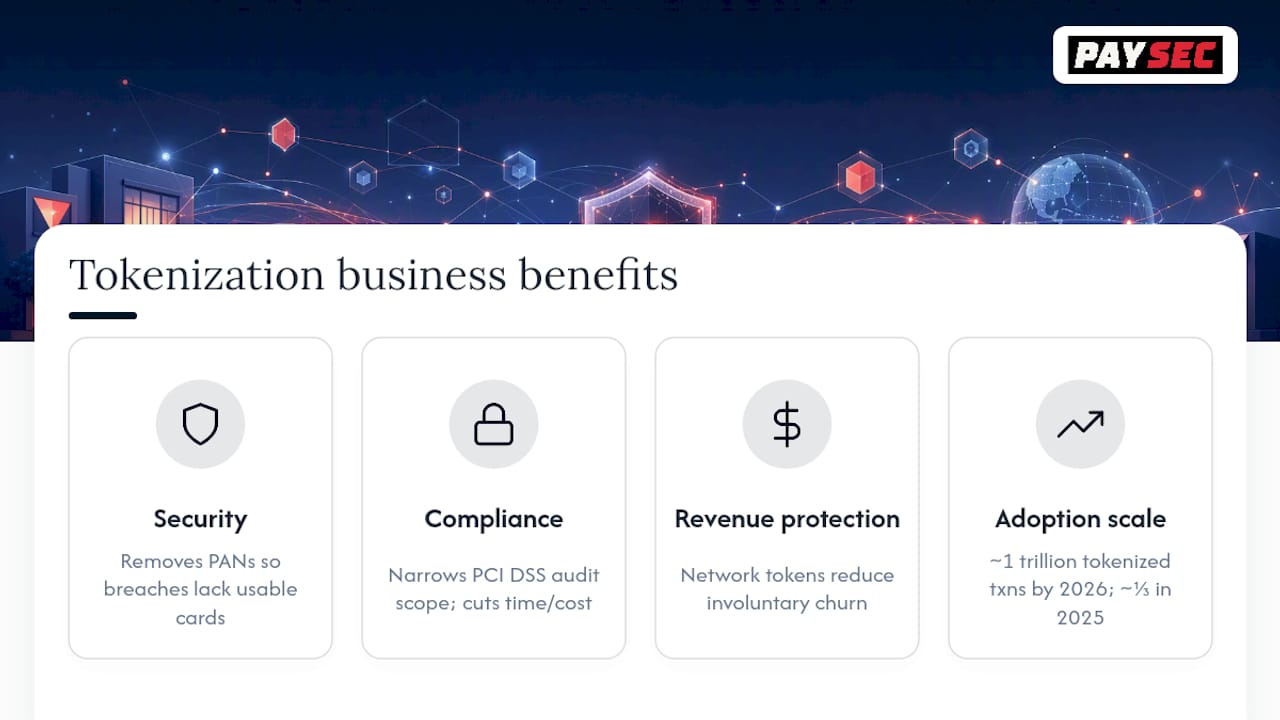
Removing PANs from your environment narrows what auditors need to examine under PCI DSS. Fewer systems touch raw card data, so fewer systems fall inside audit scope, which cuts the time and cost of annual compliance work. A breach involving tokens alone also carries far less fallout since there's no usable card data for attackers to sell or exploit.
Adoption is accelerating fast. Juniper Research projects that tokenized payment transactions will exceed 1 trillion globally by 2026, with about a third of transactions already tokenized in 2025. That scale reflects how central tokenization has become to everyday card acceptance, not a niche security feature reserved for large enterprises.
Network tokens deliver a specific revenue benefit that's easy to underestimate: involuntary churn reduction. When a subscriber's card expires or gets reissued after a fraud alert, a merchant relying on a raw stored PAN sees that recurring charge fail outright. A network token, by contrast, gets automatically updated by the card network, so the subscription keeps billing without the customer lifting a finger. For SaaS and membership businesses running recurring billing programs, that single feature can meaningfully protect monthly recurring revenue that would otherwise erode from card churn alone.
Engineering teams benefit too. Once PANs are out of the environment, fewer systems need PCI-grade hardening, freeing up development time that would otherwise go toward securing card data storage.
How Do You Manage a Token Through Its Lifecycle?
A token isn't a one-time artifact. It has a lifecycle that technical teams need to actively manage, much like any credential.
Token status typically falls into a handful of states: active (usable for transactions), suspended (temporarily disabled, often after a fraud flag), and deleted (permanently retired, usually after a customer removes a payment method or closes an account). Token-management APIs commonly expose fields like a token unique reference, along with endpoints to check, suspend, or delete a token on demand, a pattern documented in SoFi's token lifecycle management guidance.
Card reissuance is where lifecycle management earns its complexity. When a card gets replaced due to expiry or fraud, network tokens generally get remapped automatically behind the scenes. Merchant or acquirer-issued tokens may need manual reconciliation, depending on the provider.
Sound lifecycle handling includes a few operational habits:
- Log every status change with a timestamp for audit and dispute resolution.
- Monitor for a spike in failed authorizations, which often signals a batch of tokens needing reissuance.
- Build a fallback flow that prompts customers to re-enter payment details only as a last resort, after automated remapping has been attempted.
What Should You Consider Before Implementing Tokenization?
Choosing a tokenization approach means weighing trade-offs that show up months or years after go-live, not just at integration time.
The biggest long-term decision is vault architecture. A gateway-specific vault is often faster to set up but locks stored tokens to that one processor. A standalone or universal vault, independent of any single gateway, keeps tokens portable if you ever need to switch ecommerce payment processors. Research on vault design backs this up: standalone token vaults reduce re-tokenization costs and increase merchant flexibility when providers change, according to Spreedly's analysis of tokenization architecture.
Integration pattern is the second major choice:
- Client-side tokenization happens in the browser or app before data ever reaches your server, minimizing your exposure to raw card data.
- Server-side vaulting routes card data through your backend briefly before tokenizing, offering more control but requiring stronger internal safeguards.
- Wallet provisioning hands token issuance to Apple Pay, Google Pay, or similar providers entirely, removing your infrastructure from the equation for that flow.
Testing matters more here than in most integrations, since a token resolution failure during a live authorization directly blocks a sale. Load-test your token lookup and resolution paths under realistic transaction volume before launch, not after.
Pro Tip: Before signing with any tokenization vendor, ask exactly what a migration would look like if you switched providers in two years. If the answer involves re-collecting card data from every customer, you've found a vendor lock-in risk worth negotiating around now.
Which Standards and Trust Signals Should You Check Before Choosing a Vendor?
Two standards bodies define the rules that matter most here. The PCI Security Standards Council publishes tokenization guidance alongside the broader PCI DSS framework, and tokenization typically reduces the scope of a PCI audit by removing raw PANs from most of your environment. It doesn't eliminate your compliance obligations entirely. You're still responsible for secure integration, access controls, and protecting whatever data remains in scope.
EMVCo maintains the technical framework behind network tokens, including registration programs for token service providers and BIN controllers, and defines how tokens stay scoped to a merchant, device, or transaction type while remaining compatible with existing card acceptance infrastructure.
When evaluating a vendor, look for:
- Documented PCI DSS compliance evidence, ideally Level 1 for a payment processor handling high transaction volumes.
- SOC 2 attestation covering data security and operational controls.
- Clear participation in EMVCo's registration programs if network tokens are part of the offering.
- A published breach-history record and an explanation of vault architecture, gateway-tied or standalone.
Beyond PCI, businesses handling European customer data need to weigh GDPR obligations around storing and processing personal information, since tokenized payment data still sits inside a broader customer data environment governed by data protection law. Solid data controls extend well past card numbers, and a partner like Tax Form Hero's data security resources offers a useful supplementary look at SOC 2 readiness and broader encryption practices that complement a tokenization strategy.
Paysec's Approach to Tokenization and Merchant Support
The pricing model called Network Offset Pricing is based on a transparency principle similar to that of tokenization, avoiding hidden costs, surprise fees, and long-term contracts.
That same transparency extends to how Paysec supports merchants working through tokenization and compliance questions. A few resources worth bookmarking:
- The PCI compliance guide for small businesses breaks down what merchants actually need to do once tokenization reduces their audit scope.
- Merchants moving between providers can review the guide to switching ecommerce payment processors for a practical look at migration steps.
- The PCI compliance assistance page outlines how PaySec folds compliance support directly into merchant onboarding.
Real-time transaction reporting rounds out the picture, giving merchants visibility into token status and authorization patterns without needing a separate analytics stack.
Why Merchants Overthink Tokenization Vendor Choice, and Underthink the Lifecycle
Most merchants spend weeks vetting whether a vendor's tokenization is "secure enough," then spend zero minutes asking what happens when a card gets reissued eighteen months into a subscription relationship. That's backwards. Nearly every reputable processor today meets the baseline security bar. The real differentiation shows up in lifecycle handling: does the token get remapped automatically, or does the merchant lose that customer's recurring revenue to a silent authorization failure?
The conventional advice treats tokenization as a checkbox for PCI scope reduction and stops there. That's true, but incomplete. The bigger story is operational resilience: network tokens that survive card reissuance protect revenue in a way encryption never could, because encryption doesn't touch the authorization flow at all. Prioritize vault portability and lifecycle automation before comparing security certifications; certifications are table stakes, but a locked-in vault or a lifecycle gap will cost far more over three years than any marginal security difference between vendors.
— PaySec Marketing Team
Sources
- Tokenised payment transactions to exceed 1tn – Juniper Research
- PCI DSS – PCI Security Standards Council
- EMV® Payment Tokenisation – EMVCo
- Tokenization vs. Encryption: Protect Your Data | McAfee
FAQ
What Is Payment Tokenization?
Payment tokenization replaces a real card number with a randomly generated token that has no exploitable value outside the system that issued it, letting merchants store and reuse payment credentials without holding the actual PAN.
Can You Give an Example of Payment Data Tokenization?
A subscription service saves a customer's card as a token instead of the raw number; each month, the token gets sent to the payment processor, which resolves it back to the real card internally to run the charge.
How Do I Tokenize My Debit Card?
You don't tokenize a card yourself. It happens automatically when you add the card to a merchant's checkout, a mobile wallet like Apple Pay, or a stored payment profile, and the gateway or wallet provider generates the token on your behalf.
Does Apple Pay Use Tokenization?
Yes. Apple Pay requests a device-specific network token from the card network when a card is added to the Wallet app, so the actual card number is never shared with merchants during a transaction.