

The most effective patient payment options for medical practices combine credit/debit card acceptance, ACH/eCheck, HSA/FSA, mobile wallets, and pay-by-link, backed by tiered payment plans and point-of-service collection. Implement this mix by enabling card-on-file (CCoF) and ACH at check-in, adding text-to-pay links for post-visit balances, and publishing one standardized payment-plan policy before the end of your first week. With patient financial responsibility rising steadily, practices that delay building out these rails leave collections on the table and push patients toward bad debt.
First-week action checklist:
- Enable point-of-service card acceptance and ACH/eCheck through a PCI-DSS-compliant processor
- Add pay-by-text or pay-by-link to your post-visit billing workflow
- Set up patient portal payments with card-on-file storage
- Publish one written payment-plan policy covering eligibility, down payment, and plan length
- Confirm your processor meets No Surprises Act good-faith estimate requirements for self-pay patients
- Verify Paysec or your current gateway supports CCoF tokenization and auto-pay enrollment
Table of Contents
- Six best practices that reduce bad debt and improve collections
- Which payment methods should your practice accept?
- How to design patient payment-plan terms that actually work
- In-house vs. outsourced billing: how to decide
- Compliance, pricing models, and what they cost your practice
- Typical costs and how to reduce processing fees
- Key Takeaways
- Paysec cuts processing costs for practices that are ready to stop overpaying
- Useful sources and further reading
- FAQ
Six best practices that reduce bad debt and improve collections
The six practices that move the needle fastest are: self-service payment access, automated recurring payments, pre-service cost estimates, tiered and personalized plans, transparent patient communication, and consistent KPI measurement.
-
Enable self-service payment access. Patients pay faster when they can pay on their own schedule. Patient portals, text-to-pay links, and QR codes at the front desk all reduce the friction between receiving a bill and submitting payment. EHR-integrated digital payment flows measurably increase online payment rates while cutting administrative labor.
-
Automate recurring payments with CCoF and auto-pay. Card-on-file with scheduled charges removes the single biggest reason plans fail: patients forgetting to pay. Set up auto-pay at enrollment and confirm consent in writing.
-
Provide pre-service cost estimates. Patients who know what they owe before the appointment are far more likely to pay at the point of service. Estimates also satisfy No Surprises Act disclosure requirements for self-pay patients.
-
Offer tiered and personalized plans. A single rigid plan template turns away patients who need more time. Short-term plans for smaller balances and extended plans for larger or elective balances serve different patient needs without increasing your administrative load significantly.
-
Communicate clearly and train staff on scripts. Front-desk staff should be comfortable presenting payment options at check-in, not just at checkout. A two-sentence script ("We offer payment plans starting at $X/month with no interest for balances under $2,000. Would you like to set one up today?") reduces awkward pauses and improves uptake.
-
Measure and iterate. Track AR days, collection rate, and plan adherence monthly. HFMA research confirms that structured payment plan programs improve cash flow and reduce bad debt when paired with consistent performance monitoring.
Pro Tip: Linking auto-pay enrollment to a small administrative courtesy, such as waiving a statement fee or simplifying the sign-up form at check-in, materially improves plan adherence. Revenue-cycle practitioners consistently report that removing enrollment friction is the single highest-return change a practice can make to a new payment-plan program.
Staff training should happen at launch and again every six months. Patient-facing language matters: use "payment plan" rather than "financing" and "balance" rather than "debt" to keep conversations comfortable.
Which payment methods should your practice accept?
Accept credit/debit cards, ACH/eCheck, HSA/FSA cards, mobile wallets, pay-by-link, patient portal payments, and payment subscriptions. That full set covers the most popular patient payment rails and gives patients the flexibility they expect.
- ACH/eCheck: Lower cost than cards (often under $1 per transaction or a small flat fee); ideal for recurring plan payments. CMS recognizes ACH/EFT as a standard electronic payment rail for healthcare.
- Pay-by-link/text-to-pay: Send a secure payment link via SMS or email. DrChrono's integrated payment tools show that text-to-pay links reduce days-to-payment on post-visit balances.
| Payment Method | Typical Cost Shape | Patient Preference | Best Use Case |
|---|---|---|---|
| Credit/debit card | Higher (1.5%–3.5%) | Very high | Point-of-service, one-time balances |
| ACH/eCheck | Low (flat fee or <1%) | Moderate | Recurring plan payments, large balances |
| HSA/FSA card | Same as card | High (HDHP patients) | Deductible and out-of-pocket balances |
| Mobile wallet | Same as card | Growing | Contactless POS, younger patients |
| Pay-by-link/text-to-pay | Same as card | High | Post-visit collections, remote patients |
| Patient portal payment | Same as card | Moderate–high | Self-service, after-hours payments |
| Payment subscription | Same as card or ACH | Low–moderate | Chronic care, membership programs |
PCI-DSS note: Any practice storing card-on-file data must use a processor that tokenizes card numbers and holds PCI-DSS Level 1 or Level 2 certification. Never store raw card data in your EHR or practice management system. Confirm your gateway's compliance scope before enabling CCoF.
How to design patient payment-plan terms that actually work
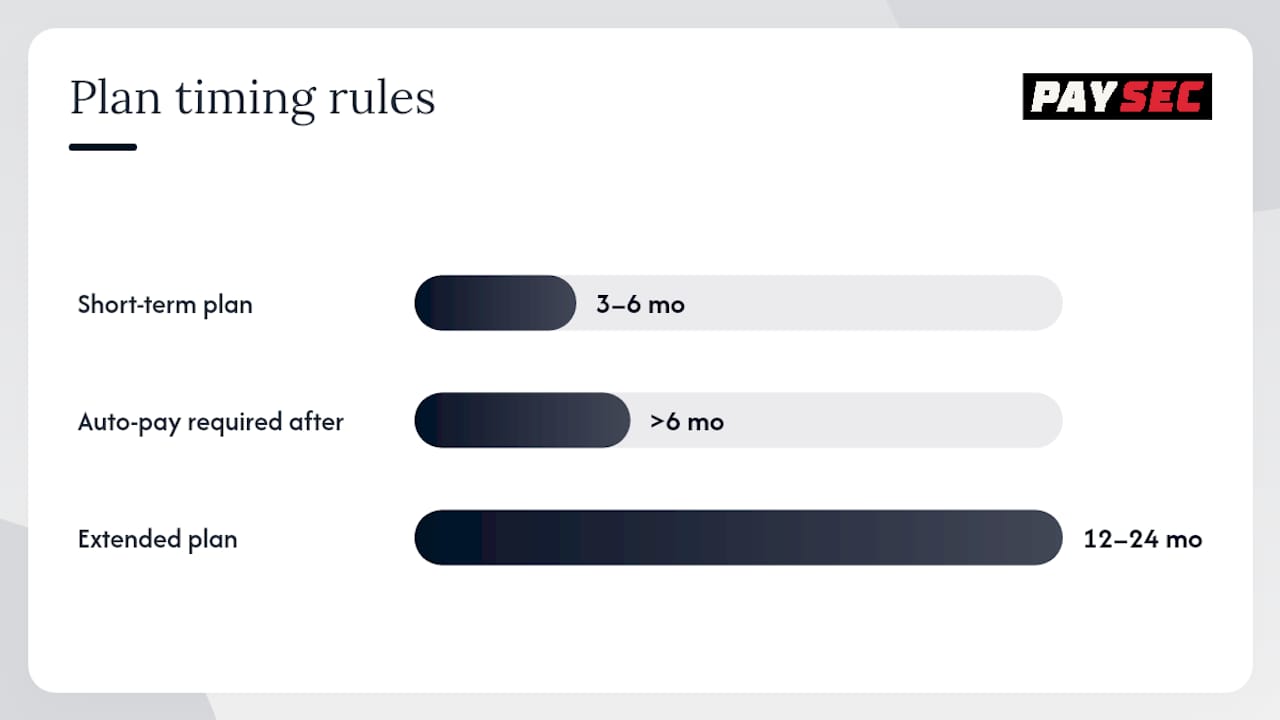
The recommended default: offer a short-term, interest-free plan (3–6 months) for balances under $2,000, and an extended plan (12–24 months with mandatory auto-pay) for larger balances or elective procedures. These two templates cover the majority of patient situations without requiring a complex approval process.
Policy components to define before launch:
- Eligibility: minimum balance threshold (commonly $100–$200), insurance adjudication status (plans should start after insurance pays)
- Required down payment: typically 10%–25% of the balance at enrollment
- Maximum plan length: 6 months for standard balances; up to 24 months for high-balance or elective cases
- Auto-pay requirement: mandatory for plans over 6 months
- Missed-payment action: one courtesy reminder, then a hold on scheduling or referral to a financial counselor
- Documentation: written consent with payment schedule, total balance, and any applicable interest rate (or explicit statement of zero interest)
Onboarding timeline:
- Insurance adjudicates the claim and posts the patient responsibility
- Staff or portal generates a cost estimate and presents plan options
- Patient selects a plan and signs a consent form (digital or paper)
- First payment collected at enrollment (down payment or first installment)
- Auto-pay charges run on the agreed schedule; automated reminders sent 3 days before each charge
- Balance reconciled after final payment; account closed in the PM system
Handling denied or partial insurance payments: Build a 30-day buffer into plan start dates when a claim is pending appeal. If a denial reverses and reduces the patient balance, recalculate the plan and notify the patient in writing. Document every adjustment with a reason code.
Pro Tip: Practices that start the payment-plan conversation before the appointment, not after, see higher enrollment rates. A pre-visit text or portal message showing the estimated patient responsibility and a one-click plan enrollment link removes the awkward post-visit money conversation entirely.
If your practice needs working capital to invest in payment technology upgrades, medical clinic financing options are available even for practices with limited credit history.
In-house vs. outsourced billing: how to decide
The core trade-off is control versus simplicity. Practices with high claim volume, complex payer mixes, or strong in-house coding staff typically benefit from keeping billing internal. Smaller practices or those struggling with denials and staffing often find outsourcing reduces overhead and error rates faster than hiring.
In-house billing:
- cms.gov
- cms.gov
- hfma.org
- kff.org
- Need to Know: 6 Most Popular Patient Payment Options in 2024
- Patient Financial Experience | Epic
- Healthcare Payment Solutions with Integrated Claims | DrChrono
- In-house vs. Outsourced Billing for Private Practice
Outsourced billing:
TowneBank's billing comparison notes that outsourced billing typically reduces administrative burden but requires strong contract terms to protect denial appeal timelines and data access.
Decision criteria:
Software and workflow implications: Whether you keep billing in-house or outsource, your payment gateway must integrate with your EHR or practice management system. Look for healthcare payment gateway integration that supports PCI-DSS tokenization, text-to-pay workflows, daily reconciliation exports, and real-time reporting. Practices using Epic can leverage MyChart payment flows; those on DrChrono or AdvancedMD have native payment integrations available.
Pro Tip: Before signing an outsourced billing contract, request a sample monthly report showing denial rates by payer, average days-to-payment, and collection rate by service line. A vendor unwilling to share this data is a red flag.
Compliance, pricing models, and what they cost your practice
Two compliance priorities come first: PCI-DSS for card data security, and No Surprises Act transparency for patient cost disclosures. Everything else builds on these two foundations.
Compliance checklist:
- No Surprises Act: — Provide good-faith cost estimates to self-pay patients before scheduled services; post your patient financial responsibility policy publicly; CMS guidance defines the specific disclosure requirements
Processor pricing models compared:
| Pricing Model | How It Works | Cost Shape | Best For |
|---|---|---|---|
| Flat-rate | Fixed % per transaction regardless of card type | Predictable; often higher net cost | Very low volume, simple needs |
| Interchange-plus | Interchange cost + fixed processor markup | Transparent; lower net cost at volume | Mid-to-large practices wanting visibility |
| Network offset (surcharge/offset) | Processing cost offset by a small patient-facing fee or internal offset | Near-zero net cost to practice | Practices prioritizing fee elimination |
Network offset pricing, the model Paysec uses, allows practices to retain full revenue on transactions by structuring fees so the processing cost is offset rather than absorbed. Interchange-plus gives you full visibility into what each card type costs, which makes it easier to identify savings opportunities. Flat-rate is the simplest but rarely the cheapest at meaningful volume.
Contract terms to watch: Look for month-to-month agreements (no long-term lock-in), itemized interchange reporting, no PCI non-compliance fees buried in the fine print, and clear BAA language. Request a full interchange breakdown for your last 90 days of transactions before switching processors. For a deeper look at processing fees healthcare providers face, the fee drivers and reduction strategies are worth reviewing before your next contract renewal.
Typical costs and how to reduce processing fees
Card processing fees for medical practices typically run 1.5%–3.5% per transaction depending on card type, pricing model, and volume. ACH fees are substantially lower, often a flat fee per transaction or a small percentage well under 1%. The gap between these two rails is where most practices find their fastest savings.
Fee reduction strategies that work:
- Switch to interchange-plus or network offset pricing: — Both models give you visibility and, in the case of offset pricing, near-zero net cost on card transactions.
For practices evaluating a technology investment to support these changes, medical practice funding options can cover the upfront cost of new terminals, gateway integrations, or staff training.
Key Takeaways
Practices that accept the full payment-method mix, automate recurring collections, and switch to transparent processor pricing consistently reduce AR days and bad-debt write-offs faster than those that rely on a single rail or a flat-rate contract.
| Point | Details |
|---|---|
| Accept the full payment mix | Enable card, ACH, HSA/FSA, mobile wallets, and pay-by-link to cover every patient preference. |
| Automate with CCoF and auto-pay | Card-on-file with scheduled charges is the single highest-impact change for plan adherence. |
| Publish one payment-plan policy | Define eligibility, down payment, plan length, and missed-payment rules before launch. |
| Track five core KPIs | Monitor AR days, collection rate, plan adherence, percent on plan, and days-to-first-payment monthly. |
| Paysec for fee reduction | Paysec's network offset pricing and interchange-plus options help practices cut processing costs by 30%–60%. |
Paysec cuts processing costs for practices that are ready to stop overpaying
Medical practices processing payments through flat-rate or tiered contracts are typically paying more than necessary on every transaction. Paysec's network offset pricing eliminates that margin loss by offsetting processing costs at the network level, so practices retain full revenue on card transactions without absorbing the fee.
Here is what Paysec brings to the table for healthcare:
- Network offset and interchange-plus pricing — with full transparency and no hidden fees
- Real-time reporting and reconciliation dashboards — for daily AR monitoring
Clients across healthcare verticals report 40%–60% reductions in processing costs after switching. Getting started is straightforward: connect with the Paysec team, share your current processing statements, and get a transparent cost comparison. Visit Paysec's healthcare payment processing page to see the full feature set and request a review.
Useful sources and further reading
- CMS No Surprises Act guidance: Regulatory requirements for good-faith estimates and patient cost disclosures; essential for compliance planning.
- CMS ACH/EFT transaction standards: Implementation standards for electronic funds transfer in healthcare; use when setting up ACH payment rails.
- HFMA: Rethinking patient payment plans: Industry data on cash flow and bad-debt outcomes from structured plan programs.
- KFF: Americans' challenges with healthcare costs: Patient affordability research; useful for benchmarking financial-assistance program design.
- Raintree: Popular patient payment options: Practical overview of payment rails, adoption rates, and fee context.
- Epic patient financial experience: EHR-integrated estimate and payment flow patterns for Epic-based practices.
- DrChrono integrated payments: Text-to-pay, payment subscriptions, and integrated claims workflows.
- TowneBank: In-house vs. outsourced billing: Decision framework and pros/cons list for billing operations choices.
- Paysec healthcare payment processing: HIPAA-aware payment processing, PCI compliance, and fee-reduction options for practices.
FAQ
What payment methods do most medical practices accept today?
Most practices accept credit and debit cards, ACH/eCheck, HSA/FSA cards, and increasingly mobile wallets and pay-by-link. Patient portal payments are growing rapidly as EHR platforms add native payment flows.
What are alternative payment methods in healthcare?
Beyond standard card acceptance, healthcare-specific alternatives include ACH/EFT (lower cost, ideal for recurring plans), HSA/FSA cards, text-to-pay links, payment subscriptions for ongoing care, and patient financing through third-party lenders. Each serves a different patient need and cost profile.
How do medical practices set up patient payment plans?
Practices define eligibility rules, a required down payment, a maximum plan length, and an auto-pay requirement, then collect written patient consent at enrollment. Plans typically start after insurance adjudicates the claim so the patient balance is final.
What is the difference between interchange-plus and flat-rate pricing for practices?
Interchange-plus pricing passes the actual card network cost to the practice plus a fixed processor markup, giving full cost visibility and typically a lower blended rate at volume. Flat-rate pricing charges a single percentage regardless of card type, which is simpler but often more expensive for practices with significant card volume.
How can practices reduce credit card processing fees?
Practices reduce fees by switching to interchange-plus or network offset pricing, increasing ACH adoption for recurring plan payments, eliminating bundled fees (PCI, batch, statement), and negotiating markup rates based on monthly processing volume. Paysec's network offset model is designed specifically to minimize net processing costs for healthcare merchants.