

Yes, merchant accounts with no monthly minimum genuinely exist, and they work well for most small and variable-volume businesses. The best pick depends on your pricing model and transaction volume, not just the "no minimum" label. Some processors offer this structure, pairing no minimums with Network Offset Pricing. Your next move: pull your last two statements or estimate your monthly card volume, then check the effective rate math before you sign anything.
TL;DR:
- Most low-volume and seasonal businesses benefit financially from no-minimum merchant accounts because they avoid paying for months with little or no sales.
- Network Offset Pricing allows merchants to pay only for processed volume, often reducing costs by 30% to 60%, especially for merchants processing less than $50,000 monthly.
- A thorough review of real transaction statements and effective rate calculations is essential before choosing a provider, as hidden fees and markups can inflate costs.
- Switching to a no-minimum account is straightforward; merchants should compare recent statements, request sample invoices, and confirm hardware compatibility beforehand.
- Security and PCI compliance obligations remain unchanged, regardless of whether the account has a minimum or not, but providers offering integrated compliance support can reduce unexpected fees.
Table of Contents
- What Does "No Monthly Minimum" Mean on a Merchant Account?
- Who Actually Benefits From a No-Minimum Merchant Account?
- How Do Processors Make Money Without Monthly Minimums?
- How Do You Evaluate a "No Monthly Minimum" Offer?
- What Does a No-Minimum Account Actually Cost at Different Volumes?
- What Hidden Fees Should You Check on a Merchant Statement?
- How Does Network Offset Pricing Help Low-Volume Merchants?
- How Do You Switch to a No-Monthly-Minimum Account?
- Does a No-Minimum Account Affect Security or Compliance?
- Publisher Perspective: Practical Priorities When Choosing No-Minimum Processing
- Ready to Get Started With PaySec?
- Sources
- FAQ
What Does "No Monthly Minimum" Mean on a Merchant Account?
A monthly minimum is a contract clause that guarantees the processor a baseline payment regardless of how much you actually process. If your transaction fees for the month land at $18 but your contract sets a $25 minimum, you get charged the $7 difference as a shortfall fee. Processors built this into legacy pricing to protect against low-volume accounts that cost more to service than they generate.
Monthly minimums commonly run $20 to $50, and a large share of older merchant contracts still carry one. A "no monthly minimum" account removes that guarantee entirely. You pay only for what you process, whether that's $40 in card sales or $4,000.
Here's where people get tripped up: "no monthly fee" and "no monthly minimum" are not the same promise.
- No monthly minimum means there's no required baseline spend on transaction fees.
- No monthly fee usually refers to a separate account or statement fee, unrelated to processing volume.
- A provider can charge zero monthly fee and still enforce a minimum, or charge a flat account fee while waiving the minimum entirely.
Some banks advertise "no monthly minimums" on basic merchant accounts, but their fee structures still vary by account type and volume tier. Read the actual contract language, not just the marketing headline.
Who Actually Benefits From a No-Minimum Merchant Account?
Not every merchant needs to prioritize this feature. It matters most for businesses whose card volume swings hard from month to month or stays consistently low.
- Seasonal businesses — a holiday pop-up shop or a summer ice cream stand that processes heavily for three months and barely at all the rest of the year avoids paying for months it can't use.
- Low-volume sellers — an Etsy-adjacent craft business doing $500 to $2,000 a month in card sales would lose a meaningful percentage of revenue to a flat $25 minimum.
- Startups and new storefronts — early months often bring unpredictable sales, and a minimum clause punishes exactly the ramp-up period when cash flow is tightest.
- Pop-ups and side hustles — anyone processing cards occasionally, not as a full-time revenue stream, benefits from paying strictly per transaction.
Here's the break-even math: if your processing fees typically land at $15 a month and your contract sets a $30 minimum, you're overpaying $15 every single month, or $180 a year, for volume you never generate. Higher-volume merchants processing $15,000 or more monthly rarely hit a minimum anyway, so for them, negotiating a lower effective rate through interchange-plus or enterprise pricing matters more than the minimum clause itself.
How Do Processors Make Money Without Monthly Minimums?
Every processor pays the same wholesale interchange rate, set by the card networks, on a given transaction. That rate doesn't change based on who processes your payment. What varies is the markup layered on top, and that markup is where "no minimum" pricing actually gets funded.
- Flat-rate pricing charges one blended percentage (often 2.6% to 2.9% plus a per-transaction fee) regardless of card type. It's predictable and easy to understand, which suits very small merchants, but it can cost more than interchange-plus once volume grows, since debit cards and rewards cards carry very different wholesale costs that flat-rate pricing ignores.
- Interchange-plus pricing passes the actual interchange rate through and adds a fixed, disclosed markup. It's more transparent, and consumer finance guides consistently recommend it because you can see exactly what the processor keeps. It can be structured with or without a monthly minimum, depending on the provider.
- Network Offset Pricing works differently: it passes through true wholesale interchange while offsetting the processor's margin through the payment network itself rather than a blanket markup on every swipe. This structure is how PaySec keeps effective rates lower without requiring any minimum spend to make the account worthwhile.
Watch for this: some providers that advertise "no monthly minimum" fund that promise with a higher per-transaction surcharge, a mandatory hardware rental program, or a gateway fee that isn't disclosed until you're two pages into the application. Buyer guides comparing free merchant accounts flag this pattern repeatedly: the "free" or "no minimum" hook is real, but it can shift cost elsewhere on the statement.
A statement's interchange and card-network assessment lines are fixed. Only the processor markup is negotiable, and that's the number to compare across offers, not the headline percentage a sales rep quotes you.
How Do You Evaluate a "No Monthly Minimum" Offer?
Sales copy is easy to write. A sample statement is harder to fake, and that's exactly why you should ask for one before signing anything.
- Request a sample statement showing a real month of transactions, not a projection.
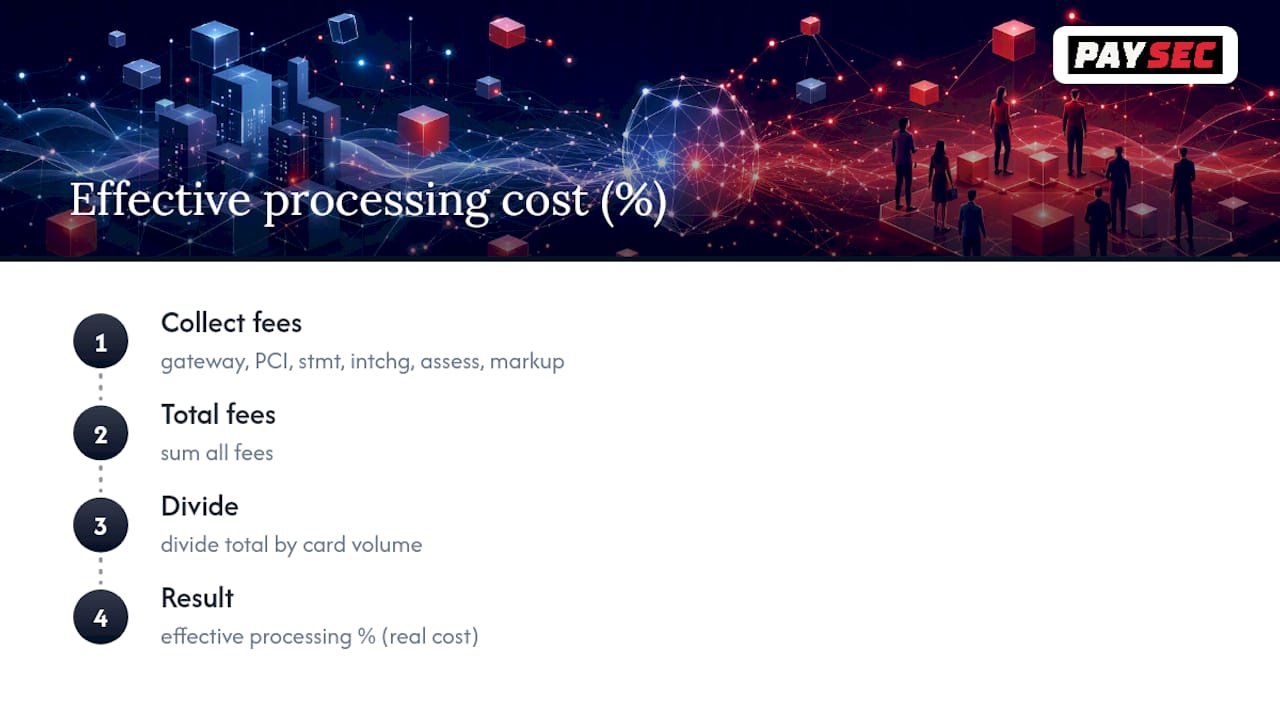
- Calculate the effective rate: total fees divided by total volume processed, expressed as a percentage.
- Ask directly about gateway fees, statement fees, PCI compliance fees, chargeback fees, and batch fees.
- Confirm funding timelines in writing, next-day funding and three-day funding produce very different cash flow outcomes.
- Read the termination clause closely, even a "no long-term contract" provider can bury an early termination fee in the fine print.
When you're on the phone with a sales rep, ask three specific questions: "What is my effective rate based on my last statement?" "Are there any fees not shown in this quote?" and "What happens if I close the account in month three?" A rep who answers clearly and in writing is a good sign. A rep who redirects to percentages without addressing your actual statement is a red flag worth walking away from.
Due diligence guides on merchant account shopping consistently point back to the same habit: request the statement first, then compare quotes against real numbers.
Pro Tip: Bring your last two statements to every sales call. A provider that can quote your effective rate from real data, on the spot, is worth far more trust than one quoting a generic teaser rate.
What Does a No-Minimum Account Actually Cost at Different Volumes?
The dollar impact of a monthly minimum shrinks fast as volume grows, and that changes what you should actually be negotiating for.
To reproduce this yourself, total every fee on a statement, including gateway, PCI, and statement charges, then divide by total card volume for that period. That percentage is your real cost, not the rate printed on your welcome packet.
High-risk categories like CBD or businesses with chargeback history may also see reserve requirements or slightly higher base rates, regardless of minimum policy. As volume climbs into the $50,000-plus range monthly, you gain real bargaining power to negotiate down the markup itself, which matters more at that scale than any minimum clause ever would.
What Hidden Fees Should You Check on a Merchant Statement?
A statement with no monthly minimum can still carry plenty of other line items worth scrutinizing before you commit.
- Chargeback fees — typically $15 to $25 per dispute, charged regardless of outcome.
- PCI non-compliance fees — charged monthly if you haven't completed your PCI Security Standards Council validation, often $20 to $30.
- Statement fees — a flat charge just for issuing your monthly statement, sometimes $5 to $15.
- Gateway fees — separate from processing fees, billed for the software connection that authorizes transactions online.
- Terminal rental fees — recurring hardware charges that can outlast the terminal's actual value many times over.
- Batch fees and AVS/CVV fees — small per-batch or per-verification charges that add up on high-transaction-count accounts.
The fastest way to tell processor markup from unavoidable cost: interchange and network assessments are published and identical everywhere. Anything above that baseline is negotiable. If a fee appears that wasn't disclosed at signup, request an itemized breakdown in writing and ask the provider to justify or waive it.
How Does Network Offset Pricing Help Low-Volume Merchants?
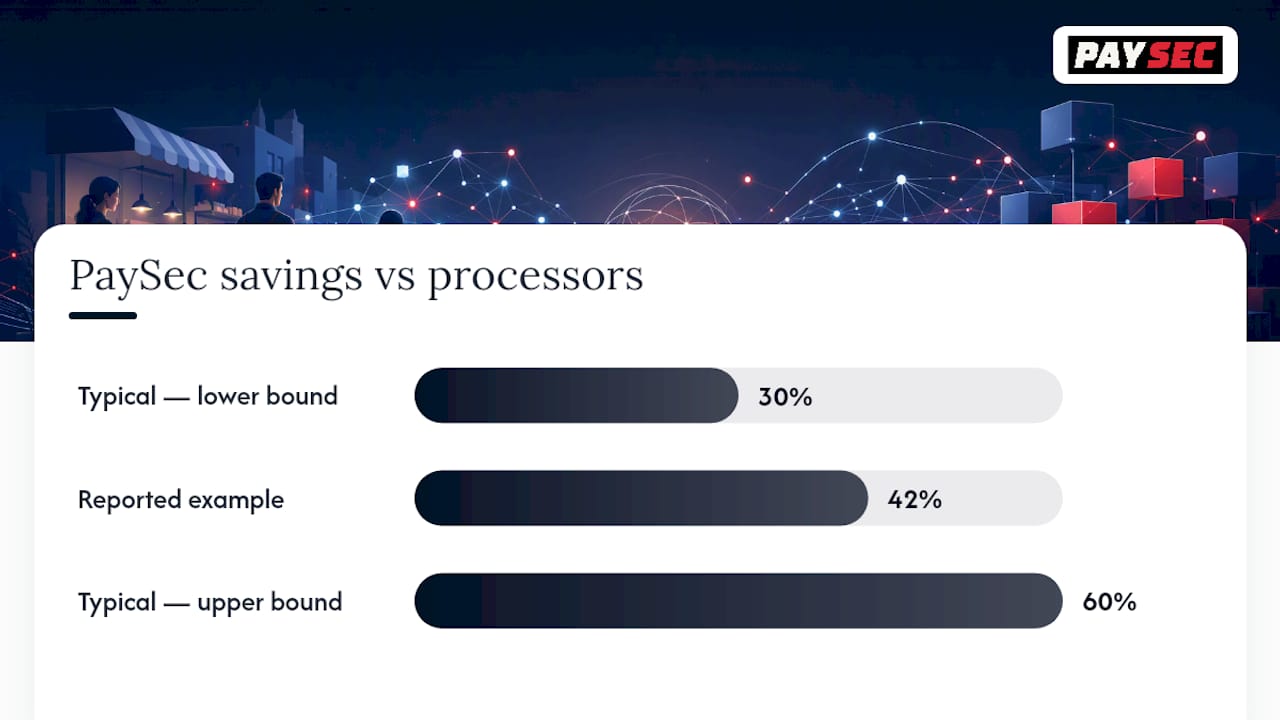
Network Offset Pricing solves the exact problem that pushes low-volume merchants toward flat-rate plans they don't actually need. Instead of layering a blanket markup on every transaction, PaySec passes through true wholesale interchange rates and offsets margin through the payment network structure itself. That's the mechanism behind PaySec merchants typically saving 30% to 60% compared to major processors, with some reporting a 42% reduction in processing costs.
This maps directly onto the merchant profiles covered earlier in this guide:
- A seasonal pop-up avoids paying for months it doesn't use, since PaySec applies no minimum spend requirement.
- A low-volume Etsy-style seller keeps a larger share of each sale instead of losing a fixed percentage to a flat minimum.
- A startup ramping up slowly gets pricing that scales with actual revenue rather than punishing early-stage unpredictability.
PaySec backs this with detailed transaction reporting, so merchants can see exactly where their money goes on every statement, and with PCI DSS Level 1 and SOC 2 compliance support built into the account rather than sold as an upsell. No long-term contracts back the pricing model, which means switching or scaling doesn't require renegotiating a lock-in you signed a year earlier. Merchants across 18-plus industries, including SaaS, restaurants, eCommerce, healthcare, and CBD retail, run on this same structure.
How Do You Switch to a No-Monthly-Minimum Account?
Switching processors sounds riskier than it is, provided you follow a clear sequence and don't cut over blind.
- Pull your last two to three statements and calculate your current effective rate.
- Request a sample invoice or rate quote from the new provider based on those actual numbers.
- Confirm your existing terminal or gateway is compatible, or get replacement hardware quoted upfront.
- Run test transactions before your official cutover date.
- Schedule the switch during a lower-volume week to minimize disruption.
Most providers request two to three months of statements, a voided check, and basic business documentation, with approval typically taking one to three business days. Because PaySec doesn't require long-term contracts, you can move to a month-to-month structure without locking into another multi-year agreement the moment you switch.
Does a No-Minimum Account Affect Security or Compliance?
No. Whether or not your account carries a monthly minimum has zero bearing on your PCI DSS obligations. Every merchant that accepts card payments, regardless of pricing structure, must follow PCI Security Standards Council guidance to protect cardholder data. That responsibility sits with the merchant, not the pricing plan.
Where this gets confusing is that some no-minimum providers bundle basic compliance support into the account itself, while others charge non-compliance fees as a separate, recurring line item if you haven't completed your annual self-assessment questionnaire. Neither approach changes the underlying requirement. You still need to validate compliance every year, and you still carry liability if cardholder data is mishandled on your watch.
The practical upside of choosing a provider that includes compliance assistance, rather than treating it as an afterthought, is fewer surprise fees and less manual paperwork. It doesn't lower your legal obligation, but it does lower the odds you'll get hit with an avoidable PCI non-compliance charge six months into the account. Fraud prevention tools, tokenization, and encrypted data handling matter just as much on a no-minimum account as on any traditional one. Pricing structure and security posture are two separate questions, and a good provider treats both seriously rather than trading one for the other.
Publisher Perspective: Practical Priorities When Choosing No-Minimum Processing
If there's one thing worth repeating from everything above: prioritize the effective rate and transparent billing over the "no minimum" label itself. A no-minimum account with a bloated markup can still cost more than a well-negotiated interchange-plus plan with a small minimum attached.
That said, once your volume climbs past roughly $50,000 monthly, spend less energy chasing a no-minimum badge and more energy negotiating interchange-plus or custom enterprise pricing directly. At that scale, the markup percentage matters far more than any minimum clause ever will. PaySec is positioned to support merchants at both ends of that spectrum, from the seasonal seller who needs zero minimum to the growing business ready to negotiate volume-based pricing.
— PaySec Marketing Team
Ready to Get Started With PaySec?
PaySec is the processor built specifically for merchants who don't want to gamble on volume every month. Network Offset Pricing passes through true wholesale interchange rates, no monthly minimums, no long-term contracts, and no hidden markups buried in fine print.
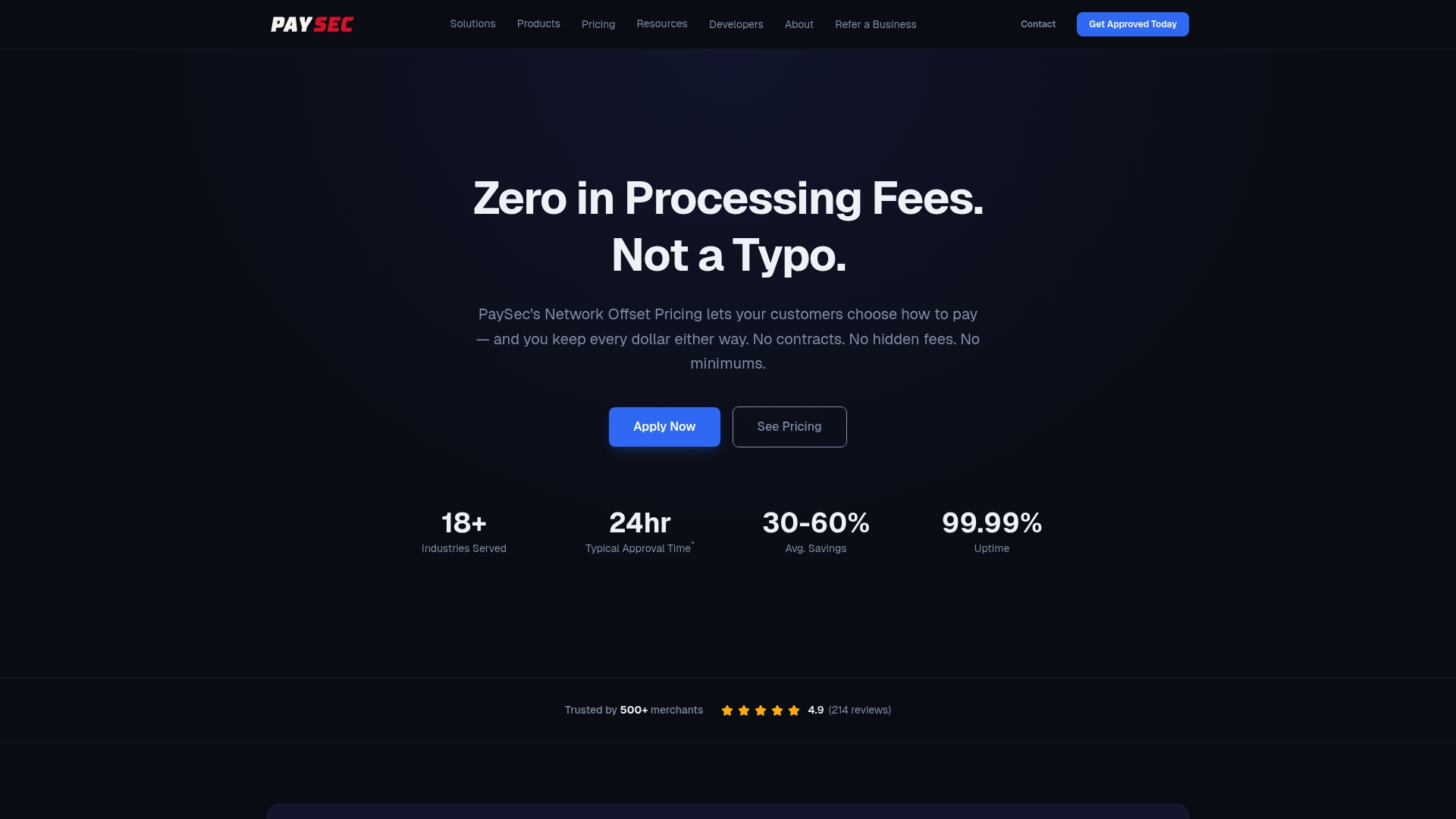
Signup starts with a quick application, and most merchants get approved within one to three business days. In your first 30 days, expect a straightforward onboarding call, terminal or gateway setup matched to your business type, and access to detailed transaction reporting from your very first processed sale. The service supports sectors including SaaS, restaurants, eCommerce, healthcare, CBD, and other high-risk verticals with transparent pricing and compliance support such as PCI DSS Level 1 and SOC 2 built in rather than sold separately.
If you're comparing plans, visit the PaySec pricing page to see how Network Offset, Flat Rate, and Custom Enterprise options line up against your current statement. Merchants who process through point-of-sale hardware can also check the free terminal placement program to avoid upfront hardware costs entirely. Whichever plan fits, the next step is the same: request your quote and compare it against the effective rate you calculated from your last two statements.
Sources
- PCI Security Standards Council — PCI Security
- NerdWallet — Credit card processing fees explained
- 6 Best Free Merchant Accounts 2026: No Fees, No Catch — TechnologyAdvice
FAQ
Which Business Accounts Have No Monthly Fees?
Many merchant accounts now waive monthly account fees, though separate charges like statement or PCI fees can still apply. PaySec's structure includes no monthly minimums and transparent Network Offset Pricing, with exact pricing details available on the PaySec pricing page.
Which Banks Offer Transaction Accounts Without Monthly Fees?
Some banks, including Wells Fargo's merchant services division, advertise basic accounts with no monthly minimum, though features and rates vary by tier. Always request a sample statement to confirm the real cost before comparing across bank and processor options.
What Is the Easiest Merchant Account to Get?
Accounts with straightforward flat-rate or Network Offset Pricing tend to approve fastest, since they don't require complex tiered underwriting. Most providers, including PaySec, approve standard applications within one to three business days once basic business documentation is submitted.
Which Bank Has No Monthly Fee for Business Accounts?
No single bank universally guarantees a no-fee business account, since terms depend on account type, volume, and business category. Comparing a sample statement against a processor like PaySec, which builds no minimums directly into its Network Offset Pricing model, gives a clearer answer than comparing marketing pages alone.