

TL;DR:
- Online transaction fees combine a percentage of the sale with a fixed charge, covering interchange, assessment, and processor costs. Calculating the actual effective rate helps businesses understand true costs and identify savings opportunities by analyzing transaction patterns and choosing transparent pricing models. Regularly reviewing processing statements and considering alternative pricing structures can significantly lower online payment expenses.
Online transaction fees are calculated as a percentage of the transaction amount plus a fixed fee per transaction, combining charges from card-issuing banks, card networks, and payment processors. Understanding how online transaction fees are calculated gives your business the power to forecast costs accurately, catch billing errors, and negotiate better rates. Credit card processing fees typically range from 1.3% to 3.5% of each transaction, plus a fixed fee of $0.10 to $0.30 per transaction. Those numbers may look small, but they compound fast across thousands of monthly transactions.
How online transaction fees are calculated: the core components
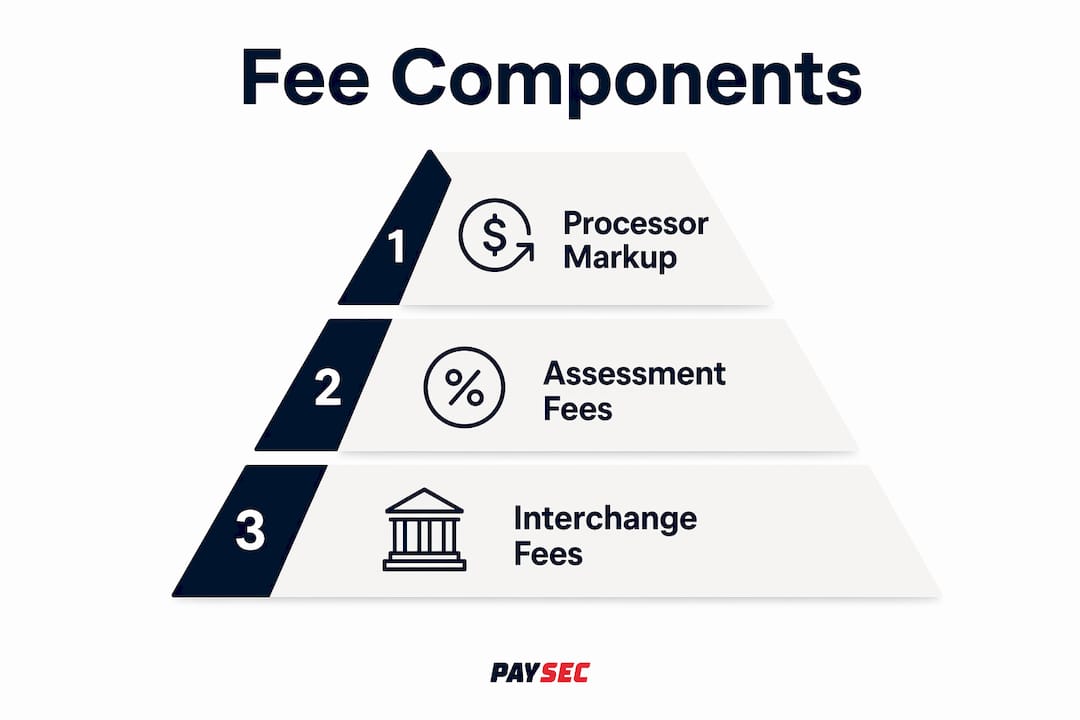
Every online payment fee you pay is actually three separate charges bundled into one line item. Separating them is the first step toward understanding your true cost of accepting payments.

Interchange fees
Interchange fees go directly to the bank that issued your customer's card. They are the largest single component of your total processing cost. Interchange ranges from 1.5% to 3.3% depending on risk, card type, and transaction method. A rewards card carries a higher interchange rate than a basic debit card because the issuing bank needs to fund those rewards.
Transaction type also shifts the rate. Online transactions carry higher interchange than in-person swipes because the card is not physically present, which raises the bank's fraud risk. That risk premium is built directly into the rate your business pays.
Assessment fees
Assessment fees go to the card network itself, such as Visa or Mastercard, to cover network operating costs. Assessment fees are a small fixed percentage of each transaction, and they are non-negotiable. No processor can waive them because they flow directly to the network. They are typically a fraction of a percent, but they appear on every single transaction you process.
Payment processor fees
The payment processor adds its own markup on top of interchange and assessment fees. Processors add markups via flat-rate or interchange-plus pricing models, and the structure they choose determines how easy it is for you to see what you are actually paying. This is the one fee component where you have negotiating room. The issuing bank and card network fees are fixed. The processor's margin is not.
Pro Tip: Review your processing statement line by line and separate interchange, assessment, and processor fees into three columns. That single exercise reveals exactly where your money goes and which component is worth negotiating.
The types of ecommerce payment fees you encounter online differ from in-person fees in one critical way: card-not-present transactions always carry a higher risk premium, and that premium shows up in every component of your fee structure.
What pricing models determine your fee structure?
The pricing model your processor uses changes how fees are calculated and how clearly you can see the breakdown. Three models dominate the market.
Flat-rate pricing
Flat-rate pricing charges one consistent rate on every transaction regardless of card type or transaction method. Flat-rate fees commonly run 2.9% + $0.30 per transaction for online payments. The calculation is simple: multiply the transaction amount by the rate and add the fixed fee. A $50 sale costs $1.45 plus $0.30, totaling $1.75.
Flat-rate pricing is easy to budget around, but it hides the underlying interchange cost. When your actual interchange rate is 1.5%, you pay 2.9% and the processor keeps the spread. For businesses with high transaction volumes or low-risk card mixes, that spread adds up to real money.
Interchange-plus pricing
Interchange-plus pricing passes the actual interchange cost to you and adds a fixed processor markup on top. An interchange-plus example looks like interchange + 0.4% + $0.08 per transaction. This model gives you full visibility into what the bank charges versus what the processor charges. Businesses with favorable transaction profiles, such as low average ticket sizes or predominantly debit card customers, often pay less under interchange-plus than under flat-rate pricing.
The tradeoff is complexity. Your monthly statement will show dozens of interchange categories rather than one clean rate. That complexity is worth it for most businesses processing more than $10,000 per month.
Tiered pricing
Tiered pricing groups transactions into qualified, mid-qualified, and non-qualified buckets, each with a different rate. Processors set the rules for which transactions fall into which tier, and those rules are rarely published clearly. Non-qualified transactions, which often include rewards cards and business cards, carry the highest rates. Tiered pricing is the least transparent model and the hardest to audit.
| Pricing model | Transparency | Best for | Calculation complexity |
|---|---|---|---|
| Flat-rate | Low | Low-volume or new businesses | Simple |
| Interchange-plus | High | Mid-to-high volume businesses | Moderate |
| Tiered | Very low | Rarely advantageous | Difficult to audit |
Pro Tip: Ask any processor for a sample statement before signing. If they cannot show you a clear separation between interchange, assessment, and their markup, that is a signal the pricing structure will be hard to audit later.
Understanding ecommerce vs. in-person processing fees matters here too. Online transactions almost always land in higher interchange tiers than in-person swipes, so the pricing model you choose has an outsized effect on your digital sales costs.
How to calculate your actual transaction fees step by step
Calculating your fees precisely requires two formulas: one for individual transactions and one for your overall effective rate.
Calculating a single transaction fee
The formula for one transaction is straightforward.
- Multiply the transaction amount by the percentage fee rate.
- Add the fixed per-transaction fee.
- The result is your total fee for that transaction.
A $100 transaction at 3% plus $0.30 costs $3.00 plus $0.30, totaling $3.30. That $3.30 represents 3.3% of the sale. Run that same math on a $20 transaction and the fixed fee becomes proportionally larger: $0.60 plus $0.30 equals $0.90, or 4.5% of the sale. Small ticket transactions carry a higher effective cost because the fixed fee does not scale with the amount.
Calculating your monthly fee total
To find your total monthly processing cost, add up the fees from every transaction in the period. Most processors provide this figure on your statement, but verifying it yourself catches errors.
- Pull every transaction from your statement for the month.
- Apply the fee formula to each transaction.
- Sum all individual fees to get your total monthly processing cost.
- Compare your calculated total to the amount your processor charged.
Discrepancies between your calculation and the processor's charge are worth investigating. Misclassified transactions, unexpected surcharges, and billing errors are more common than most businesses realize.
Calculating your effective rate
The effective rate is the single most useful number for understanding your true cost of accepting payments. The effective rate equals total fees divided by total sales, multiplied by 100. For example, $234.71 in fees on $7,521.22 in sales produces an effective rate of 3.12%. That 3.12% is your real cost, not the advertised rate on your contract.
The effective rate captures everything: interchange, assessments, processor markup, monthly fees, and any other charges. Tracking your effective rate month over month reveals whether your costs are creeping up, which is a common sign of rate increases buried in statement line items.
Statistic callout: A business processing $7,521.22 per month at a 3.12% effective rate pays $234.71 in fees. At a 2.0% effective rate, that same volume costs $150.42. The difference is $84.29 per month, or more than $1,000 per year from one rate point of improvement.
Learning how to read your processing statement is the practical skill that makes these calculations actionable. Statements are dense, but once you know where to find interchange totals, assessment totals, and processor markups, the math takes minutes.
What factors affect your online payment fees?
Several variables shift your fee costs up or down, and most of them are within your control or at least worth understanding.
-
Transaction volume. Higher monthly volume gives you negotiating leverage with processors. Most processors offer lower markups to businesses processing above certain thresholds. If your volume has grown since you signed your original contract, that alone is a reason to renegotiate.
-
Average ticket size. The fixed per-transaction fee hits small tickets harder than large ones. A business with a $15 average ticket pays a higher effective rate than one with a $150 average ticket, even at identical percentage rates. Bundling small transactions where possible reduces this drag.
-
Card type. Consumer debit cards carry the lowest interchange rates. Premium rewards cards and corporate cards carry the highest. If your customer base skews toward business card users, your interchange costs will be structurally higher. Some businesses in B2B sectors use Level 2 and Level 3 data submission to qualify for lower interchange rates on corporate card transactions.
-
Payment channel. Online transactions often cost 2.9% + $0.30 compared to in-person rates of 1.5% to 2.5%. The card-not-present environment carries inherent fraud risk, and that risk is priced into every online transaction. Businesses that offer both online and in-person channels should track fees separately by channel to understand where costs concentrate.
-
Manual entry and keyed-in transactions. Manually keyed transactions carry the highest rates of all payment channels. The card is not present and the transaction requires extra verification steps. Avoid manual entry wherever possible by using hosted payment pages or tokenized card storage.
-
Business risk profile. Processors assess your industry's chargeback history and fraud rates when setting your markup. High-risk industries such as CBD retail, subscription services, and travel pay higher processor markups than low-risk categories. Maintaining a low chargeback ratio keeps your risk profile clean and supports better rates over time.
-
Pricing model selection. As covered above, the model you choose determines how much of the interchange spread the processor captures. Switching from tiered to interchange-plus pricing is one of the highest-impact changes a mid-volume business can make.
A detailed look at online payment processing costs shows how these variables interact across different business types and transaction profiles.
Key Takeaways
Online transaction fees are calculated by combining a percentage rate with a fixed per-transaction fee, and your effective rate, total fees divided by total sales, is the most accurate measure of what you actually pay.
| Point | Details |
|---|---|
| Fee components | Every transaction fee combines interchange, assessment, and processor markup charges. |
| Pricing model matters | Interchange-plus pricing offers the most transparency and often the lowest cost for mid-to-high volume businesses. |
| Single transaction formula | Multiply the transaction amount by the percentage rate, then add the fixed fee to get the total cost. |
| Effective rate calculation | Divide total monthly fees by total monthly sales and multiply by 100 to find your true processing cost. |
| Optimization levers | Transaction volume, card type, payment channel, and pricing model all directly affect your effective rate. |
The fee calculation most businesses skip
The effective rate calculation is the most underused tool in payment cost management. Most businesses look at their advertised rate and assume that is what they pay. It is not. The advertised rate is the processor's markup. The effective rate is the full picture, and the gap between the two is where money quietly disappears.
Working with merchants across more than 18 industries, we see the same pattern repeatedly. A business signs a contract at what looks like a competitive rate, then never calculates their effective rate again. Twelve months later, their costs have drifted upward through rate adjustments, new fees, and transaction reclassifications. None of those changes required a new contract. They just appeared on the statement.
The businesses that control their processing costs best are the ones that calculate their effective rate every single month. They treat it like a KPI. When it moves, they investigate. When it holds steady, they know their processor is not quietly padding the bill.
The other pattern worth naming: businesses often focus on the percentage rate and ignore the fixed fee. For any business with a low average ticket, the fixed fee is the bigger problem. A $0.30 fixed fee on a $10 transaction is 3% before the percentage rate even applies. That math changes your entire pricing strategy.
Fee structures are also evolving. Network offset pricing models, which shift the processing cost to the customer as a transparent service fee, are gaining traction across retail, healthcare, and SaaS. They are not right for every business, but for those where customers accept the model, they effectively reduce the merchant's net processing cost to near zero. Understanding your current fee structure in detail is the prerequisite for evaluating whether a model like that makes sense for your operation.
— Paysec Marketing Team
How Paysec's Network Offset Pricing changes the fee equation
Businesses that have mastered their fee calculations often reach the same conclusion: the most effective way to reduce processing costs is to change the pricing model entirely, not just negotiate a lower markup.
Paysec's Network Offset Pricing shifts interchange costs away from the merchant by offering customers a transparent service fee at checkout. Merchants across SaaS, restaurants, ecommerce, healthcare, and CBD retail have reported processing cost reductions of 30–60%, with one case study showing a 42% reduction. Paysec operates with no hidden fees, no minimums, and no long-term contracts. Detailed transaction reporting gives you the data to verify your effective rate at any time. For businesses ready to move beyond negotiating fractions of a percent, Paysec's pricing model offers a structurally different approach.
FAQ
What is the formula for calculating a single online transaction fee?
Multiply the transaction amount by the percentage fee rate, then add the fixed per-transaction fee. For example, a $100 transaction at 3% plus $0.30 costs $3.30 total.
What is an effective rate and why does it matter?
The effective rate equals total fees divided by total sales, multiplied by 100. It captures every charge, including interchange, assessments, and processor fees, giving you the true cost of accepting payments.
Why do online transactions cost more than in-person payments?
Online transactions are card-not-present, which raises fraud risk for the issuing bank. That risk is priced into interchange rates, making online fees typically higher than in-person swipe rates.
What is interchange-plus pricing?
Interchange-plus pricing passes the actual interchange cost directly to the merchant and adds a fixed processor markup on top. It is the most transparent pricing model and often the lowest-cost option for businesses processing significant monthly volume.
How can businesses reduce their online payment fees?
Businesses can reduce fees by switching to interchange-plus pricing, increasing transaction volume to negotiate lower markups, avoiding manually keyed transactions, and calculating their effective rate monthly to catch cost increases early.