

TL;DR:
- Healthcare payment disputes involve formal disagreements between providers and insurers over reimbursement amounts or denials. Proper documentation, timely appeals, and understanding the IDR process are essential for resolution and revenue protection. Organized workflows and proactive dispute management improve outcomes and reduce administrative burdens.
A healthcare payment dispute is a formal disagreement between a healthcare provider and an insurance payer over the amount or denial of reimbursement for medical services rendered. These disputes arise across every care setting, from solo practices to large hospital systems, and they directly affect revenue, cash flow, and administrative workload. Federal frameworks like the No Surprises Act and the Independent Dispute Resolution (IDR) process have reshaped how these conflicts get resolved since 2022. Understanding the mechanics of healthcare billing disputes is no longer optional for administrators. It is a core operational competency.
What is a healthcare payment dispute in medical billing?
A healthcare payment dispute occurs when a provider formally challenges a payer's reimbursement decision, whether that decision is a full denial, a partial payment, or an underpayment relative to the contracted or expected rate. The industry term for this process is a "claim appeal" or "payment dispute," and both phrases appear in federal regulations and payer contracts. The distinction matters because the resolution pathway differs depending on whether the dispute involves an in-network claim, an out-of-network claim, or a surprise billing scenario.
Claim denials are the most common trigger. A payer may deny a claim due to incorrect procedure codes, eligibility issues, missing prior authorization, or a determination that the service was not medically necessary. Each denial reason carries its own appeal pathway and documentation requirements. Administrators who treat all denials as a single category lose time and money by applying the wrong resolution strategy.
Underpayments represent a quieter but equally damaging category of medical payment issues. A payer may process and pay a claim but at a rate below what the contract specifies. These discrepancies often go undetected without systematic claim auditing. Healthcare payment disputes related to underpayments have grown significantly as insurers rely on the Qualifying Payment Amount (QPA), the median in-network rate, to set initial payments for out-of-network services.
What are the common causes and types of healthcare payment disputes?
Healthcare billing disputes fall into several distinct categories, each with different causes and resolution strategies.
Claim denials are the most frequent source of disputes. Payers deny claims for reasons including:
- Incorrect or unsupported CPT codes submitted on the claim
- Patient eligibility issues, such as lapsed coverage on the date of service
- Missing or expired prior authorization for the procedure
- Duplicate claim submissions flagged by the payer's system
- Medical necessity determinations that conflict with clinical documentation
Underpayments tied to QPA calculations have become a growing source of conflict. Increased disputes due to QPA reliance by insurers have pushed more providers toward formal IDR proceedings to challenge reimbursement rates they consider inadequate. This is particularly common for out-of-network emergency services and specialty care.
Balance billing and surprise billing create a third category of health insurance disputes. Before the No Surprises Act took effect, out-of-network providers could bill patients directly for the difference between their charge and the insurer's payment. Federal law now prohibits this practice in most emergency and certain non-emergency settings, shifting the financial conflict from the patient to a structured provider-payer negotiation.

In-network versus out-of-network disputes follow different rules. In-network disputes typically involve contract interpretation, coding accuracy, and medical necessity. Out-of-network disputes, particularly those involving the No Surprises Act, follow the federal IDR process with defined timelines and arbitration rules. Administrators must identify which category applies before selecting a resolution strategy.
How does the Independent Dispute Resolution (IDR) process work?
The IDR process is the federal arbitration mechanism established by the No Surprises Act to resolve out-of-network payment disputes between providers and insurers without involving patients. Nearly 3.4 million disputes have been filed through the federal IDR process since 2022. That volume confirms that IDR has become a primary channel for resolving out-of-network billing disagreements at scale.
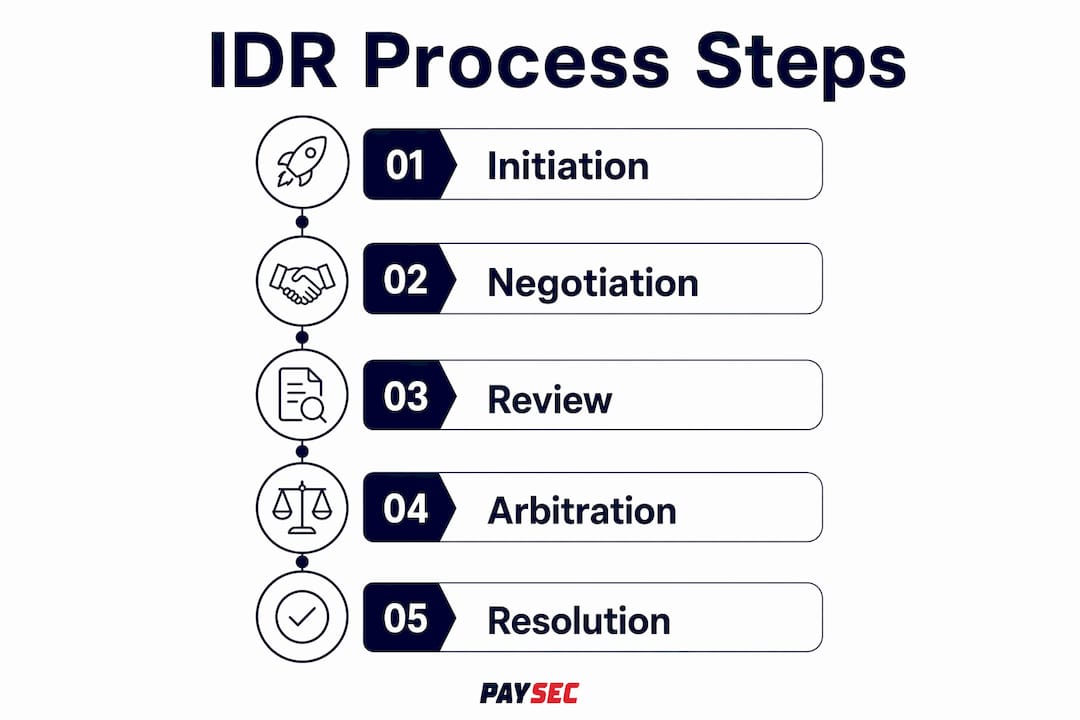
The process follows a structured sequence:
- Initial payment or denial. The insurer issues an initial payment or denial for the out-of-network claim. This triggers the provider's right to initiate open negotiation.
- Open negotiation period. Providers must initiate open negotiation within 30 business days of receiving the initial payment or denial. Both parties exchange offers and attempt to reach a voluntary agreement during this window.
- Escalation to IDR. If open negotiation fails, either party may initiate formal IDR within four business days of the negotiation period closing. The initiating party selects a certified IDR entity from the federal approved list.
- Offer submission. Both the provider and the insurer submit their final payment offers to the IDR entity. Each party also submits supporting documentation, including medical records, coding rationale, local market data, and QPA information.
- Arbitration decision. The IDR entity applies baseball-style arbitration, selecting one party's entire offer without modification or compromise. This format makes strong initial evidence submissions critical. A weak offer with poor documentation loses outright.
- Payment. The losing party must remit payment within 30 days of the binding arbitration decision.
| IDR Stage | Timeline |
|---|---|
| Open negotiation initiation | Within 30 business days of initial payment or denial |
| IDR initiation after failed negotiation | Within 4 business days of negotiation period close |
| Federal target for arbitration decision | 30 days from IDR initiation |
| Typical actual resolution time | 80–120 days due to volume and complexity |
| Payment after binding decision | Within 30 days |
Pro Tip: Submit your most detailed documentation package at the offer stage. The IDR entity reviews medical records, coding rationale, local market data, and QPA benchmarks. A well-documented first submission is your strongest asset in baseball-style arbitration.
The gap between the federal 30-day target and the actual 80–120 day timeline reflects the volume of disputes and the complexity of documentation review. Administrators should build this realistic timeline into cash flow projections when disputes are pending.
What documentation and evidence are essential for disputing payment denials?
Strong documentation is the single most reliable predictor of a successful appeal. Federal law requires at least two formal levels of health insurance claim review before a denial becomes final. That means administrators have at least two structured opportunities to present evidence, and each opportunity requires a different level of documentation depth.
The core documents for any healthcare billing dispute include:
- Explanation of Benefits (EOB). The EOB identifies the denial reason code and the payer's stated justification. Reading the denial code accurately determines which appeal argument applies.
- Itemized medical bill. A line-by-line breakdown of every charge, with corresponding CPT codes, diagnosis codes, and modifiers. Coding accuracy at this level is non-negotiable.
- Clinical records. Progress notes, operative reports, lab results, and imaging that support medical necessity. The records must align precisely with the codes submitted on the claim.
- Letter of Medical Necessity. A physician-authored document explaining why the specific service was clinically required for the patient's condition. Payers frequently request this for specialty procedures and high-cost services.
- Appeal letter with supporting rationale. A formal written challenge that references the denial code, cites the relevant contract language or federal regulation, and presents the clinical and coding evidence.
Pro Tip: A CPT modifier 25 denial is one of the most common underpayment triggers. Build a standardized appeal template specifically for modifier 25 disputes. A reusable template reduces administrative time and keeps your argument consistent across claims.
Timeliness is as critical as content. Most payer contracts and state regulations set strict deadlines for appeal submissions, often 60 to 180 days from the denial date. Missing a deadline forfeits the right to appeal regardless of how strong the clinical evidence is. Administrators should track every denial date in a centralized system and set internal deadlines at least two weeks before the payer's cutoff.
Determining the validity of an insurer's overpayment request requires the same documentation discipline. Insurers sometimes request refunds for claims they later determine were overpaid. Verifying those requests against the original EOB, contract rates, and clinical records protects the practice from returning money it legitimately earned.
What are best practices for managing healthcare payment disputes?
Effective dispute management is a system, not a reaction. Administrators who build structured workflows around denial tracking, appeal preparation, and regulatory compliance recover more revenue and spend less time on each individual dispute.
-
Establish standardized internal protocols. Create written procedures for every stage of the dispute process, from denial identification to appeal submission to IDR initiation. Standardization reduces errors and ensures that staff handle disputes consistently regardless of who is managing the claim.
-
Monitor denial rates and appeal windows in real time. Track every denied claim in a centralized log with the denial date, denial reason code, payer name, and appeal deadline. A claim that sits unaddressed for 90 days may fall outside the appeal window permanently. Real-time monitoring prevents that loss.
-
Maintain compliance with federal and state regulations. The No Surprises Act, the IDR process, and state surprise billing laws create a layered compliance environment. Administrators must know which rules apply to each claim type. Healthcare payment compliance is not a one-time audit. It requires ongoing staff training and policy updates as regulations evolve.
-
Use technology to track disputes and payment accuracy. Payment processing platforms with detailed transaction reporting give administrators a clear view of what was billed, what was paid, and where discrepancies exist. Identifying underpayments systematically is far more efficient than reviewing claims manually.
-
Collaborate with payers before escalating to IDR. The open negotiation period exists for a reason. Many disputes resolve during this phase when both parties present clear documentation and engage in good-faith discussion. Reserve IDR for cases where negotiation genuinely fails. IDR carries administrative costs and a realistic timeline of 80–120 days, so it works best as a targeted tool rather than a default response.
-
Protect patient relationships throughout the process. IDR provides a compliant pathway for providers to dispute insurer underpayments without involving patients in billing conflicts. Keeping patients out of payer disputes preserves trust and reduces the risk of complaints or negative reviews driven by billing confusion.
Proper identification and prompt appeal of improper insurance payment adjustments are vital to avoid lost revenue and excessive administrative burden. Practices that treat dispute management as a revenue protection function, rather than a back-office cleanup task, consistently outperform those that do not.
Key Takeaways
Healthcare payment disputes require structured documentation, regulatory knowledge, and timely action to resolve successfully and protect practice revenue.
| Point | Details |
|---|---|
| Define the dispute type first | Identify whether the claim involves a denial, underpayment, or surprise billing issue before selecting a resolution path. |
| IDR is a formal federal process | The No Surprises Act IDR process uses baseball-style arbitration; strong documentation at the offer stage determines the outcome. |
| Timelines are strict and consequential | Open negotiation must start within 30 business days; missed appeal deadlines forfeit the right to challenge a denial. |
| Documentation drives outcomes | EOBs, itemized bills, clinical records, and Letters of Medical Necessity form the foundation of every successful appeal. |
| Standardize to protect revenue | Written internal protocols and centralized denial tracking reduce errors and recover more revenue per dispute. |
The IDR era has changed what "resolving a dispute" actually means
Before the No Surprises Act, resolving a payment dispute often meant sending a strongly worded appeal letter and hoping the payer reconsidered. The IDR process changed that dynamic fundamentally. Providers now have a federal arbitration mechanism with defined rules, neutral third-party decision-makers, and binding outcomes. That is a genuine shift in power, but only for practices that are administratively prepared to use it.
What we have observed since IDR launched is that the practices winning arbitration are not necessarily the ones with the strongest clinical cases. They are the ones with the most organized documentation. The IDR entity reviews medical records, coding rationale, local market data, and QPA benchmarks. An arbitrator cannot weigh evidence that was not submitted. Practices that treat documentation as an afterthought lose to payers who submit thorough, well-organized packages.
The volume of disputes, nearly 3.4 million since 2022, also signals something administrators should take seriously. The system is under strain. The gap between the federal 30-day target and the actual 80–120 day resolution timeline reflects that strain. Cash flow planning must account for this reality. A pending IDR dispute is not a quick fix. It is a multi-month process that requires patience and financial runway.
The most underrated aspect of dispute management is patient communication. Keeping patients informed that a billing disagreement exists between the practice and their insurer, without burdening them with the details, preserves the relationship. Patients who feel caught in the middle of a billing conflict are far more likely to disengage from care. IDR was designed to prevent exactly that outcome, and practices that use it correctly protect both their revenue and their patient relationships simultaneously.
The regulatory environment will continue to evolve. State surprise billing laws, QPA calculation methodologies, and IDR administrative rules are all subject to ongoing litigation and regulatory revision. Practices that build flexible, documented dispute workflows now will adapt faster when the rules change again.
— Paysec Marketing Team
How Paysec supports healthcare payment management
Healthcare administrators managing billing disputes need payment infrastructure that keeps financial data clear, compliant, and accessible at every stage of the dispute process.
Paysec provides HIPAA-compliant payment processing built for healthcare providers, with detailed transaction reporting that gives administrators a real-time view of every payment, adjustment, and discrepancy. Paysec's Network Offset Pricing reduces processing costs by 30–60%, protecting revenue that disputes and denials already put at risk. With no hidden fees, no minimums, and no long-term contracts, Paysec fits practices of every size. Explore Paysec's Network Offset Pricing to see how transparent payment processing supports stronger financial outcomes for your practice.
FAQ
What is a healthcare payment dispute?
A healthcare payment dispute is a formal challenge by a provider against an insurer's reimbursement decision, covering full denials, underpayments, and surprise billing disagreements. Resolution follows either internal appeal processes or the federal IDR mechanism established by the No Surprises Act.
How long does the IDR process take?
The federal target for an IDR arbitration decision is 30 days from initiation, but actual resolution typically takes 80–120 days due to documentation volume and case complexity. Administrators should plan cash flow accordingly when disputes enter formal arbitration.
What documents do I need to appeal a denied claim?
A complete appeal requires the Explanation of Benefits, an itemized medical bill with accurate CPT codes, supporting clinical records, and a Letter of Medical Necessity when applicable. Federal law mandates at least two formal levels of insurer review before a denial becomes final.
What is baseball-style arbitration in IDR?
Baseball-style arbitration requires the IDR entity to select one party's entire offer without modification. There is no splitting the difference. This format makes the quality and completeness of your initial documentation submission the decisive factor in the outcome.
How can administrators reduce healthcare billing disputes?
Standardized internal denial tracking protocols, timely appeal submissions, and accurate coding at the point of claim submission reduce dispute volume significantly. Practices that audit claims systematically for underpayments and use IDR selectively recover more revenue with less administrative cost per case.