

The shortest path to securing healthcare payment data runs through five decisions: scope your cardholder data environment (CDE), reduce that scope with tokenization or hosted payments, implement the 12 PCI DSS controls, verify your processor's compliance evidence, then monitor and test continuously.
Start here in the next 72 hours:
- Assign a scope owner. Name one person responsible for the CDE inventory before anything else moves.
- Schedule a gap assessment. Book a qualified security assessor (QSA) or internal review against PCI DSS v4.x within 30 days.
- Request vendor evidence. Email your payment processor today and ask for their current Attestation of Compliance (AoC), Self-Assessment Questionnaire (SAQ) type, and most recent ASV scan summary.
Pro Tip: Keep a shared evidence folder from day one. Every AoC, scan report, and policy document you collect now becomes your audit package later.
Key Takeaways
Securing healthcare payment data requires scoping the CDE accurately, reducing scope through tokenization or hosted payments, implementing all 12 PCI DSS controls, verifying processor compliance evidence, and maintaining continuous monitoring and testing.
| Point | Details |
|---|---|
| Scope first | Assign a CDE owner and complete data-flow mapping before any other remediation step. |
| Reduce scope early | Tokenization and PCI-validated P2PE keep card data off your network and cut audit requirements. |
| Verify vendor evidence | Request AoC, ASV scan summaries, and SOC 2 reports from every processor before contracting. |
| Monitor continuously | Quarterly ASV scans, annual penetration tests, and 12-month log retention are non-negotiable PCI requirements. |
| Paysec reduces your burden | Paysec's PCI Level 1 and SOC 2 certification, hosted payment options, and real-time reporting directly support your compliance program. |
Table of Contents
- Why PCI DSS governs your payment data, not just HIPAA
- How do you accurately scope your cardholder data environment?
- What are the best ways to reduce your PCI scope?
- How do the 12 PCI DSS controls map to healthcare payment workflows?
- What should you ask a payment processor before signing?
- What ongoing monitoring and testing does PCI require?
- How should you respond to a suspected payment-data breach?
- How do you operationalize Requirement 12 through training and access controls?
- What does a realistic 30/90/180-day rollout look like?
- Operational checklist: 12 prioritized actions for the next 90 days
- Paysec's perspective on reducing scope and cost for healthcare practices
- How Paysec supports your payment-data security program
- Sources
- FAQ
Why PCI DSS governs your payment data, not just HIPAA
Many healthcare practices assume HIPAA covers everything. It does not. PCI DSS applies to payment-account data maintained outside designated PHI record sets. When a patient pays by credit card, that card number is cardholder data, not protected health information, and PCI rules govern it.
Key distinctions to keep in mind:
- Cardholder data includes the Primary Account Number (PAN), cardholder name, expiration date, and service code.
- PHI covers medical records, diagnoses, and treatment data protected under HIPAA/HITECH.
- A single patient encounter can generate both. PCI controls apply to the payment portion; HIPAA applies to the clinical portion.
- PCI DSS v4.x raises the bar with stronger MFA requirements, tighter encryption rules, and greater vendor scrutiny than prior versions.
How do you accurately scope your cardholder data environment?
Scoping errors are the most common reason healthcare practices fail their first PCI assessment. Scope expands through call centers, remote admin tools, shared identity platforms, and vendor admin access. An evidence-first approach cuts assessment time faster than ad-hoc remediation.
- Inventory every endpoint that touches payment data: front-desk terminals, patient-portal payment pages, phone-payment systems, kiosks, and billing software.
- Collect data-flow diagrams. Trace the card number from entry point to processor and confirm where it stops.
- Interview every team that accepts payments, including phone-based billing staff.
- Audit call recording systems. Many practices unknowingly capture card numbers on recorded lines.
- List connected systems. Any system that can reach a CDE component is in scope, even if it never sees card data directly.
Evidence to collect: data-flow diagram, system inventory spreadsheet, network diagram with CDE boundary, and a list of all third-party vendors with CDE access.
Pro Tip: Remote desktop tools and shared admin credentials are the two most common hidden scope expanders. Audit both before your first assessment.
What are the best ways to reduce your PCI scope?
Scope reduction is where most practices get the biggest return on compliance investment. Four approaches dominate:
| Method | Scope Impact | Key Requirement |
|---|---|---|
| Network segmentation | Isolates CDE from general network | Validated segmentation testing |
| Tokenization | Replaces PAN with non-sensitive token | Vendor token-vault compliance |
| PCI-validated P2PE | Card data encrypted at point of entry | Use only PCI SSC-listed P2PE solutions |
| Hosted/iframe payment pages | Card data never reaches your servers | Script inventory and integrity controls |
Tokenization and PCI-validated P2PE can materially reduce PCI scope because card data never traverses the merchant network in readable form. The organization still must validate vendor compliance.
Hosted payment pages carry one important caveat: PCI DSS v4.x added monitoring requirements for payment-page scripts to prevent e-skimming. Maintain a script inventory and enable change-detection alerts.
For network segmentation, private network solutions designed for healthcare environments can help enforce the isolation required between clinical and payment systems.
Pro Tip: After implementing segmentation, run a validated segmentation test. A firewall rule that looks correct on paper can still pass traffic in ways that expand your scope.
How do the 12 PCI DSS controls map to healthcare payment workflows?
A practical compliance roadmap runs: discover cardholder data, define scope, gap-assess, remediate, then validate via SAQ or QSA. The table below maps each PCI requirement to a concrete healthcare action.
| PCI Requirement | Healthcare-Specific Action |
|---|---|
| 1. Network controls | Firewall rules isolating payment terminals from EHR systems |
| 2. Secure configurations | Harden all CDE devices; remove default credentials |
| 3. Stored data protection | Tokenize or encrypt PAN; purge stored card data on a defined schedule |
| 4. Transmission encryption | TLS 1.2+ on all payment-data transmissions, including patient portals |
| 5. Malware protection | Endpoint protection on all CDE systems, including kiosks |
| 6. Secure systems/software | Patch CDE systems within defined windows; inventory payment-page scripts |
| 7. Access restriction | Role-based access; billing staff see only what their role requires |
| 8. Authentication | MFA for all CDE access; unique IDs per user, no shared credentials |
| Physical access controls | Lock terminal areas; log physical access to CDE rooms |
| 10. Logging/monitoring | Centralized log collection; retain logs for 12 months |
| Testing and monitoring | Quarterly ASV scans; annual penetration test |
| 12. Policies | Written information security policy; annual review and staff acknowledgment |
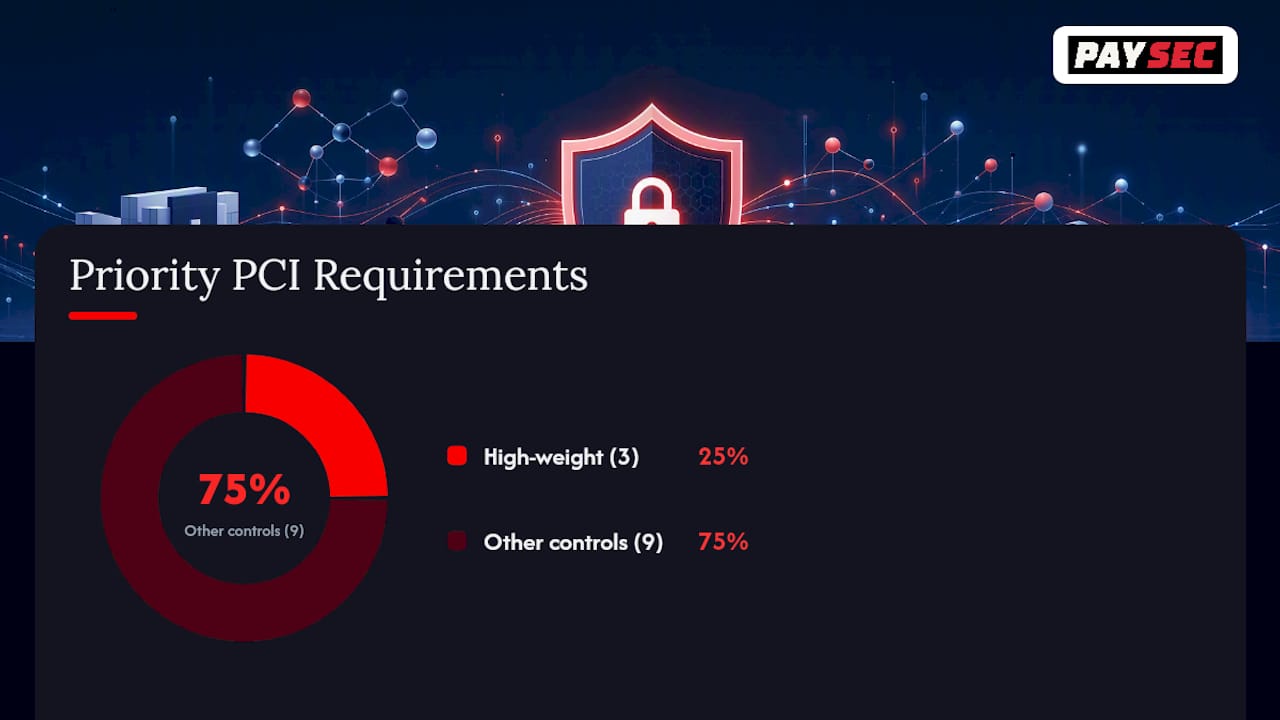
For healthcare payment gateway integration, Requirements 3, 4, and 8 carry the most weight. Where payment data interfaces with PHI, design controls to meet the stricter of HIPAA and PCI requirements. A single control set can often satisfy both frameworks. See Paysec's HIPAA-compliant payment processing guide for a detailed overlap analysis.
What should you ask a payment processor before signing?
Vendor selection is a compliance decision, not just a commercial one. Request these documents before contracting:
- Attestation of Compliance (AoC): Confirms the processor completed a PCI assessment. Verify the date and scope.
- Report on Compliance (RoC) or SAQ: Confirms the assessment type and which requirements were validated.
- ASV scan summaries: Quarterly external vulnerability scans with passing results.
- Penetration test report: Annual test covering CDE-facing systems.
- SOC 2 Type II report: Confirms operational security controls over a defined period.
- P2PE or tokenization validation: If the processor claims scope reduction, verify they appear on the PCI SSC's validated solutions list.
Requesting an AoC plus a recent ASV scan and SOC 2 report from any vendor gives a defensible basis for relying on that third party's controls.
Paysec holds PCI DSS Level 1 and SOC 2 compliance and offers hosted payment options that keep card data off your network. Request Paysec's compliance documentation directly through their healthcare payment solutions page.
Pro Tip: Store every vendor AoC and scan report in a single evidence folder with the date received. Auditors will ask for these, and a missing document from 18 months ago is a finding.
What ongoing monitoring and testing does PCI require?
Continuous validation is where many practices fall short after their initial assessment. Core ongoing tasks:
- ASV scans: Run quarterly external vulnerability scans through an Approved Scanning Vendor. Retain passing reports.
- Penetration testing: Annual internal and external tests covering CDE boundaries. Retain reports and remediation tickets.
- Log collection: Centralize payment system logs into a SIEM or log management tool. Retain for 12 months, with 3 months immediately available.
- Patch cadence: Apply critical patches to CDE systems within your defined window (commonly 30 days for critical, 90 days for high).
- Payment-page script monitoring: Automated change detection for any script running on hosted payment pages.
- Alerting: Define thresholds for failed logins, unusual transaction volumes, and CDE access outside business hours. Assign escalation owners.
Pair your payment logs with a fraud protection monitoring framework to catch anomalies that pure compliance monitoring misses.
How should you respond to a suspected payment-data breach?
Speed and evidence preservation determine outcomes. Follow this sequence:
- Isolate affected systems immediately. Take terminals or servers offline without powering them down.
- Preserve logs. Do not alter, delete, or overwrite any logs from affected systems.
- Notify your acquiring bank within 24 hours of suspecting a breach. They will engage the card brands.
- Contact card brands directly if required by your acquirer (Visa, Mastercard each publish their own incident response contacts).
- Engage a PCI Forensic Investigator (PFI). Your acquirer will likely require one.
- Notify affected patients per applicable state breach notification laws and HIPAA breach rules.
- Place ASV and pentest holds. Do not run scans that could alter evidence until the forensic team clears it.
Pro Tip: Establish chain-of-custody documentation from the first moment you suspect a breach. Write-blocked disk images taken before any remediation are the standard forensic investigators expect.
How do you operationalize Requirement 12 through training and access controls?
Policies and training are the controls most often marked "not in place" during assessments. Build this program:
- Policy checklist: Data retention policy, accepted payment channels policy, vendor governance policy, incident response plan, and change-control procedure. Review annually.
- Training frequency: Annual training for all staff with CDE access; role-specific training for front-desk, billing, IT, and vendors at onboarding.
- Role-based access: Assign least-privilege access. A front-desk coordinator should not have the same CDE permissions as a billing administrator.
- Quarterly access reviews: Pull the CDE user list every quarter. Remove or adjust access for staff whose roles have changed.
- Vendor governance: Require all third parties with CDE access to sign a security addendum and provide their own AoC annually.
What does a realistic 30/90/180-day rollout look like?
A staged approach keeps the program manageable without leaving gaps.
- Days 1–30 (quick wins): Assign scope owner, complete CDE inventory, collect data-flow diagrams, request vendor AoC and SAQ, enable MFA on all CDE accounts.
- Days 31–90 (scope reduction): Implement tokenization, hosted payment pages, or P2PE. Run first ASV scan. Document policies and begin staff training.
- Days 91–180 (full remediation): Complete segmentation engineering, schedule penetration test, deploy SIEM log collection, finalize vendor contract addenda, run tabletop incident-response exercise, submit SAQ or engage QSA for RoC.
Primary cost drivers: tokenization or P2PE procurement, network segmentation engineering, external QSA or penetration-testing fees, and SIEM tooling. Paysec's transparent pricing model removes one variable: no long-term contracts and no hidden processing fees.
Pro Tip: Prioritize scope reduction in the first 90 days. Every system you remove from scope reduces the number of controls you must validate, which cuts both assessment time and remediation cost.
Operational checklist: 12 prioritized actions for the next 90 days
| # | Action | Owner | Evidence of Completion | Priority |
|---|---|---|---|---|
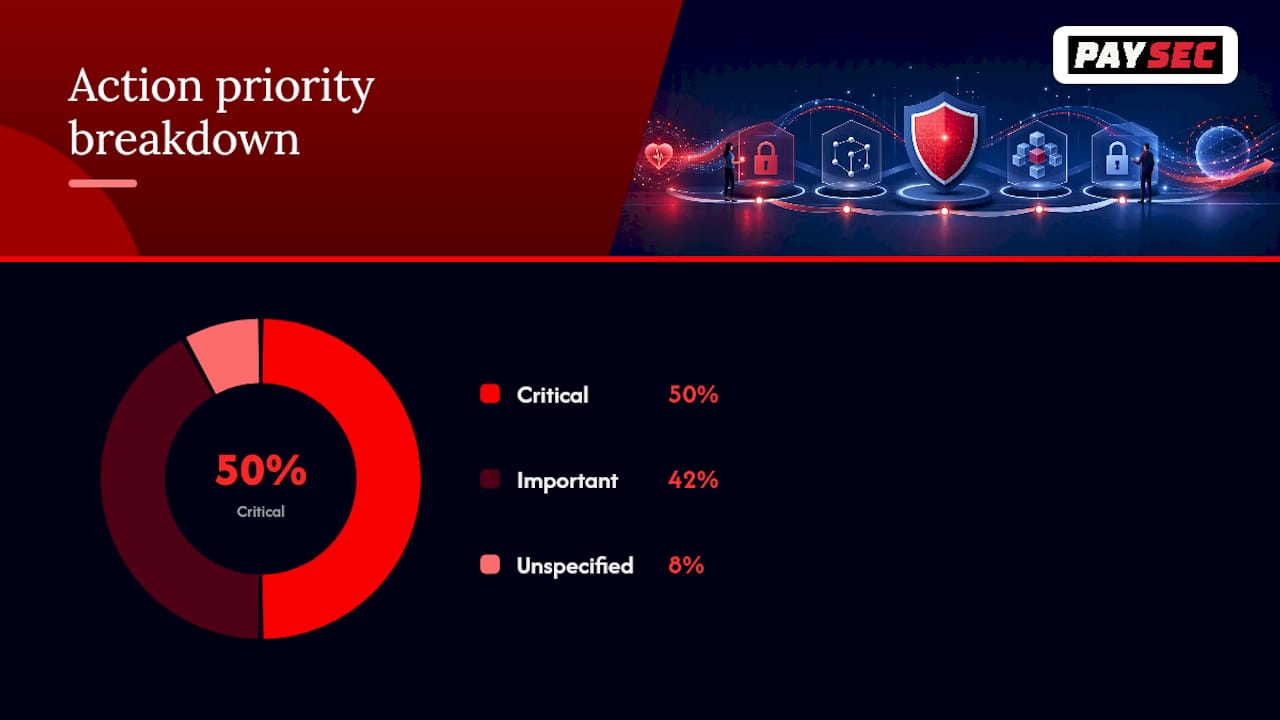
| 1 | Assign CDE scope owner | Practice manager | Named owner documented | Critical |
| 2 | Complete data-flow mapping | IT/billing lead | Approved data-flow diagram | Critical |
| 3 | Request vendor AoC and SAQ | Finance/compliance | AoC on file, dated | Critical |
| 4 | Enable tokenization or hosted payment | IT/processor | Vendor confirmation, SAQ update | Critical |
| 5 | Enforce MFA on all CDE access | IT | MFA enabled, user list confirmed | Critical |
| 6 | Run first ASV scan | IT/security | Passing scan report | Critical |
| 7 | Schedule annual penetration test | IT/security | Signed engagement letter | Important |
| 8 | Enable SIEM log collection | IT | Log ingestion confirmed, 12-month retention set | Important |
| Physical access controls | Document and publish security policies | Compliance | Signed policy set, version-controlled | Important |
| 10 | Complete role-based staff training | HR/compliance | Training completion records | Important |
| Testing and monitoring | Add security addenda to vendor contracts | Legal/finance | Signed addenda on file | Important |
| 12 | Run tabletop IR exercise | IT/compliance | Exercise summary and action items | Important |
Use Paysec's PCI compliance checklist for small businesses to cross-reference these actions against your SAQ type.
Paysec's perspective on reducing scope and cost for healthcare practices
Healthcare payment compliance does not have to mean months of expensive remediation. Paysec operates as a PCI DSS Level 1 and SOC 2-certified processor, which means the controls protecting cardholder data on Paysec's infrastructure are independently validated. For practices using Paysec's hosted payment options, card data never touches the practice's own servers, which directly reduces the number of PCI requirements the practice must validate.
Practices that benefit most are those accepting payments through patient portals, phone-based billing, or front-desk terminals where scope reduction through hosted pages or tokenization is straightforward to implement. Paysec provides real-time transaction reporting that also supports the logging and monitoring requirements under PCI Requirement 10.
The recommended next step: request Paysec's current AoC and SOC 2 report, and ask for a compliance readiness review tailored to your practice's payment channels.
How Paysec supports your payment-data security program
Paysec delivers PCI Level 1 and SOC 2-certified payment processing with no long-term contracts and no hidden fees, giving healthcare practices a clear path to reduced PCI scope from day one.
Key benefits for healthcare practices:
- Reduced PCI scope through hosted payment pages and tokenization that keep card data off your network
- Real-time payment reporting that supports Requirement 10 log and monitoring evidence
- Transparent network offset pricing with no minimums and no long-term commitment
- Compliance documentation on request: AoC, SOC 2, and ASV scan summaries available for your evidence file
Contact Paysec through the healthcare payment solutions page to request compliance documentation and a tailored 90-day readiness plan for your practice.
Sources
These sources underpin the guidance in this guide. Store all vendor attestations and testing reports in a single evidence folder for audits.
- What is PCI Compliance in Healthcare? | HIPAA Journal
- PCI DSS in Healthcare (Scope + Readiness Checklist) | Meditology
- PCI DSS Compliance for Healthcare: Complete Guide for Hospitals, Clinics & Telehealth | ValueMentor
This article is general information, not a substitute for advice from a qualified financial advisor. Consult a qualified financial professional about your own circumstances before acting on anything here.
FAQ
What is the difference between PCI DSS and HIPAA for healthcare payments?
PCI DSS governs cardholder data (credit and debit card numbers), while HIPAA governs protected health information (PHI) such as medical records. A single patient transaction can trigger both, but the controls apply to different data sets.
Which SAQ type applies to a small medical practice?
Most small practices that use hosted payment pages or a PCI-validated P2PE solution qualify for SAQ A, the simplest validation path. Practices that key-enter card data manually typically fall under SAQ B or SAQ C.
How often must ASV scans and penetration tests be performed?
PCI DSS requires quarterly external vulnerability scans by an Approved Scanning Vendor (ASV) and at least one annual penetration test covering CDE-facing systems. Retain passing reports as audit evidence.
Does tokenization eliminate all PCI requirements?
No. Tokenization reduces scope by removing readable card data from your network, but your organization remains responsible for validating vendor compliance and maintaining controls on any systems connected to the CDE.
How does Paysec help reduce PCI scope for healthcare practices?
Paysec's hosted payment options keep card data off the practice's servers entirely, and its PCI DSS Level 1 and SOC 2 certifications are available as documented evidence. Practices can request Paysec's AoC and SOC 2 report directly to support their own compliance file.