

For food-service operators who need a clear shortlist right now, here it is. When you compare payment processors for food service, five options consistently rise to the top based on pricing transparency, hardware fit, and operational depth:
- Paysec — Best for transparent fees and measurable savings. Network Offset Pricing delivers 30–60% reductions in processing costs with no long-term contracts and no hidden fees. The right call for any restaurant or food truck that wants to see exactly where every dollar goes.
- Toast — Best all-in-one POS for full-service and multi-location restaurants doing $50K+ monthly. Deep kitchen display and labor integrations justify the higher headline rate.
- Square (Square Payments) — Best for startups, food trucks, and pop-ups. No contract, inexpensive mobile readers, and near-instant setup make it the default for operators under $50K monthly.
- CDGcommerce — Best overall for POS integration depth and chargeback protection across restaurant sizes.
- Helcim — Best for catering and food-service businesses that invoice, with published interchange-plus rates and no monthly fee.
Operators above $400K monthly should request a custom interchange-plus quote before signing anything. That is where the real savings live.
Table of Contents
- How do top payment processors compare for food-service needs?
- Quick profiles: what each processor actually offers
- How to choose the right payment processor for your restaurant or food truck
- What do fees, hardware, and tipping actually mean for your bottom line?
- Key Takeaways
- What operators actually choose and why
- Paysec cuts food-service processing costs without locking you in
- Useful sources and next reads
- FAQ
How do top payment processors compare for food-service needs?
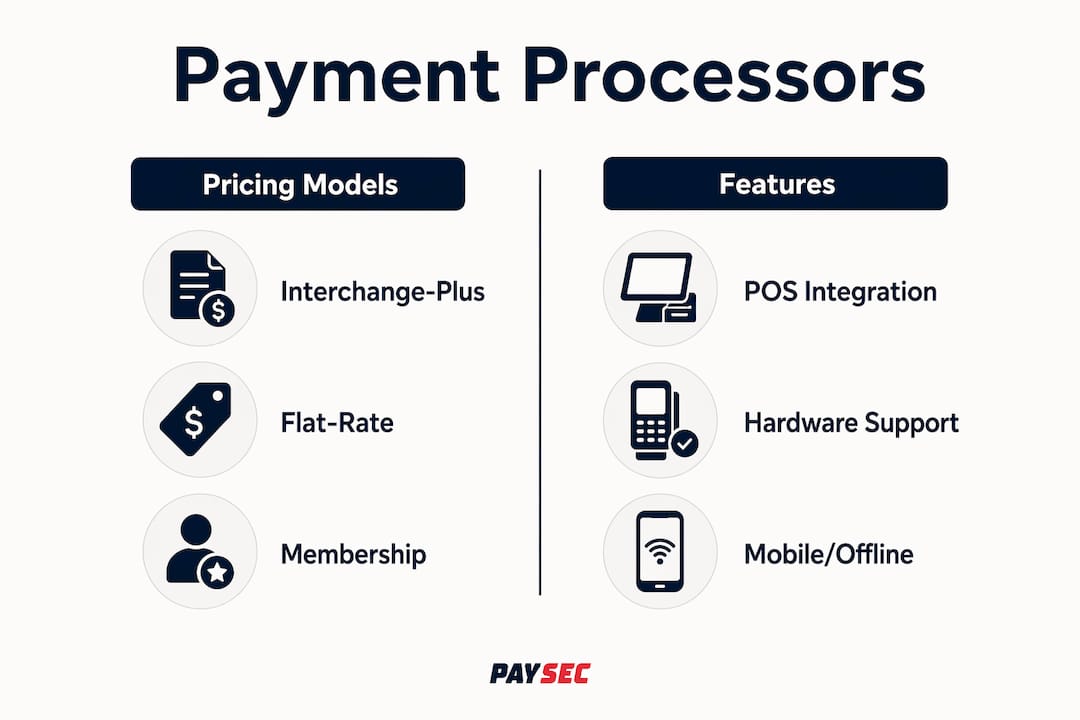
The table below covers the dimensions that actually drive the decision: pricing model, POS depth, hardware, mobile readiness, contract terms, payout speed, reporting, and support. Paysec leads the table as the featured option.
| Provider | Best For | Pricing Model & Sample Rates | POS Integrations | Hardware Support | Mobile/Offline | Contract / ETF | Payout Timing | Reporting & Analytics | Fraud & Chargeback | Customer Support |
|---|---|---|---|---|---|---|---|---|---|---|
| Paysec | Transparent fees, measurable savings | Network Offset / wholesale interchange; 30–60% savings claimed | Broad integrations; restaurant-ready | Countertop, wireless, mobile readers | Yes; mobile payments supported | No long-term contract; no ETF | Fast funding | Real-time dashboards; detailed transaction reporting | PCI-compliant; dispute management | Dedicated support |
| Toast | Full-service & multi-location restaurants | Flat-rate; free plan + paid tiers; hardware financing bundled on starter kits | Native KDS, labor, online ordering | Proprietary terminals; countertop & handheld | Limited offline mode | Annual contracts common; ETF applies | Next-day | Deep restaurant analytics | Built-in chargeback tools | 24/7 |
| Square | Startups, food trucks, pop-ups | Flat-rate: 2.6% + 10¢ in-person | Free restaurant POS (1 location); paid multi-site | Free magstripe reader; paid terminals from $0 | Offline mode available | Month-to-month; no ETF | Next-day (instant for fee) | Basic to mid-tier reporting | Chargeback waived up to $250/mo | Business hours + online |
| Stripe | Online ordering, delivery, ghost kitchens | Flat-rate: 2.7% + 5¢ in-person; custom interchange available | — | Bring-your-own hardware | Yes (API-driven offline flows) | Month-to-month | 2 days standard | Advanced API-driven analytics | Strong fraud tools | Email/chat; no phone |
| Clover | Hardware bundling; hardware portability | Monthly plans; hardware financing over 3 years | Broad app marketplace | Wide device range; countertop, handheld | Yes | Hardware agreements with ETF | Next-day | Mid-tier reporting | Standard chargeback support | 24/7 |
| Helcim | Catering, invoicing, multi-revenue restaurants | Interchange-plus: from 0.15% + 6¢; no monthly fee | Fewer native integrations; online checkout included | Fewer hardware options | Limited | Month-to-month; no ETF | 1–2 days | Invoice + transaction reporting | — | Business hours |
| Dharma Merchant Services | Quick-service restaurants; low avg ticket ($25 or less) | Interchange-plus; reduced rates for low-ticket merchants | Clover POS; several integrations | Clover hardware; virtual terminal | Yes (Apple/Android) | No long-term agreement | 1–2 days | Standard | Transparent dispute process | Business hours |
| Stax | Mid-size, full-service restaurants | Subscription: $99–$199/mo + interchange + 8¢ in-person | Broad integrations; contactless, mobile, online | Bring-your-own hardware | Yes; mobile app fallback | Month-to-month | Next-day | Strong analytics suite | $25 chargeback fee | Business hours |
| CDGcommerce | POS integration depth; enterprise rollout | Subscription: $0–$199/mo; interchange + 5¢ to 2.9% + 30¢ | 350+ platform integrations | Bring-your-own hardware | Yes | Month-to-month options | Next-day | Breadth of reporting | Strongest chargeback tools on this list | 24/7 U.S.-based |
| Payment Depot | High-volume restaurants; wholesale pricing | Membership with wholesale interchange rates; $0 monthly base | Bring-your-own; broad compatibility | Bring-your-own hardware | Month-to-month | No ETF | Next-day | Mid-tier | $25 chargeback fee | Business hours |
| Eats365 | Delivery-focused; omnichannel ordering | Varies by plan | Native delivery routing; KDS integration | Tablet-based | Yes | Varies | Varies | Order + delivery analytics | Standard | Business hours |
| Payment Gods Partner Network | Food trucks; mobile vendors | Low headline rates; mobile-first bundles | Limited | Mobile readers | Strong offline focus | Flexible | Varies | Basic | Standard | Varies |
| Luminous Payments | Cash discount programs; small restaurants | Cash discount, flat-rate, interchange-plus, tiered, or custom | Standard integrations | Standard terminals | Yes | Flexible | Varies | Standard | Standard | Business hours |
| Leaders Merchant Services | Restaurants with credit challenges; custom plans | Varies; less transparent than peers | Clover reseller; SwipeSimple | Reprogram existing terminals; Clover | Yes | Varies; review carefully | Varies | Standard | Standard | Business hours |
A note on headline rates: Effective cost differences between providers often come from hardware financing, monthly software fees, and contract terms rather than the published per-transaction rate. Always calculate the total monthly cost, not just the percentage.
Quick profiles: what each processor actually offers
Paysec
Paysec uses Network Offset Pricing and a wholesale interchange approach to give restaurants a clear, measurable alternative to traditional flat-rate processing. Merchants across 18+ industries report 30–60% reductions in processing costs, with one documented example showing a 42% cut. There are no long-term contracts, no hidden fees, and no minimums. Paysec supports countertop terminals, wireless devices, and mobile payment acceptance, making it a practical fit for restaurants, food trucks, and caterers alike. Real-time reporting gives operators full visibility into every transaction.
Toast
Toast is built from the ground up for restaurants. Its native kitchen display system (KDS), labor management, and online-ordering tools are tightly integrated in a way that general-purpose processors cannot match. It fits full-service and multi-location operations doing $50K+ monthly particularly well. The trade-off: hardware financing is often bundled into starter-kit processing rates, and annual contracts with early termination fees are common. Switching later can be expensive.
Square (Square Payments)
Square's appeal is speed and simplicity. A food truck operator can create an account and take payments the same day. The flat rate of 2.6% + 10¢ in-person is predictable, and the free restaurant POS software covers a single location without any monthly fee. For startups and mobile vendors, the no-contract structure is the single most important feature. At higher volumes, the flat rate becomes less competitive than interchange-plus alternatives.

Stripe
Stripe is the processor of choice when the payment flow itself needs to be custom-built. Ghost kitchens, delivery-first concepts, and restaurants with proprietary ordering apps benefit most. ChowNow and similar platforms run on Stripe's API infrastructure. The flat rate is 2.7% + 5¢ in-person, with custom interchange available for volume accounts. Stripe has no native POS, so in-person setups require third-party hardware and some technical configuration.
Clover
Clover sells hardware and software together, with monthly plans that spread device costs over three years. Its device range covers countertop, handheld, and curbside scenarios. The key advantage is hardware portability: Clover terminals can, in some configurations, be paired with independent merchant accounts, giving operators room to negotiate rates. Hardware agreements carry termination clauses, so read them carefully before signing.
Helcim
Helcim publishes its interchange-plus rates openly, starting from 0.15% + 6¢ in-person, with no monthly subscription. That makes it one of the most transparent processors available for catering companies and banquet halls that invoice clients and need a clean paper trail. Fewer hardware options than Clover or Square, but no setup fees and no PCI compliance surcharges.
Dharma Merchant Services
Dharma is the right call for quick-service restaurants with average tickets at or below $25. Its interchange-plus structure reduces per-transaction cost at low dollar amounts, and there is no long-term agreement. It integrates with Clover hardware and several POS platforms. Dharma is widely regarded as one of the more ethically transparent processors in the industry.
Stax
Stax charges a flat monthly subscription ($99–$199) and passes interchange directly to the merchant with a small per-transaction cent fee. For mid-size restaurants processing consistently high volumes, the math works in their favor. The analytics suite is one of the stronger offerings in this tier. For a new food truck or low-volume café, the monthly fee may outweigh the per-transaction savings.
CDGcommerce
CDGcommerce integrates with over 350 technology platforms, which is the widest POS compatibility on this list. It offers three pricing models, 24/7 U.S.-based technical support, and the strongest chargeback protection tools of any processor here. Applications are not instant-approved, but the transparency and support depth make it a strong pick for established restaurants and enterprise rollouts.
Payment Depot
Payment Depot uses a membership model with wholesale interchange rates. The effective cost per transaction drops as volume rises, making it well-suited for high-volume restaurants that process predictably. No early termination fee and a bring-your-own-hardware approach keep switching costs low.
Eats365
Eats365 is purpose-built for delivery and omnichannel ordering. Its native KDS integration and delivery routing tools serve operators who run multiple ordering channels simultaneously. Pricing varies by plan and configuration.
Payment Gods Partner Network
Positioned specifically for food trucks and mobile vendors, Payment Gods offers low-startup-cost bundles with mobile readers and a focus on offline reliability. Rates and contract terms vary by partner configuration, so verify specifics directly.
Luminous Payments
Luminous Payments is notable for its cash discount program, which lets restaurants legally pass processing fees to card-paying guests. It also offers flat-rate, interchange-plus, tiered, and custom plans, along with support for Apple Pay and Google Pay. A practical option for small restaurants looking to reduce net processing cost.
Leaders Merchant Services
Leaders has a 98% merchant application approval rate, which makes it accessible for restaurant owners with credit challenges. It can reprogram existing terminals and acts as a Clover reseller. Pricing is less transparent than Helcim or CDGcommerce, so request a full fee disclosure before signing.
How to choose the right payment processor for your restaurant or food truck
Step-by-step checklist
- Define your service model. Sit-down full-service, quick-service counter, food truck, catering, or ghost kitchen each has different hardware and workflow needs.
- Estimate your monthly volume. Under $50K monthly: prioritize no-contract, flat-rate options. $50K–$400K: compare interchange-plus providers. Above $400K: request a custom interchange-plus worksheet before signing.
- List your hardware requirements. Do you need a countertop terminal, handheld devices, a KDS, or just a mobile reader? Confirm ownership terms before committing.
- Map your online vs. in-person mix. Heavy online ordering or delivery? Stripe or a delivery-native platform like Eats365 may fit better than a restaurant POS with bolt-on online tools.
- Confirm tipping and split-pay support. Pre-authorization tip workflows and table-split functionality are non-negotiable for full-service dining. Ask for a demo before signing.
- Check reporting requirements. Multi-location operators need consolidated dashboards. Single-location owners may need only basic transaction exports.
- Account for seasonal or variable volume. Catering businesses and seasonal concepts need processors without volume minimums or penalties for low months.
Questions to ask every vendor
- Show me a sample interchange-plus worksheet for my average monthly volume.
- What is the exact early termination fee formula, and does it apply to hardware separately?
- Do I own the hardware outright, or is it financed into my processing rate?
- What is your chargeback handling SLA, and is there a dedicated rep assigned to disputes?
- Is 24/7 support included, or is it gated behind a higher plan tier?
Red flags to watch for
- Opaque rate language ("as low as" without a ceiling)
- Hardware financing buried inside the processing rate
- Unclear or uncapped early termination fees
- Proprietary terminals that cannot be reprogrammed for another processor
Switching processors without disrupting service
Switching processors mid-service is a real operational risk. A practical timeline: get quotes and review contracts in week one, order and test new hardware in week two, run parallel processing for 3–5 days before full cutover, and complete staff training before the first full-volume shift on the new system. A step-by-step switching guide can help you plan the migration without downtime.
What do fees, hardware, and tipping actually mean for your bottom line?
Pricing models explained
Interchange-plus separates the card network's base cost (interchange) from the processor's markup. You see both numbers. This is the most transparent structure and typically the most cost-effective for restaurants processing above $10K monthly.
Flat-rate bundles interchange and markup into one percentage. Predictable, but you pay the same rate on a $5 coffee as on a $200 dinner tab. At high volumes, the blended rate often exceeds what interchange-plus would cost.
Membership/wholesale (Stax, Payment Depot) charges a monthly fee in exchange for near-wholesale interchange rates. The break-even point depends on volume: run the math for your specific monthly card revenue before committing.
Tipping and split payments
Full-service restaurants need pre-authorization tip workflows: the card is authorized at the check total, the tip is added after the guest signs, and the final amount is settled in the batch. Not every processor handles this cleanly. Tableside split payments require the terminal or POS to support multi-tender transactions per check. Confirm both capabilities with a live demo.
Mobile and offline capability for food trucks
Offline mode reliability is critical for food trucks operating at festivals, markets, or remote venues. Look for local authorization that queues transactions and batches them when connectivity returns. Square and Payment Gods both support this. Confirm the offline transaction limit and the maximum queue time before relying on it at a high-volume event.
Pro Tip: Ask vendors to demonstrate offline mode during your sales call. Some processors advertise offline capability but cap it at a low transaction count or require manual reconciliation afterward.
Example cost calculation
A restaurant processing $80,000 monthly in card revenue illustrates the difference between models clearly.
Under a flat-rate at 2.6% + 10¢ with an average ticket of $45 (roughly 1,778 transactions): processing cost is approximately $2,258/month.
Under interchange-plus at an average interchange of 1.8% plus a 0.25% markup plus 10¢ per transaction: cost is approximately $1,638/month, a difference of roughly $620 per month or $7,440 annually.
That gap widens as volume grows. At $250K monthly, the total cost difference between flat-rate and interchange-plus can shift materially once hardware financing and software fees are factored in.
Switching costs matter too. Selecting a proprietary system that locks hardware and payments into a single ecosystem can cost $3,000–$8,000 in hardware and reconfiguration fees when you eventually switch. That figure should factor into any total-cost-of-ownership calculation from day one.
Security and compliance
Every processor on this list supports EMV chip transactions and PCI DSS compliance. Confirm that your chosen processor provides a PCI compliance program at no extra charge, handles tokenization for stored card data, and has a clear chargeback dispute process with defined response windows. For restaurants accepting online orders, verify that the payment gateway is PCI-compliant at the API level.
Key Takeaways
Interchange-plus pricing consistently delivers lower effective rates than flat-rate for restaurants processing above $10K monthly, and operators above $400K monthly should always request a custom quote before signing.
| Point | Details |
|---|---|
| Request interchange-plus worksheets | Operators above $400K monthly save most by negotiating custom interchange-plus rates before signing. |
| Calculate total cost, not just headline rate | Hardware financing and software fees shift effective rates; always compare full monthly cost across providers. |
| Confirm hardware ownership upfront | Proprietary lock-in can cost $3,000–$8,000 to exit; verify ownership terms before committing to any system. |
| Match processor to service model | Food trucks need offline/mobile-first setups; full-service restaurants need tipping workflows and KDS integration. |
| Paysec for transparent, contract-free savings | Paysec's Network Offset Pricing delivers claimed 30–60% savings with no long-term contracts and no hidden fees. |
What operators actually choose and why
The pattern is consistent across restaurant types. Startups and food trucks gravitate toward no-contract, mobile-friendly options because the cost of a wrong decision is low and switching is easy. Established multi-location operations tend to choose restaurant-native stacks like Toast, even when the headline fees are higher, because the operational depth in labor management, KDS, and reporting reduces friction across locations. The end-to-end integrated stack becomes a competitive advantage at scale, not just a payment tool.
Hardware portability becomes the decisive factor as revenue grows. Operators with $1M+ in annual revenue consistently prioritize the ability to negotiate merchant account terms independent of their POS provider. That flexibility is what allows them to move to interchange-plus pricing and control margin as card volume increases.
The operators who end up overpaying are almost always the ones who chose a processor based on the lowest advertised rate without reading the hardware agreement. A processor that looks cheap at $30K monthly can become the most expensive option at $200K monthly once the bundled financing and software tiers are fully loaded. Payment flexibility and long-term profitability are directly connected: the processor you choose today shapes your margin ceiling for years.
From the Paysec Marketing Team's perspective, the most underrated move a restaurant owner can make is requesting a side-by-side cost comparison from their current processor and one interchange-plus alternative before their next contract renewal. Most operators are surprised by what that comparison shows.
Paysec cuts food-service processing costs without locking you in
Most restaurants overpay on processing not because they chose the wrong provider, but because they never saw a transparent breakdown of what they were actually paying. Paysec's Network Offset Pricing changes that. By routing transactions through wholesale interchange and eliminating the markup layers that inflate flat-rate fees, Paysec gives restaurants, food trucks, and caterers a clear, documented path to lower costs. Merchants across 18+ industries have reported 30–60% reductions in processing costs, with one restaurant example showing a 42% cut.
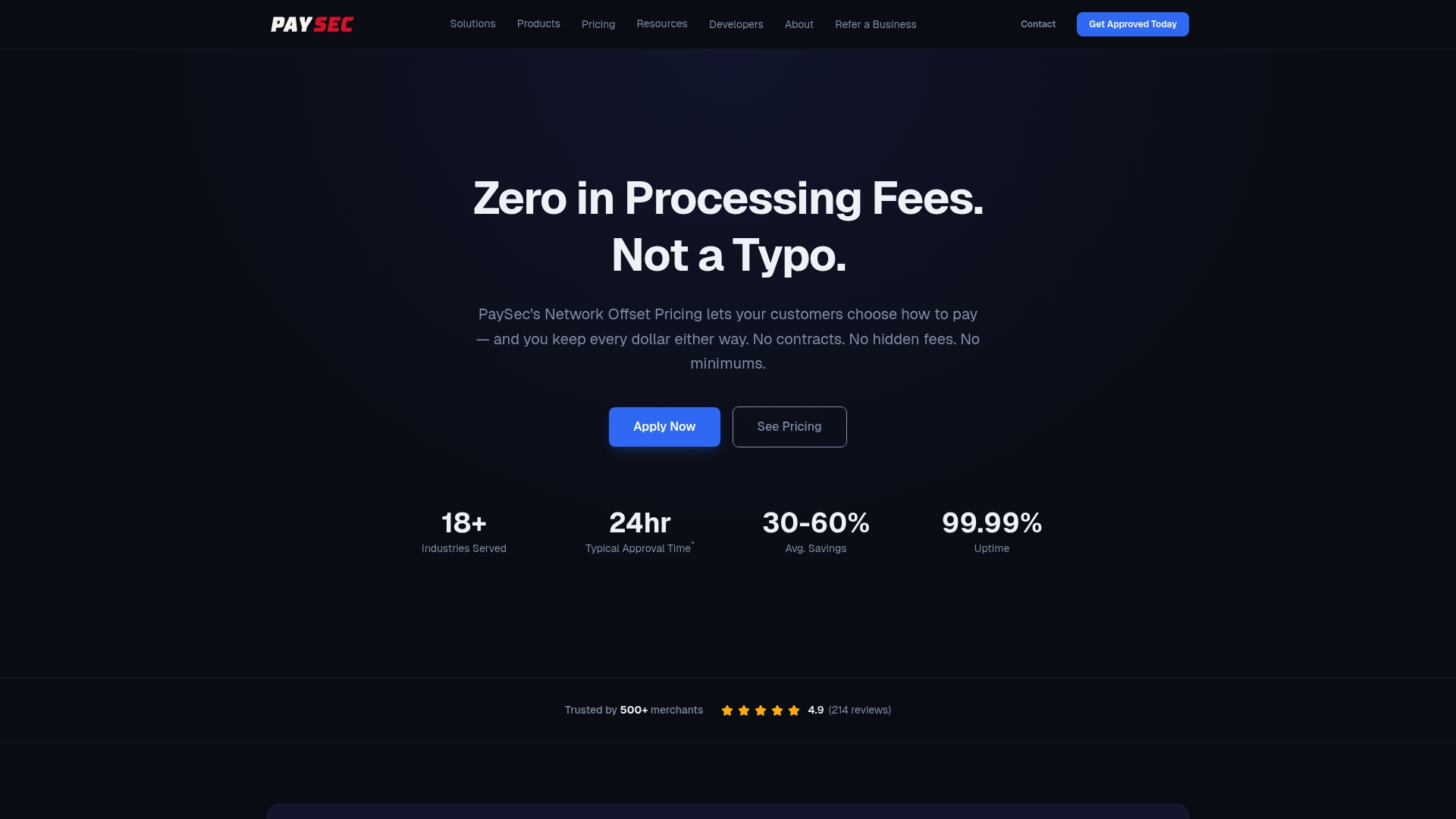
Paysec supports the full range of food-service hardware: countertop terminals, wireless devices, and mobile readers for food trucks and pop-ups. Real-time reporting and analytics give operators a live view of transaction data, making it straightforward to track costs, manage disputes, and report across locations. There are no long-term contracts, no hidden fees, and no minimums. Onboarding is fast and straightforward.
To see what Paysec's wholesale interchange approach would mean for your specific monthly volume, visit the pricing and interchange page and request a sample cost comparison. It takes minutes and gives you a concrete number to benchmark against your current processor.
Useful sources and next reads
The following sources informed this comparison and offer deeper reading on specific topics:
- RestaurantLaunchpad: Toast vs Square vs Clover (2026) — Detailed breakdown of POS and processing trade-offs across the three most common restaurant platforms, including hardware lock-in costs and revenue-band guidance.
- myPayAdvisor: Square vs Toast 2026 — Side-by-side cost analysis at different volume bands, including the $400K+ threshold for custom interchange-plus quotes.
- Payment Gods: Best Payment Processor for Food Trucks (2026) — Mobile-vendor-specific guidance on offline mode, portable readers, and no-contract setups.
- Business.com: Restaurant Payment Processing Guide — Broad overview of trust signals, pricing transparency, and what restaurants should look for in a processor.
- Restaurant Dive: What McDonald's Looks for in a Payment Partner — Enterprise perspective on why large chains prioritize end-to-end, in-house payment stacks.
- Paysec Restaurant Payment Processing — Paysec's restaurant-specific page covering tip management, terminal options, and POS integrations.
- Paysec Restaurant Payment Processing Fees Guide — Deep-dive on fee structures, example calculations, and how to read an interchange-plus worksheet.
- Paysec: How to Switch Payment Processors — Step-by-step migration guide for switching processors without service disruption.
To request an interchange-plus sample worksheet for your volume band, contact Paysec directly through the pricing page.
FAQ
Who is the most reliable payment processor for restaurants?
CDGcommerce consistently ranks at the top for reliability across restaurant sizes, with 24/7 U.S.-based support and the broadest POS compatibility on the market. Paysec is the strongest choice for operators who prioritize transparent, contract-free pricing with documented savings.
What is the most affordable payment processor for food service?
Affordability depends on volume. Helcim and Dharma Merchant Services offer the lowest effective rates for low-to-mid-volume restaurants through interchange-plus pricing with no monthly fee. For high-volume operations, Paysec's wholesale interchange approach and Payment Depot's membership model typically deliver the lowest total cost.
What are the four major payment processors?
The four major card networks that underpin all payment processing are Visa, Mastercard, American Express, and Discover. The processors in this article (Paysec, Toast, Square, Stripe, and others) sit on top of those networks and handle merchant-facing services, hardware, and pricing.
Which payment processing platform is the safest for restaurants?
Every processor on this list supports EMV chip transactions and PCI DSS compliance, which are the baseline safety standards for food-service payments. CDGcommerce offers the strongest chargeback protection tools of any processor reviewed here. Paysec provides PCI-compliant processing with tokenization and real-time dispute management built in.