
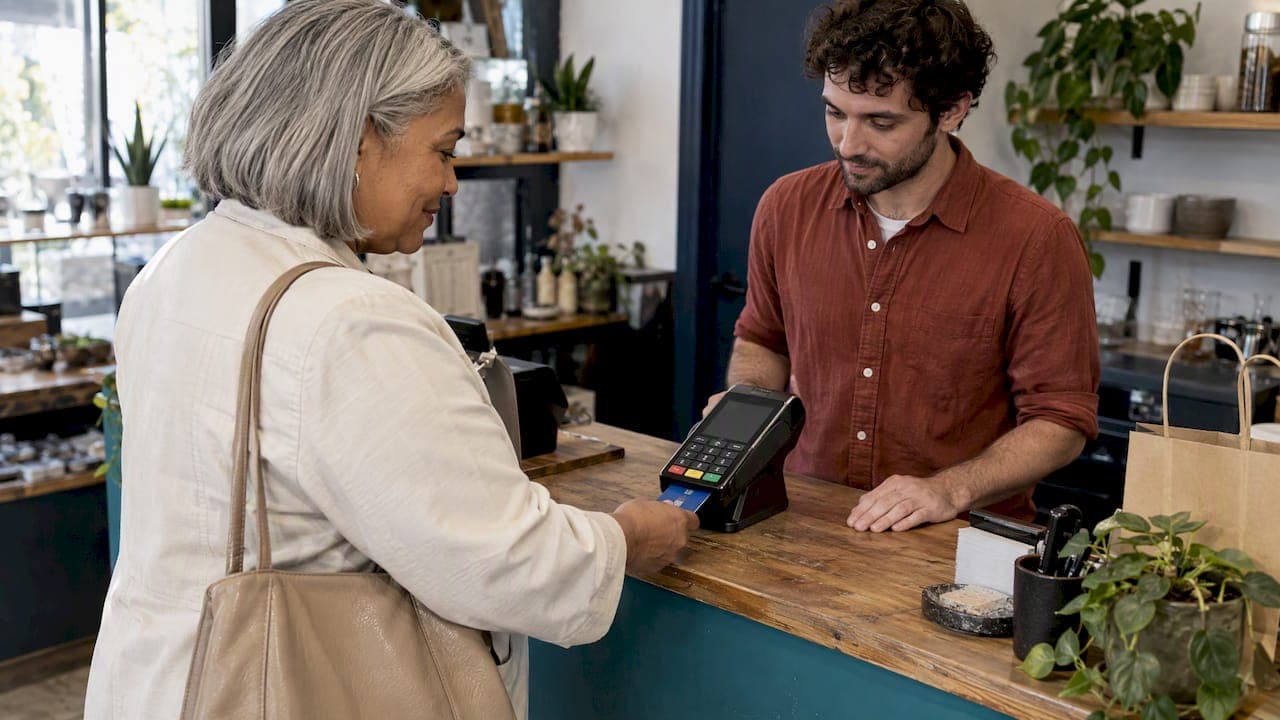
A card-present (CP) transaction happens when the customer and the physical card are with the merchant at the moment of payment: the card is dipped, tapped or swiped. A card-not-present (CNP) transaction happens when the card is not physically shown to the merchant. Online checkouts, phone orders, mail orders, invoices paid by card and recurring subscriptions all fall in this group. The split matters because it drives your processing cost, your fraud exposure and who pays when a payment is disputed.
This guide explains both types, what each one costs, where the risk sits and how to run a business that uses both.
TL;DR
- Card present means the card is read by a terminal (chip, tap or swipe). Card not present means the card details are entered or stored without the card being read, as in online, phone, mail and recurring payments.
- CNP is the riskier channel. In 2023, CNP transactions made up 54.3% of all debit card fraud, according to Federal Reserve Board data.
- CNP payments usually carry higher interchange and a higher chargeback burden. Card data capture, AVS, 3-D Secure and tokenization narrow that gap.
- Most U.S. merchants run both channels. The best setup keeps pricing transparent on each one.
Table of Contents
- What card present means
- What card not present means
- Card present vs card not present: side by side
- Why card-not-present payments cost more
- How big the CNP channel has become
- Fraud and liability: who pays when something goes wrong
- How to reduce risk and cost on card-not-present sales
- Which channel is right for your business?
- Our perspective: transparency decides the real cost
- Accept both payment types with PaySec
- A quick checklist for your next statement review
- FAQ
- Sources
What card present means
In a card-present transaction, the merchant's terminal reads the card directly. The card is physically there, the data is captured electronically from the chip, the magnetic stripe or the contactless antenna, and the customer is usually standing at the counter or the table.
Common card-present methods:
- Chip (EMV) dip: the card stays in the reader while a one-time cryptogram is generated for that payment.
- Contactless tap: a card, phone or watch is held near the reader. The payment uses a token or cryptogram, not the raw card number.
- Magnetic stripe swipe: the oldest method. It is still accepted but carries less security data than chip.
- PIN debit: the customer enters a PIN, which adds another verification step.
The terminal sends the encrypted data to the processor, the card network routes it to the issuing bank and an approval or decline comes back in seconds. Because the card was read, the transaction carries stronger proof that the card existed at the point of sale.
The Wikipedia definition of a card-not-present transaction describes the reverse: the cardholder cannot present the card for a merchant's visual examination when the order is placed. That is the simplest way to tell the two apart.
What card not present means
The phrase "card not present" is also written "card-not-present" or CNP. Standards bodies define it in similar terms. The NIST glossary entry for card not present is a good reference for the technical meaning. In plain business terms: the payment is made without the card being read by a terminal at the moment of sale.
Typical CNP transactions include:
- eCommerce checkouts: the customer types the card number, expiry and security code into a web form or uses a stored wallet.
- Phone orders (MOTO): a staff member keys the card details into a virtual terminal while the customer reads them out.
- Mail orders: card details written on a form and keyed in later.
- Recurring billing: a subscription or membership charged repeatedly from a stored credential.
- Pay links and invoices: a customer clicks a link in a text or email and pays on their own device.
- Keyed-in payments at a counter: if a card will not read, and the clerk types in the number, the sale is processed as card not present.
That last case surprises many restaurant and retail owners. A card can be physically in your hand and the sale can still be classed as CNP when the number is keyed in instead of read. Card-present status depends on how the data was captured, not on where the customer stands.
For the contractual wording, a processing agreement exhibit filed with the SEC defines a CNP transaction as one where required data is not electronically captured by reading the card, and it lists mail order, telephone order and internet transactions as examples.
Card present vs card not present: side by side
| Factor | Card present | Card not present |
|---|---|---|
| How data is captured | Terminal reads chip, tap or stripe | Typed in, stored or sent through a gateway |
| Typical settings | Restaurants, retail counters, mobile readers | Online stores, SaaS billing, phone orders, pay links |
| Fraud exposure | Lower, helped by chip and tokenized tap | Higher, because stolen card data can be used remotely |
| Interchange | Generally lower | Generally higher |
| Dispute liability | Often easier to defend with chip or PIN evidence | The merchant carries more of the burden |
| Main tools to reduce risk | EMV terminals, contactless, PIN | AVS, CVV checks, 3-D Secure, tokenization, fraud rules |
| Customer convenience | Fast at the counter | Works from anywhere, any time |
Neither type is better in every case. The right question is how to keep each channel as low-cost and low-risk as possible.
Why card-not-present payments cost more
Card networks set interchange rates by risk. A transaction where the card was read by a chip terminal is considered safer than one where the data was typed in. Keyed and online transactions therefore generally sit in higher interchange categories than their in-person equivalents.
Three things push CNP cost up:
- Higher interchange categories. The network fee that goes to the card issuer is typically greater for keyed and online payments.
- Fraud and chargeback losses. Merchants absorb a large share of fraud. The Federal Reserve survey found that merchants absorbed 49.9% of fraud losses reported by covered issuers in 2023, up from 38.3% in 2011.
- Added tooling. Gateways, fraud filters and authentication tools cost money, and some processors price them as extras.
There is also a cost that processors seldom explain: pricing structure. Under a flat-rate model, one blended percentage covers every transaction, so a low-cost in-person debit sale and a high-cost keyed rewards card are billed the same. Under interchange-plus or network offset pricing, you see the real network cost of each sale. Our guide to e-commerce vs. in-person processing fees shows how the numbers compare line by line.
A worked example
Take a store that sells $20,000 a month in-person and $20,000 a month online. With flat-rate pricing at a single blended percentage, both halves cost the same. With transparent pricing, the in-person half will usually show lower network costs and the online half higher ones. You can only decide where to invest, whether in terminals, fraud tools or tokenization, when your statement separates the two. That is why reporting by transaction type matters as much as the rate.
How big the CNP channel has become
CNP is no longer a niche. In 2023, CNP transactions accounted for 34.4% of debit and prepaid card volume and nearly half of transaction value, at $2.21 trillion out of $4.66 trillion, according to the Federal Reserve Board. The average CNP transaction was $63.96, against $36.99 for card present.
The gap is closing, too. The ratio between average CP and CNP value fell from 2.3x in 2009 to 1.7x in 2023. Online payments are no longer reserved for big baskets. Customers now buy coffee subscriptions, app credits, takeout and small add-ons online. For small-ticket sellers, every cent of fixed fee counts. Our article on the small-ticket problem explains why a $5 sale can cost far more than its percentage rate suggests.

Fraud and liability: who pays when something goes wrong
In a card-present sale, the chip and PIN or tokenized tap provide evidence that the real card was used. After the EMV liability shift in the U.S. in 2015, a merchant that has not upgraded to a chip-capable terminal can be held responsible for in-person counterfeit fraud. Keeping EMV terminals active is the card-present safeguard that matters most.
In a CNP sale, there is no chip evidence. If a thief uses a stolen number and the real cardholder disputes the charge, the merchant usually has to prove the sale was legitimate. The Federal Reserve data cited above found CNP fraud made up 0.061% of all debit purchase transactions in 2023, with an average loss of $73 per fraudulent transaction. The rate is small per transaction but adds up across thousands of orders. A newer Fed report coverage from CU Today notes that card-not-present growth is a driver behind rising fraud losses.
Common CNP fraud patterns:
- Stolen card testing: small orders to check whether numbers are live.
- Account takeover: a fraudster logs into a real customer account and uses stored cards.
- Friendly fraud: a real customer disputes a purchase they made.
- Fake card use: details generated or altered to pass basic checks. Our guide on how to detect and stop fake credit card fraud covers the warning signs.
How to reduce risk and cost on card-not-present sales
Most of the cost gap can be managed. These are the tools that make the most difference.
1. Collect the full set of data
Send the billing ZIP code and the security code with each online payment. Address Verification Service (AVS) and CVV checks help the issuer decide to approve, and they help you defend a dispute later. Sales with complete data usually authorize better than sales sent with the bare minimum.
2. Add 3-D Secure where it fits
3-D Secure adds an authentication step in which the issuer confirms the cardholder. A successful authenticated payment can shift fraud liability away from the merchant, depending on card network rules. Read our 3D Secure authentication guide and our note on what merchants need to know about 3D Secure 2 to decide which transactions to route through it.
3. Tokenize stored cards
Tokenization replaces the card number with a token that is useless outside your account. Network tokenization goes a step further. As one gateway's documentation explains, the primary account number is replaced with a token issued by the card network and used across the payment lifecycle. Because the real card data does not sit on your systems, your PCI scope can shrink. Network tokens can also pick up updated card details when a card is reissued, which reduces failed renewals on subscriptions.
For a step-by-step look at how this lowers cost, read how small merchants cut card-not-present fees with tokenization.
4. Avoid manual keying when a terminal can read the card
When a clerk keys in a card that could have been dipped or tapped, the sale moves to a higher-cost category and loses the chip evidence. Train staff to retry the chip or tap before keying. Keep readers in working order and replace worn ones.
5. Use clean descriptors and clear receipts
Many disputes come from customers who do not recognize a charge. A clear business name on the statement, an emailed receipt and clear refund terms prevent chargebacks before they start.
6. Keep a PCI program in place
Every merchant who accepts cards, in person or online, falls under PCI DSS. Smaller businesses often need a practical walk-through of the requirements, such as this PCI compliance guide for small businesses. Using a PCI-compliant gateway and tokenization reduces what you must handle yourself.
Which channel is right for your business?
Most merchants do not choose between the two. They decide how much of each to run.
Restaurants and cafes. In-person card-present sales dominate, but online ordering, delivery apps and gift cards add CNP volume. Keep terminals current for tap and chip, and use a gateway with tokenization for online ordering.
eCommerce stores. Almost all sales are CNP. Focus on AVS, 3-D Secure, fraud rules and transparent pricing. If you also sell at pop-ups or events, add a mobile reader so those sales are card present.
Healthcare practices. Front-desk payments are card present, while patient portals, payment plans and phone payments are CNP. Compliance and secure storage of cards on file are the priorities.
SaaS and marketplaces. Subscriptions are CNP by nature. Tokenization, automatic card updates and recurring billing controls protect revenue and cut failed payments.
CBD and other high-risk retail. Card acceptance depends on the processor's underwriting. Online sales carry added scrutiny, so a processor that supports your vertical and keeps reporting clear is essential.
Field services and tradespeople. Work is done at a customer's property, and payment is often collected by phone or text link. A pay link is a CNP transaction, and text-to-pay options for solo tradespeople show how that can work in practice.
When bank transfer beats a card
For large recurring payments, such as rent or B2B invoices, ACH can cost far less than a card. This comparison of ACH and card for rent payments shows the dollar difference on a single payment. Offering ACH alongside cards gives high-ticket customers a lower-cost route.
Our perspective: transparency decides the real cost
We talk to merchants every day, and the same pattern comes up. Owners compare rates by the headline percentage. They rarely compare how the processor treats card present and card not present on the statement.
Our view is simple. The card-present and card-not-present split is not a problem to fear. It is information. When your pricing passes through true wholesale interchange, you can see which channel costs what and make decisions from facts. That is the idea behind our Network Offset Pricing: the network cost is shown as it is, with no hidden fees and no flat-rate markup layered on top. Merchants across 18+ industries use it, and savings of 30-60% compared with major processors are typical for our clients.
Three principles guide how we set up merchants who take both kinds of payment:
- Read the card whenever you can. Chip and tap reads protect margin and evidence. Free terminal placement removes the hardware cost.
- Secure every remote payment. Tokenization, AVS, 3-D Secure and fraud prevention belong in the standard setup, not as an afterthought.
- Report by transaction type. Detailed reporting shows card-present and card-not-present volume, so you can act on it.
For B2B sellers, there is one more lever. Commercial enhanced data, such as tax and line-item detail, can qualify eligible B2B card payments for better interchange. Our auto dealership case study shows what that optimization achieved: savings of $2,000 a month.
— PaySec Marketing Team
Accept both payment types with PaySec
PaySec brings in-person, online, mobile and recurring payments into one account. You get in-store processing, an eCommerce gateway, mobile payments, ACH, recurring billing and fraud prevention with PCI DSS Level 1 and SOC 2 compliance, real-time reporting, no minimums and no long-term contracts. Terminals come through free placement at $0 per month, so card-present sales can start without a hardware bill.
You can pick Network Offset, Flat Rate or Custom Enterprise pricing, and you can review the options on our pricing page. For online stores, see our eCommerce payment processing page. To see how the model works, read how Network Offset Pricing works.
A quick checklist for your next statement review
Use this list when you review your processing statement or compare offers:
- Is card-present volume shown separately from card-not-present volume?
- Do you see the interchange cost per transaction, or only a blended rate?
- Are chargebacks and fraud tools priced clearly?
- Is every terminal EMV and contactless ready?
- Are stored cards tokenized?
- Do online payments send AVS and CVV data?
- Is 3-D Secure active on higher-risk orders?
- Can customers pay by ACH for large invoices?
- Does your processor support your vertical, including high-risk categories, with fast approval?
Merchants who answer yes to most of these usually pay less and dispute less. For a wider view of the market, see our guides to payment processing trends for small businesses and payment processing for small business.
FAQ
What is the difference between card present and card not present?
Card present means the terminal reads the physical card by chip, tap or swipe. Card not present means the card details are typed in, stored or sent online without the card being read. The difference affects fees, fraud risk and who is responsible for disputes.
What does card not present mean in practice?
It means the merchant did not see or read the card at the time of sale. Online orders, phone orders, mail orders, pay links and subscription charges are all card not present. A sale where a clerk keys in the number is also classed as card not present.
Why are card-not-present fees higher?
Card networks assign higher interchange to keyed and online payments because the risk of fraud is greater. Merchants also carry more of the chargeback burden. Tools such as AVS, 3-D Secure and tokenization help reduce that risk.
Is a tap or phone wallet payment card present?
Yes, when the customer taps a card, phone or watch on your reader, the terminal captures the data electronically. That is a card-present sale. A wallet payment made inside a website or app is card not present.
Can I lower the cost of card-not-present sales?
Yes. Send full data with every online payment, use tokenization and 3-D Secure, and choose transparent pricing so you can see the true cost per transaction. Offering ACH for large payments can lower cost further.
Sources
- Federal Reserve Board, Debit card fees and costs 2023
- Card-not-present transaction, Wikipedia
- Card Not Present, NIST CSRC glossary
- Card-not-present transaction definition, SEC filing exhibit
- Merchant tokenization, EGW documentation
- Fed report on debit growth and fraud losses, CU Today