

Fake credit card fraud means counterfeit plastic, stolen card data, or synthetic identities used to push unauthorized transactions through your payment system. When you spot suspected activity, take three steps immediately:
- Hold or decline any high-risk order before fulfillment ships.
- Collect evidence: pull the full gateway log, AVS/CVV results, IP address, BIN, and device fingerprint.
- Notify your processor or acquirer and open an internal incident ticket to preserve dispute evidence.
Speed matters. Every minute a fraudulent order moves toward fulfillment increases your chargeback exposure and recovery cost.
Key Takeaways
Fake credit card fraud requires layered, real-time defenses: AVS/CVV checks, 3DS2, enrichment signals, and documented incident response working together.
| Point | Details |
|---|---|
| Immediate containment | Hold high-risk orders, collect gateway logs and IP/device data, and notify your processor before fulfillment ships. |
| Enable core CNP controls | AVS, CVV, and 3DS2 are the minimum; 3DS2 shifts chargeback liability to the issuer when the challenge completes. |
| Build an enrichment pipeline | Add VPN/datacenter IP flags, device fingerprinting, and BIN checks to score transactions before authorization. |
| Vet every processor | Require a sample statement, PCI DSS Level 1 and SOC 2 proof, and transparent termination terms before signing. |
| Use Paysec for built-in coverage | Paysec provides real-time dashboards, tokenization, 3DS2, and evidence-grade logs with no long-term contracts. |
Table of Contents
- What counts as a fake credit card in merchant terms?
- What transaction signals point to a fraudulent card?
- Immediate containment steps when you suspect fraud
- How to reduce counterfeit card losses at physical points of sale
- How to reduce fake-card fraud for card-not-present transactions
- Designing a layered, real-time fraud detection pipeline
- How to spot and avoid payment processor scams
- Incident response and chargeback management after fraud occurs
- Basic compliance and operational controls every merchant should enforce
- How to choose a fraud-prevention partner or configure your processor's built-in tools
- Why layered defenses outperform any single control
- Paysec cuts fraud exposure and processing costs together
- Sources
- FAQ
What counts as a fake credit card in merchant terms?
The term "fake credit card" covers four distinct attack types, each requiring a different defense.
- Counterfeit plastic: A physical card encoded with stolen magnetic-stripe data, used at the point of sale before EMV chip adoption closed most of that gap.
- Stolen card data: Real card numbers, expiration dates, and CVV codes harvested through data breaches or phishing, then used for card-not-present (CNP) purchases online.
- Synthetic identities: Fraudsters combine a real Social Security number (often a child's or deceased person's) with fabricated name and address data to open accounts and attach payment cards.
- Account takeover (ATO): A legitimate cardholder's account is compromised; the attacker adds a new card or changes billing details and runs purchases before the real owner notices.
Developer test numbers and QA mock cards are entirely out of scope here. This article covers only fraudulent card use that harms merchants.
What transaction signals point to a fraudulent card?
Layered, real-time enrichment is the most reliable way to surface these signals before authorization. Watch for:
- AVS or CVV failure: Billing address or security code does not match issuer records.
- BIN/issuer country mismatch: The card's Bank Identification Number (BIN) resolves to a foreign issuer, but the billing address claims a US location.
- IP geolocation mismatch: The order IP resolves to a country or city inconsistent with the billing or shipping address.
- VPN, proxy, or datacenter flag: Signals like
is_vpn,is_proxy, andis_datacenterindicate the buyer is masking their real location. - Velocity anomalies: Multiple orders from one card or IP within minutes, or rapid sequential BIN testing across a card range.
- Shipping red flags: Rush shipping on a first order, a freight forwarder address, or a shipping destination that differs sharply from the billing address.
- High-value first order: A new account placing an unusually large order with no purchase history.
Signal combinations carry more weight than any single flag. A datacenter IP combined with a BIN mismatch and rush shipping to a high-risk region is a strong composite indicator, even if each signal alone might be benign.
Pro Tip: Start with two or three high-confidence signal combinations rather than blocking on every individual flag. Blocking on a single AVS partial match, for example, will reject legitimate customers who recently moved. Composite rules reduce false positives while keeping your decline rate defensible.
Immediate containment steps when you suspect fraud
Act before the package leaves the warehouse. Card testing attacks accelerate quickly, and a delayed response turns a small probe into a large fraud run.
- Place a hold or decline on the flagged order in your gateway or OMS.
- Stop fulfillment for any related orders sharing the same IP, device fingerprint, or shipping address.
- Quarantine the SKU or product category if the attack targets a specific high-value item.
- Collect full evidence: gateway transaction ID, AVS/CVV/3DS response codes, IP address, device fingerprint, order timestamp, and shipping label data.
- Notify your processor or acquirer with the evidence package and request a hold on settlement if funds have not cleared.
- Open an internal incident ticket and log every action with timestamps for dispute use.
Keep raw logs untouched. Edited or incomplete logs weaken chargeback disputes significantly.
How to reduce counterfeit card losses at physical points of sale

EMV chip readers stop most counterfeit in-person fraud because the chip generates a unique transaction code that cannot be cloned from a swipe. Tap-to-pay (NFC) adds a second layer because the card number itself is never transmitted.
Practical POS controls:
- Disable swipe-only acceptance where your terminal and processor support it. Swipe fallback is the primary vector for counterfeit plastic.
- Update terminal firmware on a regular schedule and run tamper-evident checks on the device casing and card slot.
- Restrict terminal reprogramming to verified, inbound service tickets only. Never allow a caller to walk staff through reprogramming over the phone.
- Require ID verification for high-value transactions above your defined threshold, and document refusals.
- Train staff to recognize suspicious card behavior: hesitation at the chip reader, multiple card attempts, or distraction tactics while a second person handles the terminal.
Pro Tip: Post a short laminated reference card at each register listing the top three red-flag scenarios. Staff who can spot a suspicious interaction in real time are your fastest fraud defense.
How to reduce fake-card fraud for card-not-present transactions
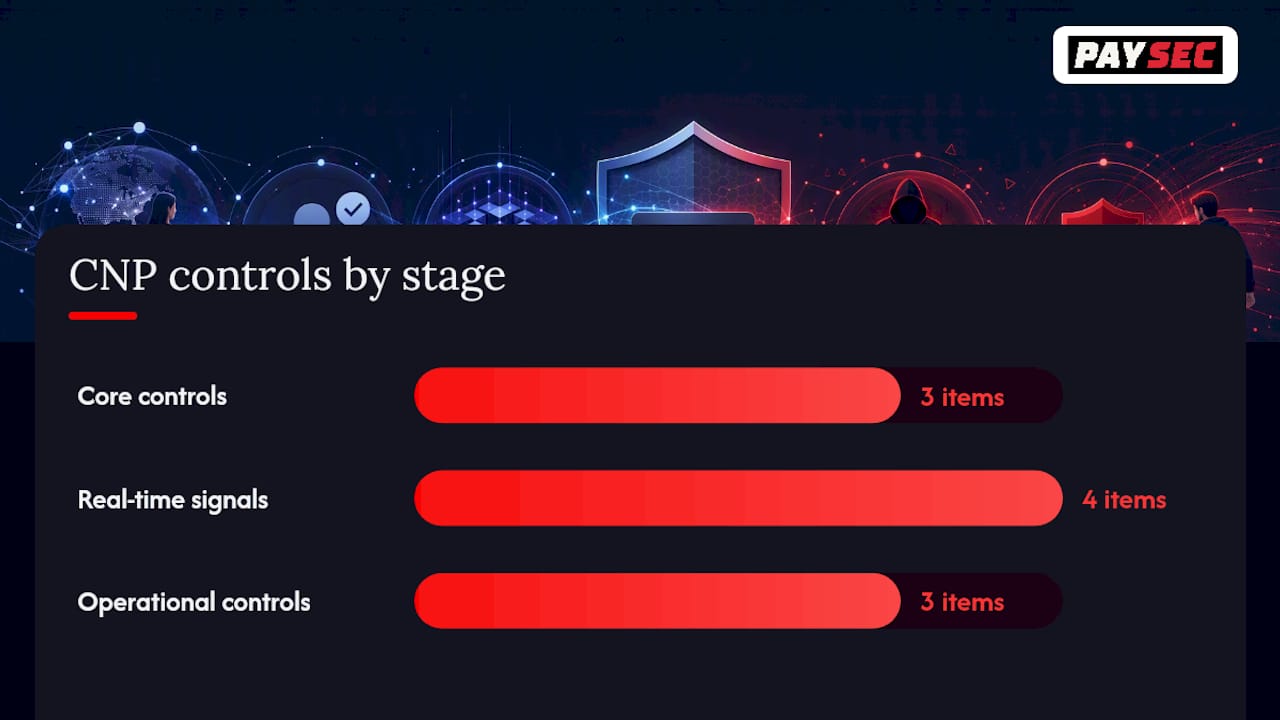
CNP fraud is where most fake credit card numbers and stolen card data cause damage. Detection requires context: device fingerprinting, IP intelligence, behavioral signals, and post-authorization monitoring.
Core controls to enable first:
- AVS + CVV checks on every transaction. Require a full match or flag for review.
- 3D Secure 2.0 (3DS2): Enables risk-based authentication and shifts chargeback liability to the issuer when the challenge is completed. See Paysec's 3DS authentication guide for integration steps.
- Tokenization through a PCI DSS-compliant gateway so raw card data never touches your servers.
Real-time enrichment signals to add next:
- IP intelligence: VPN, proxy, and datacenter flags plus geolocation.
- Device fingerprinting: browser, OS, and hardware identifiers that persist across sessions.
- Email and phone validation: check for disposable domains and unregistered numbers.
- BIN issuer checks: confirm the issuing bank country matches the claimed billing location.
Operational controls:
- Set velocity limits per card, IP, and device.
- Apply first-order restrictions: lower thresholds or require 3DS2 for accounts with no purchase history.
- Build a manual review queue for orders that score in a middle-risk band rather than auto-declining them.
Pro Tip: Use risk-based 3DS2 rather than applying the full challenge to every order. Low-risk transactions pass frictionlessly; high-risk ones get the authentication step. This protects conversion while shifting liability where it matters.
Designing a layered, real-time fraud detection pipeline
The goal is a decision in the milliseconds between checkout submission and authorization. Enriching transactions with network and device signals before authorization is the most effective merchant defense available today.
Pipeline stages:
- Pre-transaction: Collect IP flags (
is_vpn,is_datacenter, ASN), device fingerprint, email/phone validation, and BIN issuer data at checkout load. - Authorization-time scoring: Pass enriched signals to a rules engine or ML scoring model. Output: allow, review, or block.
- Post-authorization monitoring: Watch for fulfillment anomalies, chargeback spikes, and velocity patterns that emerge after the transaction clears.
Decisioning trade-offs:
| Decision mode | Fraud reduction | Conversion impact | Best for |
|---|---|---|---|
| Rules-only (hard blocks) | High on known patterns | Moderate false positives | Small merchants, low SKU count |
| Rules + ML scoring | High across novel patterns | Low false positives | Mid-to-large volume merchants |
| Staged friction (3DS2) | High with liability shift | Minimal when risk-based | CNP-heavy businesses |
Pro Tip: Build your rules with named, explainable conditions ("blocked: datacenter IP + BIN mismatch + first order > $300") rather than opaque score thresholds. Explainable rules produce dispute evidence a chargeback analyst can read and act on.
How to spot and avoid payment processor scams
Fake merchant service providers use high-pressure sales, hidden fees, or phishing to access merchant accounts. A legitimate processor will never request your account credentials over an unsolicited call or email.
Red flags when evaluating a processor:
- Aggressive cold outreach with "limited time" pricing offers.
- Refusal to provide a sample statement or a clear fee schedule. Understanding why credit card fees vary helps you spot inflated or hidden charges immediately.
- Requests for your gateway login, terminal admin password, or bank credentials over the phone.
- Vague or missing termination terms and early-exit penalties buried in fine print.
Vendor vetting checklist:
- Request a sample merchant statement and verify every line item.
- Confirm PCI DSS Level 1 and SOC 2 compliance in writing.
- Search the provider name plus "complaint" or "scam" in the CFPB complaint database and the BBB.
- Verify refund and termination terms before signing.
- Ask for documented fraud tools, dispute SLAs, and escalation contacts.
Never reprogram a terminal based on an inbound call. Require a verified service ticket and an authenticated technician before any terminal configuration changes.
Incident response and chargeback management after fraud occurs
A documented timeline is your strongest asset in a dispute. Work through these steps in order:
- Detect: Identify the fraudulent transaction through gateway alerts, chargeback notification, or manual review.
- Contain: Hold related orders, stop shipments, and quarantine affected accounts.
- Collect evidence: AVS/CVV/3DS response codes, device fingerprint, IP address, order notes, signed delivery receipts, and any ID captured lawfully at point of sale.
- Notify your processor: Submit the evidence package and request dispute support within the issuer's response window (typically 20–45 days depending on card network).
- Decide: fight or accept. Fight when you have strong AVS/CVV match, 3DS2 liability shift, or delivery confirmation. Accept when evidence is thin and the dispute cost exceeds the transaction value.
- Log and analyze: Record every incident in a central log to identify patterns and refine velocity rules.
For chargeback evidence, post-authorization monitoring often surfaces the strongest signals: behavioral anomalies, device reuse across multiple fraud orders, and IP clustering.
Basic compliance and operational controls every merchant should enforce
PCI DSS compliance is the operational floor, not the ceiling. These controls reduce attack surface and support dispute evidence:
- Use a PCI DSS-compliant gateway with tokenization so raw card data never enters your environment.
- Maintain least-privilege access: only staff who need payment tool access should have it, and access should be revoked immediately on role change.
- Rotate encryption keys and update terminal firmware on a documented schedule.
- Log all payment events with timestamps and preserve logs for a minimum of 12 months.
- Run staff training at onboarding and at least annually on social-engineering red flags, phishing recognition, and terminal security.
- Capture only the PII you need, document your data retention policy, and include incident handling procedures in writing.
A comprehensive fraud protection guide covers the full PCI operational checklist if you need a deeper reference.
How to choose a fraud-prevention partner or configure your processor's built-in tools
The right partner reduces configuration burden and gives you evidence-grade logs from day one. Use this checklist when evaluating options:
Buyer checklist:
- Transparent, itemized fee schedule with no hidden minimums.
- Real-time transaction reporting and evidence-grade dashboards exportable for disputes.
- Native support for 3DS2, AVS/CVV, and tokenization.
- IP intelligence flags (
is_vpn,is_datacenter, geolocation) available in the transaction record. - Documented SLA for incident response and chargeback support.
Questions to ask every vendor:
- Do you provide VPN and datacenter IP flags in the transaction log?
- Can I export raw gateway logs in a format my dispute team can use?
- What is your process for tuning false-positive rates, and how quickly can rules be updated?
- How do you handle PCI DSS Level 1 and SOC 2 certification renewals?
Paysec supports all of these requirements out of the box: real-time enrichment, 3DS2 integration, tokenization, PCI DSS Level 1 and SOC 2 compliance, and detailed transaction logs built for dispute evidence. Merchants across 18+ industries use Paysec's real-time reporting dashboards to monitor risk and respond to fraud without building a separate data pipeline.
Why layered defenses outperform any single control
The merchants who lose the most to fake credit card fraud are typically those relying on one control: CVV alone, or AVS alone, or a basic velocity rule. Each of those controls has a known bypass. CVV data is sold alongside card numbers in breach dumps. AVS can be partially matched with publicly available address data. Velocity rules are evaded by distributing attacks across many cards and IPs.
The practical path forward is enrichment plus scoring plus actioning, running in real time before authorization. That combination catches novel attack patterns that no single rule anticipates, and it produces the explainable, timestamped evidence that wins disputes. Paysec's architecture is built around exactly this model, which is why merchants using it see both lower fraud rates and lower processing costs across verticals from healthcare to eCommerce.
Paysec cuts fraud exposure and processing costs together
Most fraud-prevention tools add cost without touching your processing fees. Paysec does both. With Network Offset Pricing, merchants across SaaS, restaurants, eCommerce, healthcare, and CBD retail report processing savings of 30–60%, with one dental practice cutting costs by 33%. Fraud protection is built in, not bolted on.
Paysec's fraud-prevention capabilities include:
- Real-time transaction dashboards with evidence-grade logs ready for dispute submission.
- Tokenization and 3DS2 support for CNP liability shift and PCI DSS Level 1 compliance.
- VPN and datacenter IP flags surfaced directly in the transaction record.
- SOC 2 certified infrastructure with no long-term contracts and no hidden fees.
Ready to see what transparent pricing and built-in fraud monitoring look like for your business? Review Paysec's pricing and get started today.
Sources
Keep these resources on hand for deeper reading and dispute support:
- Payment Fraud: Types, Signs, and Detection | Abstract API
- Prevent credit card scams - U.S. Chamber of Commerce
- Guide: Card Testing Detection - How to Catch Enumeration Attacks in Real Time
- E-Commerce Payment Fraud: What It Is and How to Stop It - Sift
Preserve all raw gateway logs and transaction records. Documented, timestamped proof is the foundation of every successful chargeback dispute.
FAQ
What is a fake credit card in the context of merchant fraud?
A fake credit card refers to counterfeit plastic, stolen card numbers, or synthetic identity cards used to make unauthorized purchases. These are distinct from developer test cards and cause direct financial losses through chargebacks and stolen goods.
How do AVS and CVV checks reduce fake-card fraud?
AVS verifies the billing address against issuer records; CVV confirms the physical card is present. Together they flag mismatches that indicate stolen or synthetic card data before the transaction authorizes.
What is 3D Secure 2.0 and why does it matter for merchants?
3DS2 is an authentication protocol that adds a risk-based challenge step for CNP transactions. When the cardholder completes the challenge, chargeback liability shifts from the merchant to the card issuer.
How quickly do I need to respond to a suspected card-testing attack?
Immediately. Card testing attacks accelerate across card ranges in real time, and delayed action allows fraudsters to identify working card numbers before you can block them.
How does Paysec support fake-card fraud prevention?
Paysec provides real-time transaction dashboards, tokenization, 3DS2 support, VPN and datacenter IP flags, and evidence-grade logs, all under PCI DSS Level 1 and SOC 2 compliance with no long-term contracts required.