

Marketing professionals in the U.S. earn a wide range of pay depending on role, experience, and location. The national median for marketing managers sits at $166,790 (May 2025 BLS OEWS), while specialist-level roles typically land in the $60,000–$90,000 range. The gap between those two tiers is real and navigable.
- National midpoint: Marketing managers have a median annual wage of $166,790 and a mean of $177,770 as of May 2025 across hundreds of thousands of jobs nationally.
- Top-tier pay: CMOs and VPs at growth-stage tech companies regularly clear high six-figure base salaries, with equity pushing total comp well beyond that.
- Percentile reality: The 10th percentile for marketing managers sits below typical mid-career salaries; the 90th percentile reaches very high earnings. Where you land depends on role, industry, and how well you negotiate.
Use the tables below to find your role, then check the industry and metro premium bullets to estimate your market rate. If you're within 15% of the 75th percentile for your role, you have a strong case to negotiate up.
Table of Contents
- What marketing career salary looks like nationally
- Which marketing roles pay the most?
- How experience and education change your pay
- Total compensation: what's beyond your base salary
- How to increase your marketing salary in the next 3–18 months
- Job outlook for marketing careers through 2034
- 2026 salary trends shaping what employers actually pay
- How we compiled these numbers
- Key Takeaways
- How the Paysec Marketing Team would use these figures
- Useful sources and further reading
- FAQ
What marketing career salary looks like nationally
The BLS Occupational Outlook Handbook groups marketing occupations into two broad tiers: management roles and specialist/analyst roles. The pay gap between them is significant.
| Occupation | Median Annual Wage | Mean Annual Wage | 10th Percentile | 90th Percentile | Source/Year |
|---|---|---|---|---|---|
| Marketing managers | $166,790 | $177,770 | — | — | BLS OEWS, May 2025 |
| Advertising & promotions managers | — | — | — | — | BLS OEWS, May 2024 |
| Market research analysts & marketing specialists | — | — | — | — | BLS OEWS, May 2024 |
| Public relations managers | — | — | — | — | BLS OEWS, May 2024 |
| Public relations specialists | — | — | — | — | BLS OEWS, May 2024 |
Median vs. mean vs. percentile: The median is the midpoint — half earn more, half earn less. The mean is pulled upward by high earners at the top. Percentiles tell you where you actually stand relative to peers. For negotiation, the 75th percentile is your target anchor, not the median.
One important caveat: BLS OEWS figures aggregate across all industries and company sizes. A market research analyst at a Fortune 500 tech firm earns very differently from one at a regional nonprofit. Use these as a floor, not a ceiling.
Which marketing roles pay the most?
Pave's 2026 marketing salary guide and Glassdoor's crowdsourced data both confirm that revenue-linked and analytics-heavy roles command the steepest premiums. Here are the top-paying titles ranked by typical midpoint.
| Role | Median Base | 25th Percentile | 75th Percentile | Typical Education | High-Paying Industries |
|---|---|---|---|---|---|
| Chief Marketing Officer (CMO) | $325,000+ | — | $400,000+ | Bachelor's/MBA | Tech, SaaS, Finance |
| VP of Marketing | — | — | — | Bachelor's/MBA | Tech, Pharma, Media |
| Director of Demand Generation | $160,000 | $130,000 | — | Bachelor's | SaaS, B2B Tech |
| Product Marketing Manager (Senior) | — | $118,000 | $178,000 | Bachelor's | SaaS, Consumer Tech |
| Marketing Analytics Manager | $130,000 | $105,000 | $160,000 | Bachelor's/Master's | Tech, Finance, Retail |
| Director of Content Marketing | $120,000 | $95,000 | $148,000 | Bachelor's | Media, SaaS, Healthcare |
| Field Marketing Manager | $110,000 | $88,000 | $135,000 | Bachelor's | Enterprise Tech, Pharma |
| SEO/Organic Growth Manager | $95,000 | $75,000 | $120,000 | Bachelor's | eCommerce, SaaS |
| Email & Marketing Automation Manager | $90,000 | $72,000 | $115,000 | Bachelor's | Retail, SaaS, Finance |
| Brand Manager | $88,000 | $70,000 | $112,000 | Bachelor's | CPG, Retail, Healthcare |
What drives top pay in each tier:
- Marketing Analytics Manager: — Data fluency is the fastest-growing premium in 2026. Roles that own attribution modeling and revenue reporting command 20–30% above generalist marketing managers at the same level.
Pro Tip: For CMO and VP roles, always request the equity breakdown before comparing offers. At growth-stage companies, a $50,000 base difference can be irrelevant next to a 2x difference in option grants.
How experience and education change your pay
Pay bands in marketing are steep. An entry-level coordinator and a senior director can sit in the same department and earn four times as much apart.
| Experience Level | Typical Salary Range | Example Titles |
|---|---|---|
| Entry (0–2 years) | $42,000–$62,000 | Marketing Coordinator, Social Media Associate, Marketing Assistant |
| Early Career (2–4 years) | $60,000–$85,000 | Marketing Specialist, Content Writer, SEO Analyst |
| Mid-Level (4–8 years) | $80,000–$130,000 | Marketing Manager, Brand Manager, Demand Gen Manager |
| Senior (8–14 years) | $120,000–$185,000 | Senior Marketing Manager, Director, Senior PMM |
| Executive (14+ years) | $175,000–$400,000+ | VP Marketing, CMO, Chief Growth Officer |
Education's real impact on pay:
- A bachelor's degree in marketing averages around $67,990 at the entry level, according to Coursera's analysis. It's the baseline credential for most roles.
- A master's degree or MBA typically adds $10,000–$20,000 to starting pay and accelerates the path to director-level titles, particularly in brand management and product marketing.
- Certifications (Google Analytics 4, HubSpot, Salesforce Marketing Cloud, Meta Blueprint) rarely replace a degree but can add $5,000–$15,000 in annual pay when paired with demonstrated results.
- For analytics-heavy roles, a master's in data science or marketing analytics often outperforms an MBA in raw salary terms.
Pro Tip: An MBA pays off fastest when you're targeting a CMO or VP path at a large company. For a specialist track in analytics or automation, a targeted certification plus a portfolio of measurable results typically delivers faster salary growth at lower cost.
Total compensation: what's beyond your base salary
Base pay is only part of the picture. For senior marketing roles, the gap between base and total compensation can be substantial.
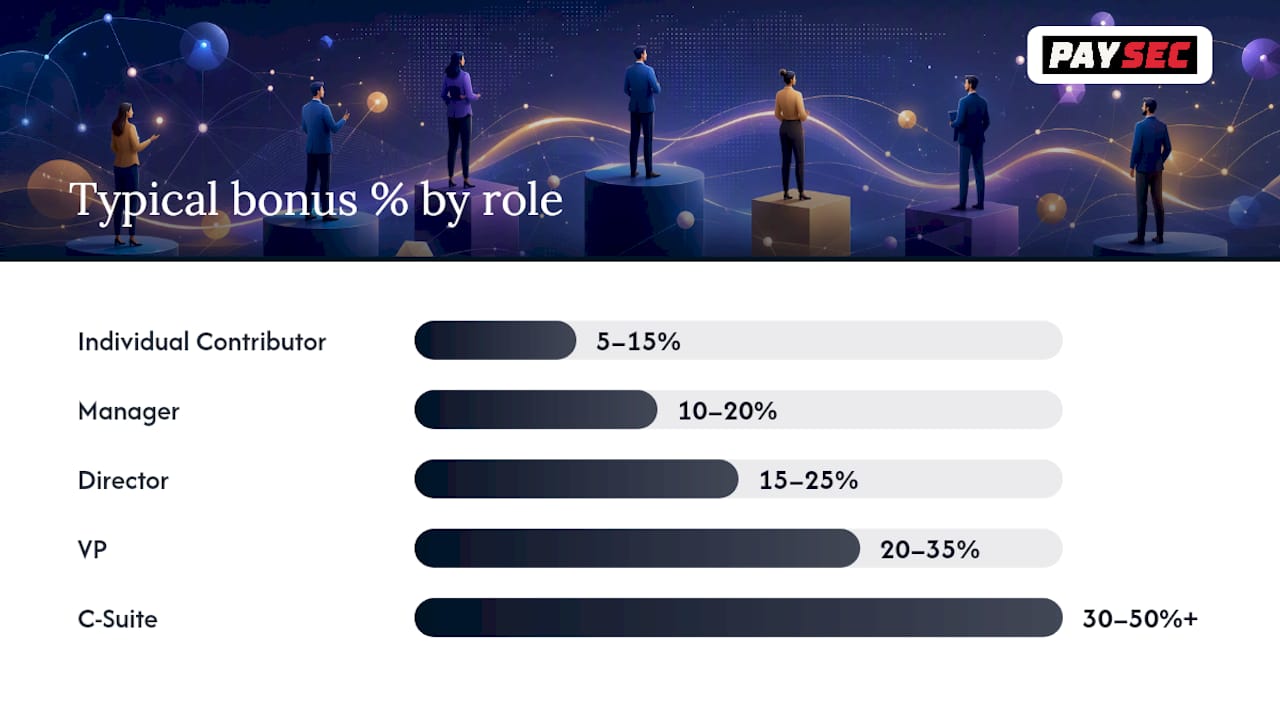
| Role Tier | Base Salary Range | Typical Bonus % | Equity Expectation | Common Role Examples |
|---|---|---|---|---|
| Individual Contributor (IC) | $55,000–$130,000 | 5–15% | Rare/minimal | Specialist, Coordinator, Analyst |
| Manager | $90,000–$160,000 | 10–20% | RSUs at tech companies | Marketing Manager, Brand Manager |
| Director | $130,000–$200,000 | 15–25% | RSUs or options common | Director of Demand Gen, Content Director |
| VP | $175,000–$280,000 | 20–35% | Significant equity | VP Marketing, VP Growth |
| C-Suite | —–$400,000+ | 30–50%+ | Dominant component | CMO, Chief Growth Officer |
Compensation components to understand:
- Base salary: Fixed annual pay. The floor for all negotiations.
- Annual bonus: Performance-linked cash, typically 10–30% of base for managers and above. Ask whether it's discretionary or formula-driven.
- Commission: Rare in pure marketing roles but common in field marketing and growth roles tied to pipeline targets.
- Equity (RSUs/options): At growth-stage and public tech companies, equity can dwarf base salary for leadership roles. Vesting schedules (typically 4 years with a 1-year cliff) matter as much as the grant size.
- Benefits: Health insurance, 401(k) match, PTO, and professional development budgets. A 5% 401(k) match on a $120,000 salary is worth $6,000 annually.
When comparing offers, ask:
- What is the total target compensation (base + bonus + equity)?
- What is the vesting schedule and cliff for equity?
- Is the bonus discretionary or tied to measurable targets?
- What is the company's current valuation or stock price trend (for private equity)?
- What professional development budget is included?
How to increase your marketing salary in the next 3–18 months
The moves below are ranked by impact. Start at the top.
-
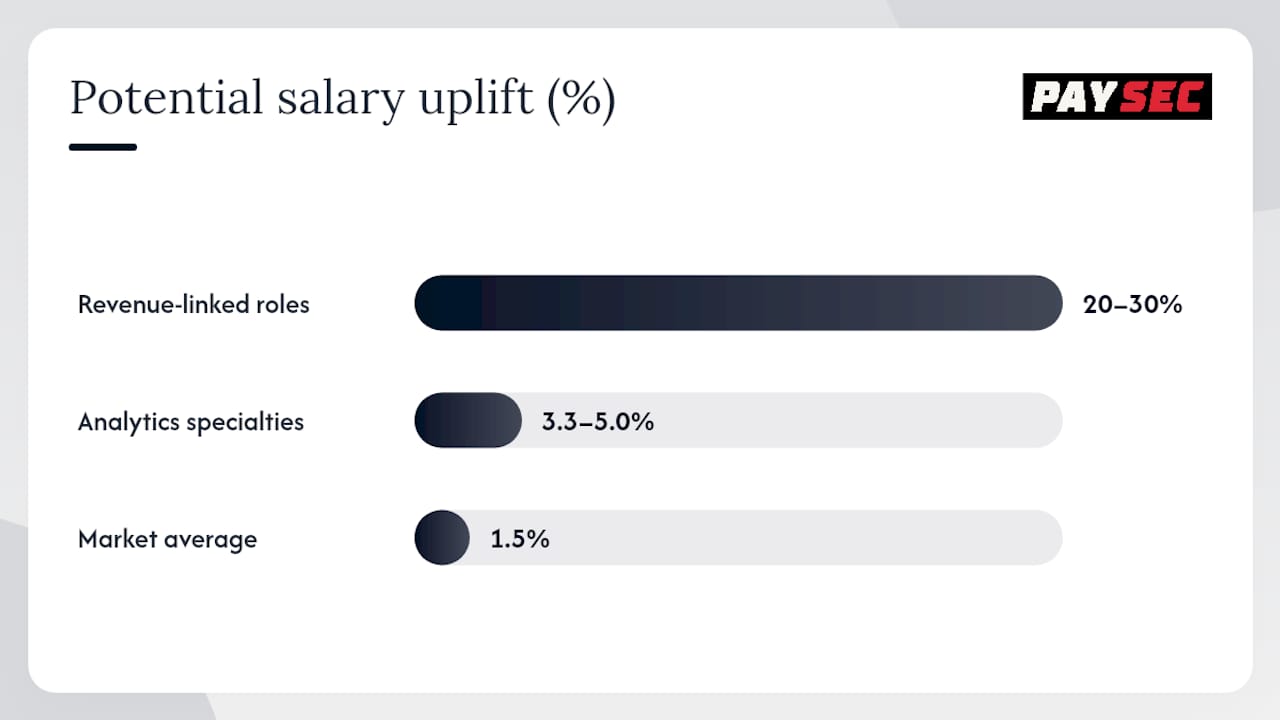
Move to a revenue-linked role. Demand generation, product marketing, and growth marketing roles that own pipeline metrics command 20–30% premiums over generalist marketing positions at the same level. If you're in a brand or communications role, building a bridge to a revenue-accountable function is the single highest-impact career move.
-
Specialize in analytics or AI. Robert Half's 2026 Salary Guide projects above-average gains for analytics and digital roles, with certain specialties seeing 3.3–5.0% increases versus the 1.5% overall average. Proficiency in GA4, Salesforce, HubSpot, and AI-assisted content tools is now table stakes; attribution modeling and marketing mix modeling are the premium skills.
-
Switch industries or company stage. Moving from a nonprofit or retail employer to a SaaS or fintech company at the same title can add $30,000–$60,000 in base pay. Company stage matters too: a Series B startup may offer lower base but higher equity upside than a Fortune 500 peer.
-
Negotiate with data, not feelings. Pull three to five comparable job listings from Glassdoor and Salary.com before any negotiation. Bring specific deliverables: pipeline generated, cost-per-lead reduced, revenue attributed. Numbers beat tenure every time.
-
Target a geographic premium. If remote work is available, apply to roles posted in San Francisco, New York, or Boston even if you live elsewhere. Negotiate the posted range, then discuss location adjustments after an offer is made.
-
Earn a high-signal certification. Google Analytics 4 certification, HubSpot's Marketing Hub certification, Salesforce Marketing Cloud credentials, and Meta Blueprint all signal specific platform fluency. Pair any certification with a portfolio case study showing measurable results.
-
Build a public portfolio of results. A LinkedIn profile that quantifies impact ("grew organic traffic 140% in 8 months," "reduced CPL by 32% through audience segmentation") attracts inbound recruiter interest and strengthens negotiation leverage.
Skill matrix: what pays and how to learn it
| Skill | Why It Pays a Premium | How to Learn It |
|---|---|---|
| Marketing analytics / attribution | Directly tied to revenue proof | Google Analytics 4, Coursera, DataCamp |
| AI-assisted content & automation | Efficiency multiplier; employer demand high | HubSpot AI tools, Jasper, Coursera AI courses |
| Demand generation / ABM | Pipeline ownership = negotiation power | Demandbase, 6sense certifications, LinkedIn Learning |
| Product marketing | Cross-functional; hard to replace | Pragmatic Institute, Product Marketing Alliance |
| Marketing automation | Reduces headcount need; high ROI | HubSpot, Marketo, Salesforce certifications |
Pro Tip: Before your next review, document three specific outcomes with dollar figures or percentages. "I managed the email program" is forgettable. "I increased email revenue by $240,000 in Q3 through segmentation changes" is a raise.
Job outlook for marketing careers through 2034
The BLS projects steady demand across marketing occupations, with management roles growing faster than the average for all occupations.
- Marketing managers: — Projected to grow 8% from 2024 to 2034, faster than the 4% average for all occupations. The BLS attributes this to increasing demand for digital marketing expertise and data-driven campaign management.
- Market research analysts: — Projected to grow 8% over the same period, driven by business demand for consumer data and competitive intelligence.
Stat callout: The BLS projects marketing manager employment to add roughly 31,000 new jobs through 2034, reflecting consistent demand for professionals who can tie marketing activity to measurable business outcomes.
What this means for your bargaining power: growing occupations with above-average projected demand support stronger salary negotiation, particularly for candidates with analytics and digital credentials. Roles in shrinking sub-categories (traditional print/broadcast advertising) carry less leverage. Timing a move to a high-growth specialty before the market fully prices in the premium is the strategic play.
2026 salary trends shaping what employers actually pay
Robert Half's 2026 Salary Guide projects an overall marketing and creative salary increase of +1.5% for 2026, with analytics, content, and digital roles seeing somewhat higher increases for in-demand specialties. That's a modest overall number, but the distribution is uneven.
Key employer behavior shifts in 2026:
- Salary transparency is spreading — More employers are publishing pay ranges in job postings, driven by state transparency laws in Colorado, California, New York, and Washington. This shifts negotiating power toward candidates who know their market rate.
Pro Tip: When a job posting includes a salary range, treat the top of the range as your opening anchor, not the midpoint. Employers post ranges knowing most candidates will aim for the middle.
Pro Tip: If you're in a longer job search, take contract work in your specialty. It keeps skills current, adds recent results to your portfolio, and often converts to full-time at a negotiated rate.
How we compiled these numbers
Transparency on sourcing matters. Here's what went into this guide and why.
- BLS OEWS (May 2025): The primary source for national median, mean, and percentile figures for marketing managers and related occupations. OEWS data is the most comprehensive public dataset available, covering hundreds of thousands of wage records.
- BLS Occupational Outlook Handbook: Used for job outlook projections (2024–2034), typical education requirements, and occupational descriptions.
- Pave (2026): Role-level compensation platform data used for senior and executive role medians and equity benchmarks. Pave's employer-reported data captures total comp more accurately than public surveys for leadership roles.
- Robert Half 2026 Salary Guide: Used for projected salary growth rates and employer behavior trends. Robert Half surveys employers directly, making it useful for near-term hiring market signals.
- Glassdoor: Crowdsourced total pay data used to triangulate employer offers and illustrate variance from BLS figures. Self-reported; useful for directional comparisons.
- Salary.com: Percentile breakdowns and role-specific ranges used to populate negotiation benchmarks.
- Coursera: Education-impact analysis on how degree level correlates with starting and mid-career pay.
- Christoph Olivier Consulting (BLS data summary): State and metro-level OEWS May 2025 figures used for geographic premium comparisons.
Methodology notes: Where BLS OEWS and role-level platforms (Pave, Glassdoor) diverged, we used BLS as the floor and compensation platforms for senior/executive figures where OEWS aggregation understates actual pay. Percentile columns are drawn from Salary.com and OEWS where available. Total comp figures incorporate base, bonus, and equity as reported by Pave and Robert Half employer surveys.
Caveats: BLS data lags by 6–12 months. Self-reported platforms (Glassdoor) skew toward tech and larger employers. For company-specific benchmarks, consult your HR team or a compensation consultant with access to proprietary survey data.
Key Takeaways
Marketing career salary in the U.S. ranges from under $45,000 for entry-level specialists to over $400,000 for CMOs at tech companies, with role type, industry, and location driving most of the variance.
| Point | Details |
|---|---|
| Management vs. specialist gap | Marketing managers median $166,790; the national mean is $177,770 — both among the highest in marketing career ladders. |
| Geography adds up to 53% | San Jose marketing managers average ~$255,360 vs. Mississippi's ~$120,770 — choose your market deliberately. |
| Specialization beats tenure | Analytics, AI, and demand gen roles see 3.3–5.0% salary growth vs. 1.5% overall in 2026. |
| Equity dominates at the top | CMO base salaries at tech companies often start in the high six figures; equity can substantially increase total compensation. |
| Negotiate with data | Bring three to five comparable listings and specific revenue-impact figures to every salary conversation. |
How the Paysec Marketing Team would use these figures
If we were planning a marketing career move right now, the playbook would be straightforward. First, identify the role tier you're targeting and pull the 75th percentile figure from the tables above. That's your negotiation floor, not your ask. Second, audit your current deliverables for revenue attribution. If you can't attach a dollar figure or a percentage to at least three recent projects, that's the 30-day priority before any conversation with a hiring manager.
Third, check your industry. If you're in nonprofit or traditional retail, a lateral move to SaaS or fintech at the same title is likely worth $30,000–$50,000 in base pay with no promotion required. Fourth, if you're in a longer search, take contract work in your specialty. It keeps your skills current and gives you recent results to cite.
The 90-day plan: gather three comparable job listings, document three revenue-impact deliverables with numbers, and apply to at least two roles in a higher-paying industry or metro. That combination, executed consistently, is what moves the needle.
Useful sources and further reading
These sources are worth bookmarking for localized lookups and deeper dives. All were last checked in June 2026.
- data.bls.gov
- Advertising, Promotions, and Marketing Managers : Occupational Outlook Handbook : U.S. Bureau of Labor Statistics
- 2026 Marketing and Creative Salaries and Compensation Trends | Robert Half
- Marketing Salary Guide 2026: Average Pay by Role, Level, and Industry
- Marketing salary information — Glassdoor
- What Salaries Can You Earn with a Marketing Degree? — Coursera
Sources last checked: June 2026.
FAQ
Do marketers make good money?
Yes. Marketing managers earn a national median of $166,790 (BLS OEWS, May 2025), and senior specialists in analytics and demand generation regularly clear $120,000–$160,000. Pay varies significantly by role, industry, and location.
What career in marketing pays the most?
Chief Marketing Officer is the highest-paying marketing role, with median base pay around $325,000 at tech and SaaS companies, plus equity that can substantially increase total compensation. VP of Marketing and Director of Demand Generation are the next highest tiers.
Is marketing a good-paying major?
A bachelor's in marketing averages around $67,990 at the entry level, according to Coursera's analysis. Earning potential grows sharply with experience and specialization, making marketing a strong long-term investment when paired with revenue-linked skills.
What are five well-paying careers in marketing?
Chief Marketing Officer, VP of Marketing, Director of Demand Generation, Product Marketing Manager, and Marketing Analytics Manager are consistently among the highest-paying marketing roles in the U.S., with midpoints ranging from $130,000 to $325,000+.
How fast are marketing salaries growing in 2026?
Robert Half's 2026 Salary Guide projects an average increase of +1.5% across marketing and creative roles, with analytics, content, and digital specialties seeing increases of up to 3.3–5.0% for in-demand skills.