
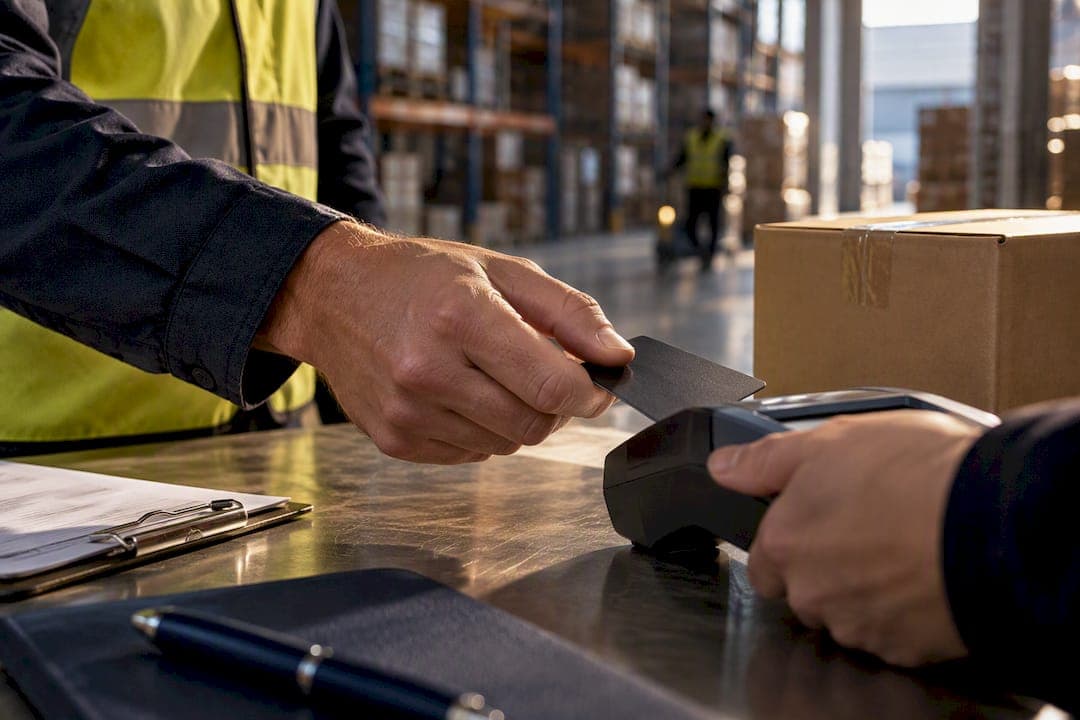
Large ticket interchange is a reduced, card-brand-published rate band that applies to qualifying high-value credit card transactions. Visa, Mastercard, Discover, and American Express each set thresholds and pricing tiers for these transactions, and merchants unlock the savings by submitting enhanced or Level 3 data at the point of sale. Skip that step and the transaction defaults to a standard, higher-cost rate.
TL;DR:
- Qualifying large-ticket transactions typically involve processing amounts between $5,000 and $25,000, with rates around 1.2% to 1.5%, significantly lower than standard commercial rates above 3%.
- Complete, structured Level 3 data submission—including order details, PO numbers, tax info, and line-item breakdown—is critical to unlocking large-ticket pricing advantages.
- Support from all processing points—POS, gateway, and acquirer—is necessary; missing or partial data can cause transactions to default to higher-cost rates.
- Using a network offset pricing model and verifying qualification through test batches can maximize savings and ensure transactions are correctly categorized.
- Large-ticket savings can reach hundreds of dollars per high-value invoice, with industries like B2B and government contracting benefiting most from proper qualification efforts.
Table of Contents
- What large ticket interchange is and how it differs from standard interchange
- Brand thresholds and example large ticket rate ranges
- How to qualify transactions for large ticket interchange
- Tactics merchants can use to reduce interchange on large-ticket sales
- Benefits and savings examples: quick ROI math for large ticket qualification
- How PaySec helps merchants capture large ticket savings
- Impact of large ticket interchange rates on merchant pricing and profitability
- Challenges and risks merchants face with large ticket transactions
- Industry trends and recent changes in large ticket interchange policies
- Comparison of interchange fees with other payment costs like processor fees
- How different industries commonly deal with large ticket interchange fees
- When to prioritize large-ticket optimization vs. other fee strategies
- Start capturing large ticket savings with PaySec
- Primary sources: card-brand rate tables and key references
- Sources
- FAQ
What large ticket interchange is and how it differs from standard interchange
Interchange is the fee card networks set and route to the cardholder's issuing bank on every transaction. It makes up the largest share of a merchant's total processing cost, well above the markup a processor or acquirer adds on top.
Card brands created large-ticket bands because high-value transactions carry a different risk and cost profile than everyday retail swipes. A $50 coffee purchase and a $50,000 equipment invoice do not cost the issuer the same amount to process, and a flat percentage on the larger sale would generate an outsized fee relative to the actual risk involved. Large-ticket pricing corrects for that.
A few factors shape whether a transaction qualifies:
- Transaction channel: Card-present swipes and dips process differently than card-not-present or keyed entries, which often carry higher risk pricing.
- Card product: Commercial and purchasing cards used for B2B and B2G buying tend to have their own interchange categories, separate from consumer rewards cards.
- Data completeness: The more transaction detail a merchant transmits, the more precisely the network can classify and price the sale.
Merchants that process occasional large invoices, rather than high-frequency small-ticket sales, are the ones most likely to see this pricing structure matter.
Brand thresholds and example large ticket rate ranges
Each network sets its own dollar threshold and rate table, and those figures are the ones merchants should check before assuming they qualify. According to Visa's interchange reimbursement fee tables, the Commercial Product Large Ticket rate is 1.30% plus $35.00, and the GSA Large Ticket rate is 1.20% plus $39.00. Mastercard's 2025-2026 U.S. Region interchange document lists tiered large-ticket bands, including Large Ticket 1 at 1.20% for transactions between $10,000 and $25,000, with lower percentage bands applying as transaction size increases.
Independent merchant guides describe large-ticket thresholds commonly starting somewhere between $5,000 and $10,000 depending on the network and card product, with qualifying rates often falling in the 1.2% to 1.5% range.
- Visa and Mastercard publish the authoritative rate tables; treat third-party summaries as directional, not final.
- Discover and American Express maintain their own large-ticket structures, separate from Visa and Mastercard's published bands.
- Rates and thresholds change periodically, so confirm current numbers against the brand's own document before pricing a large sale.
One data point worth remembering: Visa's Commercial Product Large Ticket rate sits at 1.30% plus $35.00, a fraction of what a standard commercial card transaction would cost at full retail interchange.
How to qualify transactions for large ticket interchange
Qualification is a data problem, not a negotiation. Networks reward transactions that arrive with complete, structured detail, commonly known as Level 3 or enhanced data.
- Capture merchant name and identifying details exactly as required by the card brand's specification.
- Include the customer's purchase order number when the buyer is a business or government entity.
- Break out line-item detail: item description, quantity, unit of measure, and unit price for each product or service sold.
- Report the tax amount separately from the order subtotal, along with a tax-exempt indicator where applicable.
- Submit order-level totals, including freight and duty amounts where relevant.
- Map commodity codes where the card product or buyer requires them, particularly for government and large enterprise purchasing cards.
The processing chain matters as much as the data itself. Your point-of-sale system, payment gateway, and acquirer all need to support Level 3 fields end to end. If any one link in that chain drops a required field, the transaction falls back to a higher-cost band regardless of what you originally submitted. Keyed transactions frequently fail qualification because they skip the structured data capture that swipe or integrated terminal flows handle automatically. Settling batches promptly and mapping the correct MCC for your business type also affects whether a transaction prices at the large-ticket rate or defaults higher.
Pro Tip: Run a test batch through your gateway and check the settlement report for a Level 3 confirmation flag before assuming your enhanced data actually reached the issuer.
Tactics merchants can use to reduce interchange on large-ticket sales
Lowering the cost of high-value transactions takes a combination of technology choices and process discipline.
- Submit Level 3 data end to end: confirm your POS, gateway, and acquirer all pass enhanced fields through without dropping any of them.
- Use tokenization and point-to-point encryption: reducing fraud exposure can influence how a transaction is priced within a given category.
- Cut manual and keyed entries: integrated terminal or card-present flows qualify more consistently than manually typed card numbers.
- Settle batches promptly: delayed settlement is one of the more common, avoidable reasons a transaction misses a qualifying window.
- Evaluate your pricing model: interchange-plus and network offset structures pass through the true published rate, while flat-rate pricing can mask whether you're actually capturing large-ticket savings.
Negotiating with a processor only moves the markup on top of interchange, since the interchange rate itself is set by the card brand. The real savings lever is qualification: getting the transaction data right so it prices into the lower band in the first place. Interchange fee education resources note that submitted data, card type, and transaction channel are the primary factors networks use to set the final rate, which puts most of the control back in the merchant's hands.
Pro Tip: Track your large-ticket qualification rate monthly. A drop usually points to a gateway update or MCC mismatch rather than a change in the card brand's published table.
Benefits and savings examples: quick ROI math for large ticket qualification
Consider a $10,000 sale. At a standard commercial card rate near 3.5%, that transaction costs $350 in interchange alone. At a qualifying large-ticket rate of roughly 1.2%, the same sale costs closer to $120, a difference of $230 on a single transaction.
Illustrative savings on a $10,000 sale: dropping from a 3.5% standard rate to a 1.2% qualifying large-ticket rate saves roughly $230 per transaction, and that gap compounds fast for merchants who process several high-value invoices a month.

The savings come from the network's own pricing logic, not from anything the merchant negotiates directly. For B2B and B2G sellers with recurring invoice cycles, qualifying consistently also tends to speed up reconciliation, since Level 3 data ties each payment to a specific order and line-item detail, which can shorten days sales outstanding for invoice-heavy operations.
How PaySec helps merchants capture large ticket savings
PaySec's case study on a wholesale distributor shows a 44% reduction in processing costs after implementing Level 3 optimization across the merchant's POS and gateway setup. A separate case study involving a CPA firm shows a 38% reduction in processing costs following interchange optimization on recurring client billing.
PaySec's relevant capabilities for large-ticket merchants include:
- Network Offset Pricing, which passes through the true published interchange rate instead of a blended markup.
- Enhanced Data Optimization, built to capture and transmit Level 3 fields across the processing chain.
- Merchant Services tailored to B2B and B2G billing patterns, including recurring and invoice-based flows.
Merchants who want to see where they stand can start by measuring their current large-ticket qualification rate against their published interchange spend.
Impact of large ticket interchange rates on merchant pricing and profitability
Interchange is a direct line item against gross margin, and for merchants who regularly process high-value transactions, the gap between a standard rate and a qualifying large-ticket rate can materially affect what a sale actually nets after fees. A distributor selling $15,000 orders on commercial cards absorbs a meaningfully different cost structure depending on whether that order qualifies for large-ticket pricing or defaults to standard commercial rates.
That cost pressure often shows up in how merchants price their products or structure payment terms. Some build the expected fee into list pricing, others pass a surcharge on card payments where permitted, and others push buyers toward ACH or bank transfer for the largest orders specifically to avoid interchange altogether. None of those choices are free of tradeoffs: surcharging can discourage card use among buyers who prefer the float or the rewards, while pushing invoices to ACH can slow payment for buyers accustomed to paying by card.
Profitability impact compounds with volume. A merchant processing a handful of large invoices a month feels a different effect than one running dozens, but in both cases the fee sits on top of already thin margins in wholesale, distribution, and professional services, where markups are often narrower than in retail. Getting large-ticket qualification right is less about a single transaction and more about protecting margin across every high-value sale that comes through the door over a full year.
Challenges and risks merchants face with large ticket transactions
High-value transactions carry higher stakes when something goes wrong. A dispute or chargeback on a $500 sale is a minor inconvenience; a dispute on a $50,000 order can tie up meaningful cash and staff time while it works through the resolution process.
Large-ticket sales also tend to draw more scrutiny from issuers and networks, particularly when a transaction is unusually large relative to a merchant's typical volume. That scrutiny can trigger holds, requests for documentation, or delayed funding while the issuer verifies the transaction is legitimate. Merchants who don't typically process large invoices may find their account flagged for review the first time a bigger-than-usual sale comes through.
Keyed and card-not-present transactions, common in B2B settings where the buyer calls in an order or pays through an emailed invoice link, carry higher fraud risk pricing and a higher likelihood of chargeback disputes since there's no physical card presentation to confirm the buyer's identity. Clear documentation, matching the PO number and order detail to the actual goods or services delivered, becomes the merchant's best protection if a dispute does arise.
Settlement timing adds another layer of risk. A transaction that qualifies for large-ticket pricing at authorization can still lose that qualification if it isn't settled within the window the card brand requires, pushing the cost back up after the fact and catching a merchant off guard during reconciliation.
Industry trends and recent changes in large ticket interchange policies
Card brands update their interchange tables on a recurring cycle, and large-ticket bands are part of that ongoing adjustment. Mastercard's 2025-2026 U.S. Region interchange document reflects the kind of periodic revision merchants should expect: tiered bands with specific dollar ranges and rates that shift from one publication cycle to the next.
One trend gaining traction is the move toward custom or value-based interchange programs rather than one-size-fits-all large-ticket bands. Visa-commissioned research found that 72% of suppliers said they would expand commercial card acceptance if fees were structured around value rather than a flat published rate. That finding points to growing appetite, on both the network and supplier side, for interchange arrangements tailored to specific buyer-supplier relationships rather than a generic large-ticket band applied uniformly.
Regulatory attention on interchange structures is also active outside the standard merchant fee conversation. Analysis of interchange caps in cross-border commerce shows how policy interventions can affect authorization rates and costs differently depending on jurisdiction, a reminder that interchange is not a static number but a policy lever that shifts with regulatory and network decisions. For merchants, the practical takeaway is the same regardless of which trend line moves: check the current published tables rather than relying on a rate you learned about a year or two ago.
Comparison of interchange fees with other payment costs like processor fees
Interchange is only one layer of what a merchant pays to accept a card. It's set by the network and passed through to the issuing bank, and no processor or acquirer controls that number directly.
On top of interchange sits the processor's own markup, which covers the acquirer's assessment fees, network dues, and the processor's margin. This is the layer that's actually negotiable, and it's where pricing models diverge. A flat-rate plan bundles interchange and markup into a single percentage, which is simple to understand but often hides whether a merchant is capturing large-ticket savings at all. An interchange-plus or network offset model separates the two, showing the true interchange rate and the processor's markup as distinct line items, which makes it far easier to confirm that a $20,000 sale actually priced at the qualifying large-ticket band rather than a standard rate with a thin markup layered on top.
Gateway fees, monthly account fees, and PCI compliance fees add further cost but sit outside interchange entirely. For a merchant evaluating total cost of acceptance, interchange remains the largest and least negotiable piece, which is exactly why qualification, submitting the right data to earn the lower published rate, matters more than trying to negotiate around a number the processor never set in the first place.
How different industries commonly deal with large ticket interchange fees
Wholesale distributors and manufacturers, who routinely invoice large B2B orders, tend to invest early in Level 3 data capture since their average ticket size makes the qualification gap worth the setup effort. Professional services firms, including accounting and legal practices billing large retainers or project fees, often see recurring billing cycles that make consistent enhanced-data submission particularly valuable since the same client relationship repeats month over month.
Healthcare providers billing large procedures or equipment purchases face a mix of card-present and invoice-based payments, and often route the largest transactions through ACH specifically to sidestep interchange altogether on amounts where the fee would otherwise be substantial. Government contractors selling to public sector buyers frequently encounter GSA-specific large-ticket rates and purchasing card requirements that differ from standard commercial card categories, making accurate PO and commodity code data especially important.
Retailers selling high-ticket goods like furniture, appliances, or specialty equipment tend to have lower transaction frequency but higher average order values, which puts them in a similar position to B2B sellers even though they're consumer-facing. Across all of these sectors, the common thread is that businesses processing occasional high-value transactions have the most to gain from getting large-ticket qualification right, while businesses running high-frequency, low-ticket volume typically find flat-rate simplicity a reasonable tradeoff instead.

When to prioritize large-ticket optimization vs. other fee strategies
Prioritize large-ticket work if you process occasional or recurring high-value B2B or B2G invoices, or run a costly commercial card mix. If your volume is high-frequency, low-ticket, flat-rate simplicity may serve better. Either way, test and measure before committing.
— PaySec Marketing Team
Start capturing large ticket savings with PaySec
PaySec's Network Offset Pricing passes through the true published interchange rate instead of folding it into a blended markup, so a qualifying large-ticket transaction actually prices like one.
If large invoices are a regular part of your business, the next step is to see what your current qualification rate looks like against the published rate tables. PaySec's Enhanced Data Optimization service helps map the right fields through your POS, gateway, and acquirer so transactions qualify consistently rather than by accident.
- Review current plan options on the PaySec pricing page.
- Explore the Network Offset Pricing model and how it applies to your transaction mix.
- Check available merchant services, including eCommerce gateway and in-store processing support.
Request a savings estimate and see where your large-ticket transactions currently stand.
Primary sources: card-brand rate tables and key references
For exact figures, go directly to the brands. Visa's interchange reimbursement fee tables and Mastercard's 2025-2026 U.S. Region rate document list current thresholds and bands. The Visa/Forrester custom interchange study offers context on B2B commercial card adoption.
- Visa's official rate tables cover Commercial Product and GSA Large Ticket pricing.
- Mastercard's rate document lists tiered large-ticket bands by dollar range.
- The Visa/Forrester study provides supplier-side context on custom interchange adoption.
Sources
- Visa USA Interchange Reimbursement Fees
- Drive commercial card growth with custom interchange (Visa / Forrester)
- Your Guide to Large Ticket Interchange (Credit Card Processing for High-Dollar Transactions)
FAQ
Why are interchange fees so high?
Interchange fees reflect the risk, cost, and card-product economics that issuing banks factor into every transaction, and rates vary by card type, merchant category, and how the transaction data is submitted. Large-ticket bands exist specifically because networks recognize that a flat percentage on a high-value sale would otherwise generate a disproportionate fee.
What is a good interchange rate?
A good rate depends on the transaction size and card product, but qualifying large-ticket transactions often land in the 1.2% to 1.5% range compared to standard commercial rates that can run well above 3%. Visa's Commercial Product Large Ticket rate of 1.30% plus $35.00 is one concrete published example.
What credit card has the highest interchange rate?
Rates vary by network, card product, and transaction type rather than by a single card being universally highest, and rewards and premium commercial cards generally carry higher interchange than basic consumer cards. Checking the specific brand's published rate table for the card product in question is the only reliable way to compare.
Who pays interchange fees?
The merchant accepting the card payment pays interchange, which the card network collects and routes to the cardholder's issuing bank. The processor or acquirer then adds its own markup on top, and that combined amount forms the total processing cost the merchant sees.
How can merchants qualify for large ticket interchange rates?
Merchants qualify by submitting complete Level 3 or enhanced data, including line-item detail, tax amount, and PO number, through a POS, gateway, and acquirer chain that all support those fields. Enhanced Data Optimization services are designed to help merchants map and transmit that data consistently.