

A payment gateway collects and encrypts card data at checkout; a payment processor routes and settles that transaction between banks. Most small businesses don't need to pick just one. They need a provider that handles both clearly, with transparent fees and reporting that shows exactly where the money goes. Before signing anything, verify how the fees are bundled and what kind of reporting you'll actually receive.
TL;DR:
- Most small businesses can reduce costs and simplify reconciliation by choosing a provider that handles both gateway and processing with transparent fees.
- Gateway fees often include flat monthly or per-transaction charges, while processing costs typically range from 1% to 3% of each sale, depending on pricing models.
- Clear transaction-level reporting that separates interchange from markup can help merchants identify fee leakage and make better pricing decisions.
- Integrated providers usually offer a single statement and support line, but separate vendors may be preferable for specialized fraud tools or specific POS needs.
- Accurate cost management depends on asking vendors for detailed fee breakdowns, real-time transaction reports, and transparency around reserve policies and settlement timing.
Table of Contents
- What Is a Payment Gateway?
- What Is a Payment Processor?
- How Does a Transaction Flow From Capture to Settlement?
- Gateway vs Processor: Key Differences at a Glance
- Costs, Fees, and Settlement Timing: What to Budget For
- Integration Types and Operational Tradeoffs
- How Should You Choose a Gateway and Processor?
- PaySec's Approach to Gateway and Processor Decisions
- An Editorial Take on Choosing Your Payment Stack
- See Your Real Processing Costs With Paysec
- Sources
- FAQ
What Is a Payment Gateway?
A payment gateway is the front-end tool that captures a customer's card details, encrypts them, and forwards them for authorization. Think of it as the digital cashier: it never touches settlement, but it decides how safely and smoothly a sale gets captured in the first place. NerdWallet's breakdown of gateways and processors confirms this narrow but critical job. It collects and encrypts the customer's card information, then sends it on to a processor for approval.
Gateways show up in three common forms:
- Hosted redirect: the customer leaves your site briefly to enter payment details on the provider's secure page.
- Embedded fields: card fields live directly on your checkout page but are tokenized so raw card data never touches your servers.
- POS readers: physical terminals that capture card data in person and encrypt it before it leaves the device.
Security is where gateways earn their keep. Encryption and tokenization strip usable card data out of the equation almost immediately, which shrinks how much of your systems fall under PCI DSS scope. That distinction matters for your compliance workload, not just your checkout page.
Pro Tip: Ask any gateway vendor exactly which parts of your checkout stay outside PCI scope after tokenization. The answer tells you how much audit work you're avoiding.
Fee models vary. Some gateways charge a flat monthly platform fee, others charge per-transaction, and some blend both. Gateway fees often appear as a separate line item from your processor's markup, which is one reason statements can look confusing until you know what you're reading.
What Is a Payment Processor?
A payment processor is the back-end engine that moves a transaction from your gateway to the card networks and issuing banks, then handles authorization and settlement. Forbes Advisor's comparison of the two roles describes the processor as the party that transmits card data between merchant, network, and issuing bank, and manages the money's actual movement.
Merchants generally access processing through one of two structures: a dedicated merchant account tied to your business specifically, or a payment service provider (PSP) model where you share an aggregated account with other merchants. Dedicated accounts tend to offer better rates at volume; PSP models trade some pricing leverage for faster setup.
Processors typically handle:
- Authorization requests and real-time approval or decline responses
- Settlement and batch reconciliation at the end of each business day
- Dispute and chargeback management
- Refund processing
- Transaction-level reporting
A quick statistic worth knowing: merchants commonly pay a total cost, often called the merchant discount rate, that lands somewhere around 1% to 3% of each sale, depending on interchange costs and whatever markup the processor and gateway add on top. Pricing models range from flat-rate (simple, but often costlier at volume) to tiered (opaque) to interchange-plus (transparent, cost-plus pricing that shows the real interchange rate separately from markup). The pricing model you pick shapes your margin more than almost any other single decision in your payment stack.
How Does a Transaction Flow From Capture to Settlement?
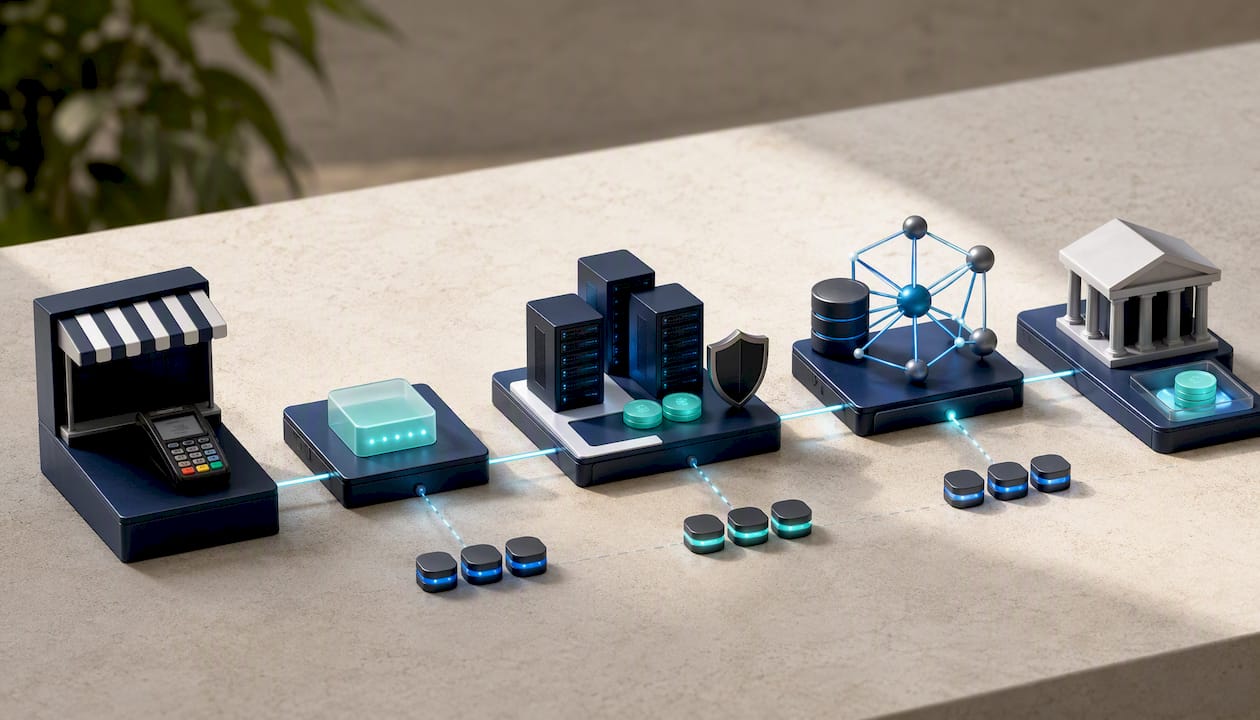
A single card swipe or checkout click triggers a chain of handoffs that usually completes in under two seconds, even though it touches four or five separate systems along the way.
- Capture: the customer enters card details at your POS terminal, hosted checkout, or embedded field.
- Encryption: the gateway encrypts and often tokenizes that data immediately.
- Routing: the processor receives the encrypted data and routes it to the correct card network.
- Network transmission: Visa, Mastercard, or another network passes the request to the issuing bank.
- Issuer decision: the issuing bank checks funds, fraud flags, and account status, then approves or declines.
- Response: the decision travels back through the network, processor, and gateway to your checkout screen, typically in one to two seconds.
- Settlement: approved transactions batch up and move funds from the issuing bank to your merchant account, usually within one to three business days.
Fraud screening and tokenization both happen early, right around steps two and three, which is why a weak gateway can create fraud exposure no processor can fix downstream. Chargeback triggers, by contrast, surface much later, often weeks after settlement, when a cardholder disputes a charge with their issuing bank.
The most common failure points aren't dramatic outages. They're mismatched batch times, delayed settlement due to reserve holds, or a gateway timeout that a merchant never notices until reconciling reports at month's end. Good transaction-level reporting catches these before they become cash flow problems.
Gateway vs Processor: Key Differences at a Glance
The functional split comes down to who touches what, and who's accountable when something breaks.
- Data capture and encryption: handled by the gateway, not the processor.
- Routing and authorization: handled by the processor, in partnership with card networks.
- Settlement and funding: the processor's job, working with your merchant account or acquiring bank.
- Chargeback and dispute handling: almost always the processor, since disputes flow through the merchant account.
- PCI compliance scope: shared, but tokenization at the gateway level reduces how much of your systems the standard actually covers.
Bundling changes the economics more than it changes the technology. When one provider handles both gateway and processing, you get one statement, one support line, and usually clearer pricing since there's no second vendor adding its own markup on top. Separate vendors can still make sense for merchants who need a specialized fraud engine or a gateway built for a specific POS ecosystem, but that setup means reconciling two fee schedules and two support relationships instead of one.
A standalone gateway generally makes sense when you already have a processing relationship you like and just need better checkout tooling. An integrated provider makes more sense when you're starting fresh or want a single point of accountability for reporting and settlement.
Costs, Fees, and Settlement Timing: What to Budget For
Three layers stack up on every transaction: interchange (set by the card networks and paid to the issuing bank), processor markup, and gateway fees. Interchange plus markup typically lands in the 1% to 3% range per transaction, though your actual rate depends on card type, industry risk category, and transaction volume.
- Interchange: non-negotiable, set by Visa, Mastercard, and other networks based on card type and merchant category.
- Processor markup: negotiable, and the biggest lever you have for lowering total cost.
- Gateway fees: often a flat per-transaction or monthly charge layered on top.
- Chargeback and refund fees: typically $15 to $25 per dispute, charged by the processor regardless of outcome.
Settlement timing ranges from same-day to two or three business days, and that gap directly affects how much cash you have on hand to cover payroll or inventory. A restaurant running tight margins feels a three-day settlement delay very differently than a SaaS company with predictable recurring revenue.
Pricing transparency options like interchange-plus and network-offset pricing separate the non-negotiable interchange cost from the markup, so you can actually see what you're paying for. Fee-optimization research from Forbes Advisor makes a point worth internalizing: chasing the cheapest gateway fee rarely moves the needle as much as fixing markup transparency across the whole stack. Merchants who focus on the full picture, not just one line item, tend to find the real savings.
Integration Types and Operational Tradeoffs
Your sales channel decides which integration makes sense, and getting this wrong is the most common reason merchants end up mid-project with a half-finished checkout.
- POS-embedded gateways work best for brick-and-mortar and restaurant counters, where the gateway lives inside the terminal itself.
- Hosted or redirect checkout suits merchants who want the fastest path to accepting payments online with minimal development work.
- API or embedded-field integrations fit businesses that want a fully branded checkout experience and have developer resources to build it.
- White-label integrations work for platforms or software companies that want to offer payments under their own brand.
Most major ecommerce platforms offer plugins or extensions for common gateways, which cuts custom development time substantially. Tokenization and hosted fields also do real work here: they pull raw card data out of your servers entirely, shrinking your PCI audit scope regardless of which integration type you choose. And as POS systems increasingly ship with gateway technology built in, the line between "in-person" and "online" payment handling keeps getting blurrier, which is good news for merchants who sell across both.
How Should You Choose a Gateway and Processor?
Run every vendor through the same six criteria: pricing transparency, reporting detail, settlement timing, experience in your vertical, PCI scope reduction, and chargeback handling. A vendor that scores well on five but stays vague on pricing structure isn't actually transparent.
Ask vendors these questions directly:
- What's the full fee breakdown, including interchange, markup, and any gateway charges?
- Are there reserves or rolling holds on my funds, and under what conditions?
- What's the realistic onboarding timeline from signed agreement to first live transaction?
- How often will I receive transaction-level reports, and in what format?
- What's the service-level agreement for refund and dispute resolution?
Watch for red flags: opaque fee schedules that bury markup inside a blended rate, long-term contract minimums that penalize you for growing slower than projected, and reporting dashboards that only show totals instead of per-transaction detail.
Pro Tip: Request a sample of actual transaction-level reporting before you sign anything, and push for interchange-plus pricing wherever the vendor offers it. Seeing real reports beats trusting a sales deck.
PaySec's Approach to Gateway and Processor Decisions
An innovative Network Offset Pricing model has been built around the exact transparency problem this article keeps circling back to: merchants losing track of where fees come from. That model has helped merchants cut processing costs by 30% to 60%, with some seeing reductions as high as 42%, by separating true interchange cost from markup instead of blending them into one confusing rate.
Fee transparency isn't a feature. It's the difference between guessing your margins and knowing them. Merchants who can see every line item on every transaction make better pricing decisions across their entire business, not just at checkout.
A bundled gateway and processing integration with detailed, real-time transaction reporting removes the reconciliation headache of managing two vendors and two statements. There are no long-term contracts and no minimums, so onboarding can start without a rigid rollout timeline standing in the way.
An Editorial Take on Choosing Your Payment Stack
Speed to market usually favors a bundled provider. Specialized fraud tooling or complex omnichannel setups sometimes justify separate vendors. Either way, pull your current transaction-level reports and ask any prospective vendor for a real interchange-plus sample before switching. Validate savings with your own numbers, not a sales projection.
— PaySec Marketing Team
See Your Real Processing Costs With Paysec
Some providers give merchants a single bundled service with fees traceable transaction by transaction. A pricing approach that separates true interchange cost from markup on every sale can address the transparency gap this guide has been pointing at.
There can be no long-term contract, no minimum volume requirement, and reporting detailed enough to catch fee leakage before it eats into margin. If you run a home services business, the dedicated payment processing built for HVAC, plumbing, and electrical merchants applies the same model to your billing cycle. For a closer look at what your current gateway and processor combination is really costing you, visit Paysec's merchant services page and request a sample of your transaction-level reporting.
Sources
- Payment Gateway vs. Payment Processor: What’s the Difference? - Forbes Advisor
- Payment Gateway vs. Payment Processor: The Difference - NerdWallet
FAQ
Is Visa a Payment Gateway or a Processor?
Neither. Visa is a card network that sits between the processor and the issuing bank, setting interchange rates and routing authorization requests, but it doesn't capture card data or hold merchant accounts the way a gateway or processor does.
Is Clover a Gateway or a Processor?
Clover is primarily a point-of-sale system with embedded gateway technology built in, and it works alongside a processing partner to complete the transaction. It's not a standalone processor on its own.
Is Fiserv a Payment Processor or a Gateway?
Fiserv operates as a payment processor, handling transaction routing, authorization, and settlement for merchants, and it also offers gateway capabilities through its broader product suite.
Do I Need Both a Gateway and a Processor?
Yes, virtually every card transaction requires both functions to complete, but most merchants get both from a single bundled provider rather than managing two separate vendor relationships.
Which Costs More: the Gateway or the Processor?
There's no fixed answer since fee structures vary by provider, but total costs typically land between 1% and 3% per transaction once interchange, processor markup, and gateway fees are combined.