
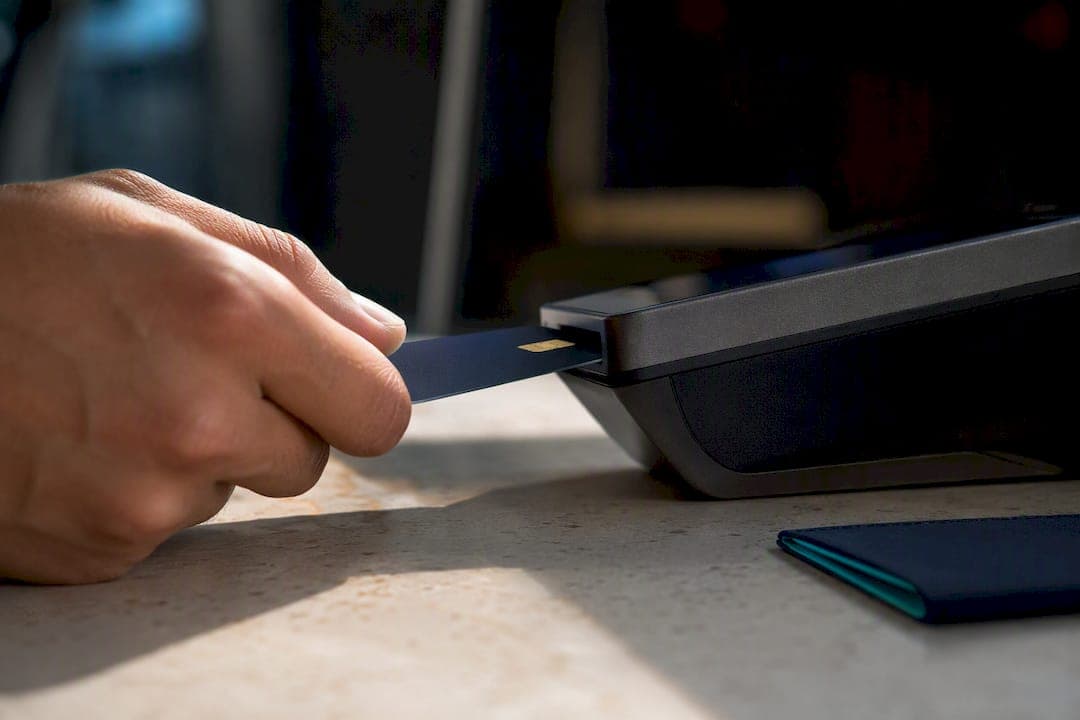
The fastest safe way to accept EMV chip cards is to enable a certified EMV terminal, add a standalone or mobile EMV device, or integrate EMV through a payment gateway's SDK. Each route protects you from counterfeit-fraud liability, cuts card-present fraud exposure, and builds customer trust at checkout. Your next move: confirm your current terminal's certification status and contact your payment processor, or Paysec, to activate EMV acceptance this week.
TL;DR:
- Using certified EMV terminals or SDK integration shifts counterfeit fraud liability back to the issuer and reduces card-present chargebacks significantly.
- Certification involves three levels, with your acquirer managing the most complex Level 3 testing, making vendor choice crucial to avoid delays.
- Integration options range from standalone terminals for quick deployment to SDK and gateway solutions, selected based on transaction complexity and system needs.
- Implementation costs and timelines vary: standalone terminals can be operational in days, while full POS integrations may take weeks to months.
- Pairing EMV acceptance with 3D Secure protects against both counterfeit and card-not-present fraud, enhancing overall payment security.
Table of Contents
- Why EMV Integration Matters for POS Liability and Fraud
- What Are the Integration Options for EMV Payments?
- How Does EMV Certification Work for POS Systems?
- What's the Timeline and Cost for EMV Deployment?
- PaySec's Take on Simplifying EMV Enablement
- What Actually Matters When You Integrate EMV Payments
- Get EMV Acceptance Running With Paysec
- Sources
- FAQ
Why EMV Integration Matters for POS Liability and Fraud
The October 2015 liability shift changed who pays when a counterfeit card gets used at your register. If your terminal cannot read a chip and a customer's counterfeit card gets swiped instead of dipped or tapped, the chargeback liability generally lands on you, not the card issuer. The U.S. Payments Forum's liability shift white paper walks through the network-by-network scenarios, and the rules vary enough by card brand that verifying details with your acquirer beats assuming blanket protection.
EMV chip technology stops a specific kind of fraud: counterfeit cards used in person. It does nothing for card-not-present fraud, which is why 3D Secure authentication still matters for online orders. Visa's own liability guidance confirms that liability outcomes hinge on both card and terminal capability, not just one side of the transaction.
Fraud reporting has climbed into the millions of incidents a year according to the FTC's Consumer Sentinel Network data, which is exactly why liability protection carries real weight for a retailer or restaurant operator.
What EMV integration for POS actually buys you:
- Liability protection on card-present counterfeit fraud, shifting risk back to the issuing bank in most network scenarios
- Lower chargeback volume since chip transactions are far harder to counterfeit than magnetic stripe cards
- Faster PCI conversations with your acquirer, since EMV-capable hardware often satisfies part of their risk checklist
- Customer confidence at checkout, since chip and tap acceptance is now the expected standard
Pro Tip: Don't assume EMV alone covers you. Pair chip acceptance with 3D Secure 2 for your online channel so counterfeit and card-not-present fraud are both addressed.
What Are the Integration Options for EMV Payments?
Choosing how to integrate EMV payments depends on how much your POS software needs to know about the transaction, and how much time your team has to spend on it.
- Standalone certified EMV terminals run independently of your POS software. You key or import the total, the terminal handles the chip read, and it hands back an approval code. This route suits small retailers, pop-ups, and any business that wants EMV acceptance running within days rather than weeks.
- Integrated EMV POS terminals talk directly to your point-of-sale software, so a chip transaction updates inventory, ties to a specific order, and prints a unified receipt. Restaurants and multi-register retail stores generally need this depth of integration to keep tickets, tips, and stock counts synced.
- Middleware and SDK integration puts a software layer between your POS application and the terminal's payment kernel. Tools like Payment SPI, CommerceDriver, and various vendor SmartPOS SDKs abstract away hardware differences, so your developers write one integration instead of one per terminal brand.
- Gateway or API integration hands EMV processing to the payment gateway itself. The gateway manages the chip flow and returns the required EMV receipt fields to your POS, which is often the quickest path for eCommerce-adjacent businesses adding in-person acceptance. A gateway integration example shows how this handoff typically works in practice.
- SoftPOS and tap-to-phone acceptance turn an NFC-enabled smartphone or tablet into a card reader. EMVCo's contact kernel approval process now supports TapToMobile certification, but confirm your specific software has that certification before relying on it for chip and tap transactions.
Retailers juggling inventory systems tend to land on integrated POS terminals, while service businesses running a single register often start with a standalone unit and grow into deeper integration later. A retail POS integration guide walks through how inventory and EMV acceptance typically connect for multi-location operators.
How Does EMV Certification Work for POS Systems?
EMV certification runs through three testing levels, and knowing which one applies to your project saves weeks of confusion. Level 1 tests the physical and electrical communication between the card and the terminal. Level 2 tests the kernel, the software logic that actually processes the chip data. Level 3 tests the full, end-to-end integration between your specific terminal, its kernel, and the payment network. The EMVCo approvals and evaluations documentation breaks down exactly what each level covers and who holds responsibility for it.
Your terminal vendor typically owns L1 and L2 certification before you ever buy the hardware. Your acquirer or payment processor usually manages L3 testing, since that step confirms the terminal works correctly on their specific network rails. This is why choosing an acquirer with an established certification track record removes a real integration headache before it starts.
Your POS also needs to handle specific EMV data correctly, not just process the payment:
- EMV tags carrying application identifiers, cryptogram data, and terminal verification results
- Cardholder Verification Method (CVM) results, showing whether a PIN, signature, or no verification was used
- POS entry mode codes, distinguishing chip, tap, swipe, and manual entry for reporting and dispute purposes
- Receipt fields required by network rules, including the application label and, in most cases, the AID
Two integration patterns cover most deployments. Delegated processing lets the gateway or processor handle the entire EMV flow and simply return a result to your POS, which is lighter on your development team. POS-hosted processing has your application talk to the terminal's SDK directly, giving you more control over the checkout experience at the cost of more integration work.
Pro Tip: Before going live, run transactions through a staged test merchant profile using your processor's approved test cards. This catches receipt formatting and CVM handling errors before a real customer ever sees them.
What's the Timeline and Cost for EMV Deployment?
Budget and timeline both scale with how deep the integration goes, and setting expectations up front prevents a rollout from stalling halfway through.
- Audit current hardware. Confirm which terminals are already EMV-capable and which need replacement or a firmware update.
- Confirm certification status with your processor, since an uncertified terminal cannot process chip transactions even if the hardware technically supports it.
- Pick your integration route from standalone, integrated POS, SDK, or gateway based on how tightly you need payment data tied to your other systems.
- Update receipt templates to include the required EMV fields before your pilot goes live.
- Run a pilot at one register or location to catch formatting and workflow issues early.
- Train staff on chip insertion, tap acceptance, and how to handle a declined or fallback transaction.
- Roll out in phases across remaining registers or locations once the pilot runs clean.
A standalone terminal swap can be live in days to a couple of weeks. Integrated POS with SDK work usually runs weeks to a few months, depending on developer availability. A full POS platform replacement stretches into months once you factor in staff training and data migration.
The upside on cost: reduced counterfeit chargebacks and better interchange qualification on chip transactions tend to offset integration spending within the first year for most mid-volume merchants.
PaySec's Take on Simplifying EMV Enablement
An integrated payments partner removes most of the friction from EMV enablement. Paysec supplies EMV-certified terminals, a developer-friendly gateway, and integration documentation that shortens the path from decision to live acceptance. Merchants across 18+ industries have used Network Offset Pricing to cut processing costs by 30 to 60 percent while adding EMV acceptance, with no long-term contract locking them into a single hardware path. If you're scoping certification or a pilot deployment, that's the conversation worth having first.
What Actually Matters When You Integrate EMV Payments
Most EMV advice online treats certification as the hard part. It isn't. The real friction shows up in receipt formatting, staff training on fallback transactions, and picking an integration pattern that matches how your business actually operates, not how a vendor's default setup assumes it does.
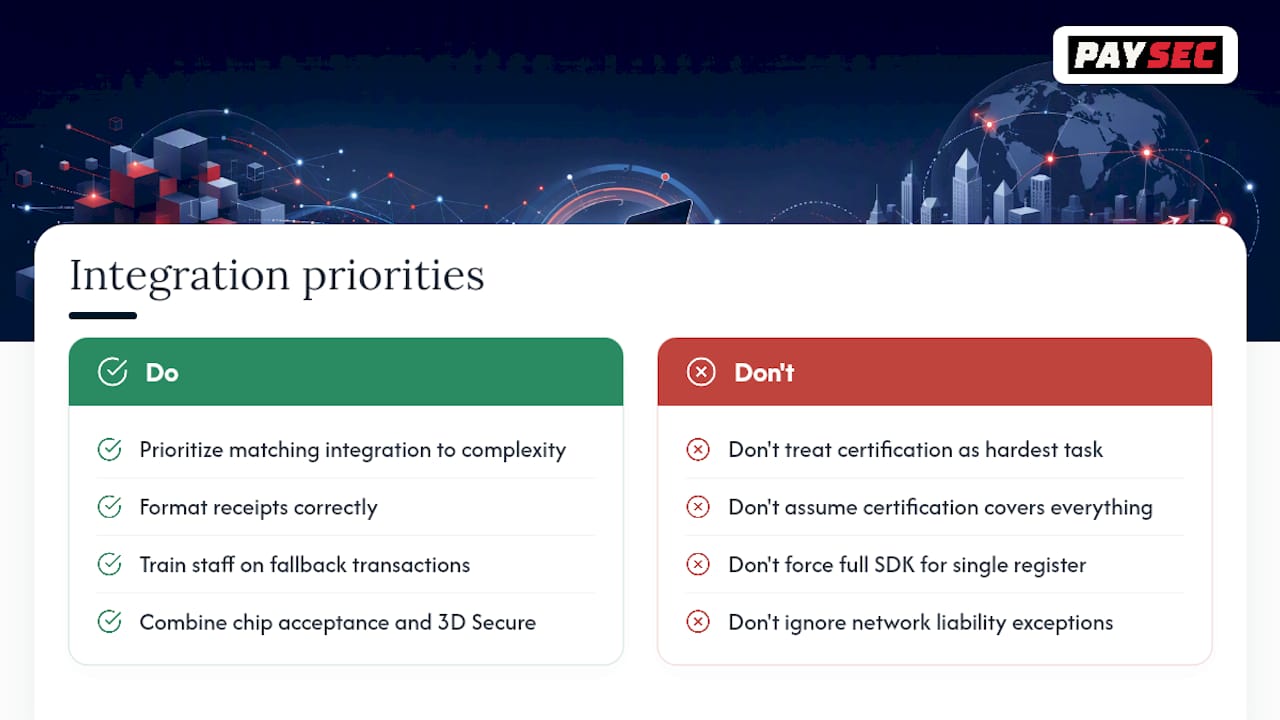
The conventional wisdom says "get EMV certified and you're covered." That's incomplete. Liability shift rules carry network-specific exceptions, and EMV was never built to stop card-not-present fraud, so a merchant running both a storefront and an online store needs chip acceptance and 3D Secure working together, not one or the other.
Prioritize the integration route that matches your transaction complexity today, not the one that sounds most future-proof. A single-register retailer forcing through a full SDK integration wastes months solving a problem a standalone terminal solves in a week. Save the deeper integration work for the point where inventory sync, multi-location reporting, or custom checkout flows actually demand it.
— PaySec Marketing Team
Get EMV Acceptance Running With Paysec
Paysec is the direct route to EMV acceptance without the delay of piecing together hardware, a gateway, and certification paperwork from separate vendors. Merchant Services covers in-store processing, an eCommerce gateway, mobile payments, and recurring billing under one account, so your EMV terminal and your online checkout report through the same dashboard instead of three disconnected systems.
Terminal placement is available through Free Placement, which can help reduce upfront hardware cost during an EMV rollout. Add transparent Network Offset Pricing with no minimums and no long-term contract, and you get real-time transaction reporting on every chip, tap, and card-not-present sale from day one. Visit the terminals page to check hardware options, or reach out to scope your EMV pilot and get a merchant account moving this week.
Sources
- EMV chips & the liability shift (Chargeback Gurus)
- EMV fraud liability shift (U.S. Payments Forum)
- EMVCo approvals and evaluations eBook (EMVCo)
- Visa liability shift (Visa)
FAQ
How Do You Integrate EMV Into an Existing POS?
Audit your current terminal's certification status first, then choose a standalone terminal, an integrated POS terminal, or a gateway/SDK approach based on how much payment data needs to sync with your other systems. A retail POS integration guide shows a typical path from audit to live acceptance.
Is EMV the Same as NFC?
No. EMV refers to the chip standard and its certification framework, while NFC is the wireless technology behind tap-to-pay and mobile wallets. A single EMV-certified terminal often supports both chip-and-dip and NFC tap transactions.
What Does EMV Stand For?
EMV stands for Europay, Mastercard, and Visa, the three networks that created the global chip card standard now managed by EMVCo. The name stuck even though the standard now covers many more card networks.
Can an ATM Support EMV Chip Technology?
Yes. Most modern ATMs are EMV-capable and read the chip the same way a POS terminal does, verifying the card's cryptogram before authorizing a withdrawal. ATM operators face similar liability-shift rules to POS merchants when their machines lack EMV support.
How Much Does It Cost to Add EMV Acceptance?
Costs depend on the integration route: a standalone terminal is typically the cheapest and fastest option, while SDK or full POS integration takes more developer time and budget. Paysec's terminal placement starts at $0 per month, and full pricing details are available on the Paysec pricing page.