

TL;DR:
- Most new U.S. small-business owners prefer forming an LLC due to its liability protection, simple paperwork, and flexible tax options. However, startups planning outside investment or stock options often choose a C-corp for easier fundraising and ownership transfers. Both structures limit personal liability but differ significantly in taxation, management, and compliance requirements.
For most new U.S. small-business owners, an LLC is the better starting point. It offers the same liability protection as a corporation with far less paperwork, flexible tax treatment, and no requirement for annual shareholder meetings or formal minutes. If you plan to raise venture capital or issue stock options to employees, a C-corp becomes the stronger choice.
TL;DR:
- Taxation: LLCs default to pass-through taxation; corporations default to C-corp double taxation unless you elect S-corp status via IRS Form 2553.
- Investor readiness: VCs and angel investors strongly prefer corporations because of stock classes and equity mechanics.
- Compliance burden: Corporations require annual meetings, minutes, and bylaws enforcement; LLCs set their own rules through an operating agreement.
- Ownership flexibility: Transferring LLC membership typically requires member consent; corporate shares transfer freely.
- Formation: Both require state filing, but the SBA notes that LLCs generally involve fewer ongoing formalities.
| Dimension | LLC | Inc (Corporation) |
|---|---|---|
| Taxation | Pass-through (default) | C-corp double tax or S-corp pass-through |
| Liability | Limited for members | Limited for shareholders |
| Formation cost & speed | Lower fees, faster in most states | Slightly higher fees, more documents |
| Management & governance | Flexible; governed by operating agreement | Board, officers, bylaws, formal meetings |
| Raising capital | Membership units; complex for VCs | Stock issuance; preferred by investors |
| Ongoing compliance | Annual report, state fees | Annual report, meetings, minutes, fees |
Table of Contents
- What an LLC and a corporation actually are
- How to form an LLC vs. a corporation: steps, fees, and timelines
- What liability protection actually covers — and where it stops
- How taxation works for LLCs and corporations
- How management, ownership, and control differ
- Raising money and transferring ownership
- Ongoing compliance: what you need to do every year
- Pros, cons, and who each structure fits best
- Decision checklist: how to choose the right structure
- Can you convert an LLC to a corporation (or vice versa)?
- Ownership eligibility and restrictions you need to know
- How state laws shape your LLC or corporation choice
- Key Takeaways
- Which entity fits your payment operations?
- Useful sources
- FAQ
What an LLC and a corporation actually are
An LLC (limited liability company) is a state-registered business entity that separates personal assets from business liabilities. Owners are called members, and the business is governed by an operating agreement rather than a formal corporate charter. To form one, you file Articles of Organization with your state's Secretary of State. A single-member LLC is treated as a disregarded entity by the IRS by default; a multi-member LLC is treated as a partnership.

A freelance consultant, a real estate investor holding a rental property, or a small retail shop often chooses an LLC because the structure is straightforward and the tax filing stays simple.
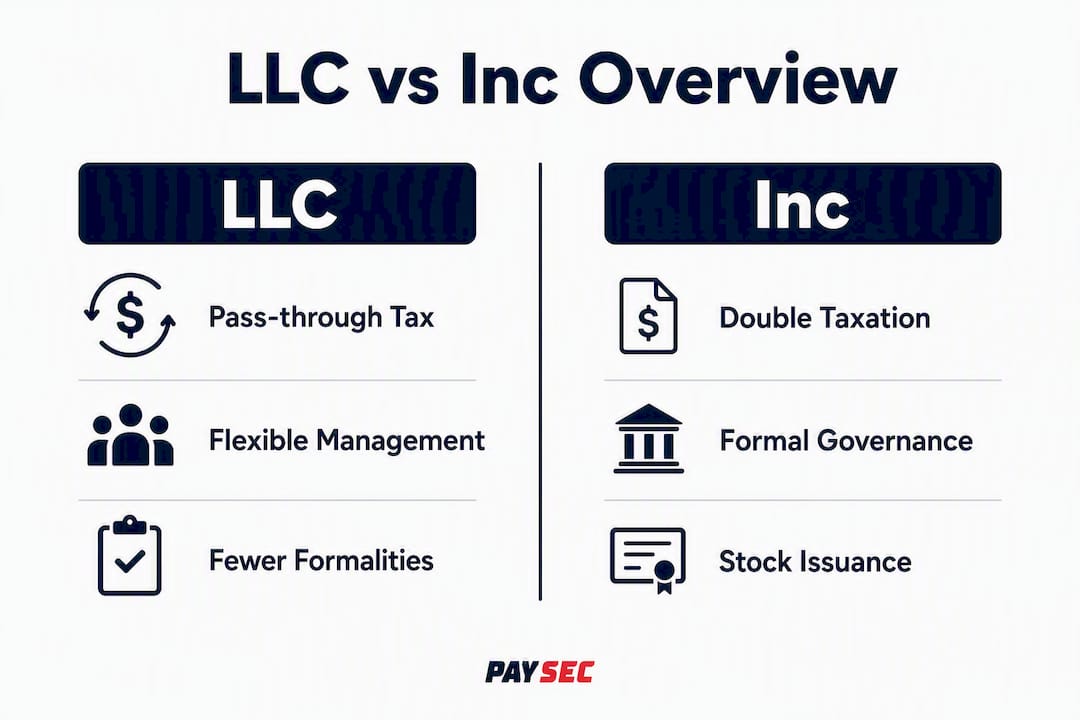
An Inc. is a corporation, a separate legal entity created by filing Articles of Incorporation. Owners are shareholders, and the company is governed by a board of directors, officers, and formal bylaws. Corporations come in two main tax flavors: a C-corp (the default, subject to corporate income tax) and an S-corp (pass-through taxation, elected via IRS Form 2553). A tech startup planning to raise a seed round, or any business that wants to issue stock options to employees, typically chooses a corporation.
Both structures create a separate legal entity and provide limited liability protection, but they differ significantly in taxation, management structure, ownership transfer rules, and compliance requirements.
How to form an LLC vs. a corporation: steps, fees, and timelines
Forming an LLC
- Obtain an EIN — Apply free at IRS.gov. Required for taxes, bank accounts, and hiring.
Forming a corporation
- Choose your state. Delaware is the dominant choice for startups seeking outside investment because of its well-developed corporate law.
- File Articles of Incorporation. Includes the company name, registered agent, authorized shares, and incorporator details. Fees are similar to LLC filing fees but vary by state.
- Appoint an initial board of directors.
- Draft and adopt bylaws. Bylaws govern how the corporation operates: meeting procedures, voting rights, officer roles.
- Issue stock to founders. Document the initial stock issuance and maintain a cap table.
- Appoint a registered agent.
- Obtain an EIN and open a business bank account.
- Hold an organizational meeting. Adopt bylaws, elect officers, and record minutes.
Formation typically takes a few business days to a few weeks depending on the state and whether you use expedited processing. LLCs are often simpler and cheaper to run than corporations, though both carry recurring state fees and reporting obligations.
What liability protection actually covers — and where it stops
Both LLCs and corporations shield owners from personal responsibility for most business debts and legal judgments. If your business is sued, creditors generally cannot come after your personal bank account, home, or car. That protection is real and valuable.

But it has limits every owner should know.
Personal guarantees are the most common override. Lenders frequently require owners to sign personal guarantees on business loans or credit lines, making them personally liable regardless of entity type. The entity structure does not change what you signed.
Piercing the corporate veil is the legal doctrine that lets courts hold owners personally liable when they blur the line between personal and business finances. Commingling funds, failing to maintain separate accounts, or ignoring required formalities are the most common triggers.
Unpaid payroll taxes are another exception. The IRS can pursue responsible individuals personally for trust fund taxes (employee withholdings) regardless of entity type.
Fraud and intentional misconduct are never shielded by any business entity.
Some states treat LLCs as limited-life entities that can dissolve on a member's departure unless the operating agreement explicitly provides for continuity. This is an operational risk that owners often overlook entirely.
Pro Tip: Draft your LLC operating agreement to include explicit continuity and transferability clauses. Without them, a member's exit could trigger state-mandated dissolution and force a costly reformation.
How taxation works for LLCs and corporations
Tax treatment is often the deciding factor between these two structures.
LLC tax defaults
- Single-member LLC: Treated as a disregarded entity; income and expenses report on Schedule C of the owner's personal return.
- Multi-member LLC: Treated as a partnership by default; files Form 1065 and issues K-1s to members.
- Self-employment tax: LLC members who are active in the business pay self-employment tax (currently 15.3% on the first portion of net earnings) on their share of profits.
Corporation tax defaults
- S-corp: — Profits pass through to shareholders' personal returns, avoiding double taxation. Requires filing IRS Form 2553 to elect S-corp status.
The S-corp election and self-employment tax savings
An LLC can elect S-corp tax treatment using IRS Form 2553, which changes payroll and self-employment tax outcomes compared with default pass-through status. Here is a simplified example of how that works:
An LLC owner earning $120,000 in net profit pays self-employment tax on the full amount under default treatment. After an S-corp election, the owner pays themselves a reasonable salary (say, $70,000), pays payroll taxes only on that salary, and takes the remaining $50,000 as a distribution not subject to self-employment tax. The savings on that $50,000 can be meaningful, though you must weigh them against the added cost of running payroll and filing a corporate tax return.
For a deeper look at S-corp vs. LLC tax mechanics, The Tax Refinery's comparison is a useful resource.
State-level taxes
State tax treatment adds another layer. Some states charge annual fees or franchise taxes that can exceed $800, sometimes regardless of whether the business is profitable. California is a well-known example, with an $800 minimum annual franchise tax for LLCs. These recurring costs can shift the math on which entity is cheaper to maintain over time.
Processing fees are also a deductible business expense once your entity is active. See how processing fees interact with your tax picture as your business scales.
How management, ownership, and control differ
LLC governance
LLCs are either member-managed (all members share in day-to-day decisions) or manager-managed (members delegate authority to one or more managers, who may or may not be members). The operating agreement defines everything: who can sign contracts, how profits are split, what vote is needed to admit a new member, and what happens if a member wants to exit.
This flexibility is a genuine advantage for small teams. Two co-founders can structure profit splits that do not mirror ownership percentages, something a corporation cannot do as cleanly.
Transferring a membership interest usually requires the consent of other members unless the operating agreement says otherwise. A new person can receive economic rights (a share of profits) without automatically becoming a voting member.
Corporate governance
Corporations require formal governance: a board of directors sets policy and hires officers; officers run day-to-day operations; shareholders vote on major decisions at annual meetings. Minutes must be kept. Bylaws must be followed.
Corporate shares transfer freely unless a shareholder agreement restricts them. This makes it straightforward to bring in investors, grant stock options, or sell the company.
A practical example: If a corporation wants to hire a new CEO, the board votes, records the decision in minutes, and the officer is appointed. In an LLC, the operating agreement dictates who has authority to hire senior management, and the process can be as formal or informal as the members agreed to when they drafted it.
Raising money and transferring ownership
Fundraising mechanics are where corporations have a clear structural edge.
Why investors prefer corporations:
- Corporations can issue multiple classes of stock (common and preferred), which is the standard mechanism for venture capital investment.
- Stock options and equity compensation plans (like ISOs under an incentive stock option plan) are straightforward in a corporation and complicated in an LLC.
- Most VC funds are structured as pass-through entities themselves and cannot hold interests in other pass-through entities (like S-corps or LLCs taxed as partnerships) without tax complications.
- Convertible notes and SAFEs (Simple Agreements for Future Equity) are designed for corporations.
If you expect to raise venture capital or issue different classes of stock, a C-corp is generally the preferred structure because it supports stock issuance and investor-friendly equity mechanics.
How LLCs handle investment:
LLCs can accept outside investment through membership units or profits interests, but the documentation is more complex, and many institutional investors will ask you to convert to a corporation before they write a check. For bootstrapped businesses, angel investors, or friends-and-family rounds, an LLC often works fine.
Bank lending: Both entity types can obtain business loans. Lenders typically require an EIN, business bank account, and operating history regardless of structure. Personal guarantees are common for early-stage businesses in either structure.
Ongoing compliance: what you need to do every year
Both entities require recurring attention to stay in good standing.
Common to both:
- Maintain a registered agent with a physical address in the state of formation.
- File an annual report (or biennial report, depending on the state) and pay the associated fee.
- Pay state franchise taxes or minimum fees where applicable.
- Renew business licenses relevant to your industry.
Corporation-specific requirements:
- Hold annual shareholder meetings and board meetings.
- Record and retain minutes of those meetings.
- Enforce bylaws consistently.
- Maintain a stock ledger and cap table.
LLC recordkeeping:
LLCs have fewer mandatory formalities, but a well-drafted operating agreement reduces ambiguity and protects members in disputes. Keep records of major decisions, amendments to the operating agreement, and any changes in membership.
Entrepreneurs often underbudget for recurring entity costs beyond formation: registered agent fees, annual reports, franchise taxes, and accounting for payroll when electing S-corp status. These can materially change the entity's annual cost profile. For businesses handling payments, PCI compliance is an additional ongoing obligation worth planning for from day one.
Pros, cons, and who each structure fits best
| LLC | Inc (Corporation) | |
|---|---|---|
| Pros | Simple formation; flexible governance; pass-through taxation by default; fewer formalities | Investor-ready; stock options and equity plans; unlimited shareholders; clear role separation |
| Cons | Self-employment tax on active income; complex for VC funding; state-specific dissolution risks | Double taxation (C-corp); more paperwork; annual meeting and minutes requirements |
Best for an LLC:
- Freelancers, consultants, and solo service providers
- Real estate investors holding properties
- Small retail or restaurant businesses
- Partnerships with flexible profit-sharing needs
- Businesses that do not plan to raise institutional capital
Best for a corporation:
- Startups planning to raise angel or VC funding
- Businesses that want to offer employee stock options
- Companies with many investors or complex equity structures
- Businesses planning an eventual IPO or acquisition
Edge cases where the recommendation flips:
- A highly profitable LLC may benefit from S-corp election to reduce self-employment tax, but the added payroll and accounting costs must pencil out.
- A corporation with non-U.S. owners cannot elect S-corp status (S-corps are restricted to U.S. citizens and resident aliens).
- A business with a single owner and modest revenue rarely needs the complexity of a corporation.
Decision checklist: how to choose the right structure
Work through these questions before filing anything.
- What is your revenue expectation in year one? If you expect modest income, an LLC's simplicity and lower compliance cost usually wins.
- Do you plan to raise outside investment? If yes, and especially if that means institutional VC, start as a C-corp in Delaware.
- How many owners are there, and what are their citizenship statuses? Non-U.S. owners cannot be S-corp shareholders; LLCs have no such restriction.
- Do you need flexible profit-splitting? LLCs allow profit allocations that differ from ownership percentages; corporations generally do not.
- How much compliance work can you handle? If annual meetings, minutes, and bylaws feel like a burden, an LLC is the practical choice.
- Do you want to offer equity to employees? Stock options are far simpler in a corporation.
- What does your CPA say about your self-employment tax exposure? If it is significant, an S-corp election (either as an LLC or a corporation) may create real savings.
Red flags that warrant immediate professional advice:
- Multiple investor classes or complex equity arrangements
- Non-U.S. owners or investors
- High regulatory risk (healthcare, cannabis, financial services)
- Planned acquisition or IPO within a few years
Concrete next steps:
- Talk to a CPA about a tax projection under each entity type before you file.
- Consult an attorney to draft an operating agreement or bylaws.
- File the simplest entity that meets your current needs.
Many advisors recommend starting as an LLC and converting to a corporation only when outside investment or stock mechanics require it. That path keeps early costs low and preserves flexibility.
Can you convert an LLC to a corporation (or vice versa)?
Yes, conversion is possible, but the process and tax consequences vary by state.
Conversion options:
- Statutory conversion: Available in many states, this is a direct legal conversion that preserves the entity's contracts, bank accounts, and EIN in most cases. It is the cleanest path.
- Dissolution and reformation: In states without a statutory conversion process, you dissolve the LLC and form a new corporation, then transfer assets. This can trigger transfer taxes and requires updating all contracts and accounts.
- Asset transfer: The LLC contributes its assets to a newly formed corporation in exchange for stock. Tax treatment depends on how the transfer is structured.
Converting an LLC to a corporation is commonly possible, but state processes and tax impacts vary. Statutory conversions exist in many states while others require asset transfers or reformation.
Tax consequences to watch for:
- Built-in gains from appreciated assets can trigger immediate tax on conversion.
- Timing of the S-corp election matters: file Form 2553 within 75 days of the new corporation's tax year start to take effect for that year.
- Converting from a C-corp back to an LLC is generally more complex and can trigger significant tax events.
Practical steps:
- File the state conversion form (or dissolution and new formation documents).
- Determine whether you need a new EIN or can retain the existing one.
- Update all contracts, vendor agreements, and bank accounts to reflect the new entity name and type.
- Notify clients, payment processors, and financial institutions.
- Work with a tax advisor to time the conversion and any S-corp election correctly.
Tax warning: Conversion without proper planning can create unexpected taxable events. Always consult a tax advisor before filing conversion documents.
Ownership eligibility and restrictions you need to know
Not every business structure is open to every owner. These restrictions are practical, not theoretical.
S-corp shareholder restrictions:
- S-corps are limited to 100 shareholders.
- All shareholders must be U.S. citizens or resident aliens. Non-resident aliens cannot hold S-corp stock.
- S-corps can only have one class of stock (though voting rights can differ).
- Certain entities, including partnerships, corporations, and most trusts, cannot be S-corp shareholders.
These restrictions make S-corps unsuitable for businesses with international investors or complex equity structures.
LLC ownership:
LLCs have no federal restrictions on the number or type of members. Foreign nationals, corporations, other LLCs, and trusts can all hold membership interests. This makes the LLC the more flexible choice for businesses with diverse or international ownership.
C-corp ownership:
C-corps have no restrictions on shareholder type or number, which is why they are the default for venture-backed startups with institutional investors.
How state laws shape your LLC or corporation choice
State law governs both entity types, and the differences are material.
Delaware is the dominant choice for corporations seeking outside investment. Its Court of Chancery has centuries of corporate case law, predictable outcomes, and well-developed statutes. Most VC-backed startups incorporate in Delaware even if they operate elsewhere.
Wyoming has become a popular LLC state for its low fees, strong asset protection statutes, and no state income tax.
Nevada offers similar benefits to Wyoming for LLCs and corporations, with no state corporate income tax and strong privacy protections.
California is expensive for both entity types. The $800 minimum franchise tax applies to LLCs and S-corps, and the state's regulatory environment adds compliance costs. Businesses operating in California generally cannot avoid California taxes by forming elsewhere.
Practical note: If you form in a state other than where you operate, you will likely need to foreign qualify in your home state, which means paying fees and filing requirements in both states. For most small businesses, forming in the home state is simpler and cheaper.
State Secretary of State websites are the definitive authority for current formation fees, annual report deadlines, and franchise tax schedules. Check your state's SoS page before filing.
Key Takeaways
An LLC suits most new entrepreneurs because it combines liability protection with pass-through taxation and minimal governance requirements, while a corporation is the right choice when outside investment or employee equity plans are on the table.
| Point | Details |
|---|---|
| LLC is the default starting point | Pass-through taxation and fewer formalities make it the practical choice for most new businesses. |
| Corporations win for investor funding | VCs and angels prefer C-corps because of stock classes, options, and equity mechanics. |
| S-corp election changes the tax math | Filing IRS Form 2553 can reduce self-employment tax, but adds payroll and accounting costs. |
| State fees vary significantly | Some states charge $800+ in annual franchise taxes regardless of profitability. |
| Consult a CPA before filing | A tax projection under each structure often reveals the right answer faster than any checklist. |
Which entity fits your payment operations?
From where we sit at Paysec, the entity choice has a direct, practical effect on how quickly a business can open bank accounts, sign merchant agreements, and start processing payments.
An LLC is typically faster to onboard with banks and payment processors. The documentation is simpler: Articles of Organization, an EIN, and an operating agreement. Corporations require Articles of Incorporation, bylaws, and board resolutions before most financial institutions will open an account. Neither is a barrier, but the LLC path moves faster for a business that wants to start accepting payments on day one.
For merchants planning to grow, the entity choice also shapes vendor contracts and payment processor agreements. A corporation's clear officer structure makes it straightforward to authorize signatories and execute contracts. An LLC's operating agreement needs to spell out who has authority to bind the company, or you risk delays when a vendor asks for documentation.
Pro Tip: If you plan to offer equity to key employees or raise a Series A within two to three years, form as a Delaware C-corp from the start. Converting later is possible but adds legal fees, tax complexity, and administrative work that is easy to avoid by choosing the right structure upfront.
Once your entity is set up and your bank account is open, payment processing costs become one of the most controllable line items in your business. Paysec's Network Offset Pricing lets merchants pass processing costs to customers transparently, with no hidden fees, no minimums, and no long-term contracts.
Useful sources
These are the primary references used in this article and the best places to verify current rules for your state.
- IRS Form 2553 — Election by a Small Business Corporation: The official IRS page for S-corp election, including eligibility rules and filing deadlines.
- IRS Form 1120-S — U.S. Income Tax Return for an S Corporation: The annual tax return for S-corps; useful for understanding ongoing filing obligations.
- U.S. Small Business Administration — Choose a Business Structure: Plain-language SBA guidance on LLCs, corporations, and other entity types.
- Wolters Kluwer — LLC vs Inc: Key Differences Explained: A detailed side-by-side comparison of entity features.
- Nolo — What Is a Limited Liability Company?: Practical legal overview of LLC formation, costs, and ongoing obligations.
- DWT Startup Law Blog — Considerations for Startups Converting an LLC to a Corporation: Legal analysis of conversion mechanics and tax consequences.
- Your state's Secretary of State website is the definitive authority for current filing fees, annual report deadlines, and franchise tax schedules. Search "[your state] Secretary of State business filings" to find the official page.
- Paysec's payment reporting and analytics tools help merchants reconcile accounts and track transaction data once their entity is active and processing payments.
This article is general information, not legal or tax advice. Confirm current rules with your state's Secretary of State, the IRS, or a qualified attorney or CPA before filing.
FAQ
Is it better to be an LLC or Inc?
For most new small-business owners, an LLC is the better starting point because it offers liability protection, pass-through taxation, and fewer compliance requirements. A corporation is the better choice when you plan to raise venture capital or issue employee stock options.
Can you convert an LLC to an Inc?
Yes. Many states offer a statutory conversion process that preserves contracts and accounts; others require dissolution and reformation. Tax consequences vary, so consult a tax advisor before filing conversion documents.
Is Google an LLC or Inc?
Google LLC is a subsidiary of Alphabet Inc., a Delaware corporation. The parent company, Alphabet, is structured as a C-corp, which is standard for publicly traded companies that need to issue multiple classes of stock.
Why would a business switch from Inc to LLC?
A business might convert from a corporation to an LLC to reduce compliance obligations, gain more flexible profit-splitting, or simplify governance. However, converting from a C-corp to an LLC can trigger significant tax events, so this move requires careful tax planning before execution.
What are the S-corp shareholder restrictions?
S-corps are limited to 100 shareholders, all of whom must be U.S. citizens or resident aliens. Non-resident aliens, corporations, and most partnerships cannot hold S-corp stock, and S-corps may only have one class of stock.