

Cashless medical payments strengthen compliance by creating auditable, standards-based transaction trails while reducing the cash-handling risks that expose practices to fraud and audit findings. Every electronic transaction generates a timestamped record that ties directly to a claim, a patient, and a remittance, something a cash drawer simply cannot do.
Core compliance wins healthcare leaders see almost immediately:
- Audit trails that document who processed what, when, and how much
- Standardized EFT/ERA remittances that match payments to claims automatically
- Fewer cash-handling exposures, cutting the risk of diversion or misappropriation
The verdict: this isn't a back-office upgrade. It's a compliance-led operational shift that healthcare administrators should be evaluating this year, not next.
Key Takeaways
Cashless medical payments strengthen compliance through standardized, auditable transaction data while directly reducing collection time and administrative cost.
| Point | Details |
|---|---|
| Map standards to features | Confirm any vendor supports X12 835, EFT/ERA operating rules, and CAQH CORE requirements. |
| Secure BAAs before launch | Any processor touching PHI must sign a Business Associate Agreement before go-live. |
| Baseline KPIs first | Track DSO, denial rate, and labor hours per statement before rollout to prove ROI later. |
| Choose a compliance-built processor | PaySec offers HIPAA-capable processing with tokenization, BAAs, and real-time reporting built in. |
This article is general information, not a substitute for advice from a qualified lawyer. Consult a qualified legal professional about your own circumstances before acting on anything here.
Table of Contents
- What Compliance Benefits Cashless Medical Payments Actually Deliver
- How Cashless Payments Improve Compliance: Seven Concrete Wins
- Operational and Financial Payoffs of Stronger Payment Compliance
- Security and Privacy Controls Your Payment System Needs
- Which U.S. Standards Govern Electronic Medical Payments
- Planning a Compliant Rollout: Contracts, Integration, and Staff Readiness
- Measuring ROI: KPIs That Prove the Compliance Case
- A Real-World Example of Compliance-Driven Savings
- Getting Staff and Stakeholders on Board
- Where Cashless Adoption Tends to Go Wrong
- What Patients Actually Notice
- Why We Think Compliance Should Drive the Adoption Decision
- A Payment Partner Built for Healthcare Compliance
- Sources
- FAQ
What Compliance Benefits Cashless Medical Payments Actually Deliver
Cashless medical payments cover any transaction that moves money without physical currency changing hands: card-on-file billing, patient portals, insurer electronic funds transfer (EFT), and tokenized recurring payments. In a clinical setting, these methods replace both patient cash payments at the front desk and paper checks from payers.
A typical transaction moves through a predictable sequence:
- Patient registration and insurance verification
- Real-time eligibility check with the payer
- Payment capture (card, ACH, or patient portal)
- Reconciliation using EFT plus Electronic Remittance Advice (ERA)
The eligibility check and payment capture steps are where protected health information (PHI) usually enters the transaction, which is exactly where HIPAA's Administrative Simplification rules and Business Associate Agreement (BAA) obligations kick in. Any processor touching that data needs a signed BAA before it ever sees a patient record, according to Pabau's HIPAA compliant payment processing guide. Reconciliation, meanwhile, depends entirely on how well your EFT and ERA data line up, which is where most compliance gaps actually surface.
How Cashless Payments Improve Compliance: Seven Concrete Wins
Each of these benefits maps to a specific risk healthcare organizations face during audits, payer disputes, or internal reviews.
- Audit trails replace guesswork. Every transaction logs a timestamp, user ID, and amount, giving auditors a complete record instead of a stack of receipts with gaps.
- Standardized ERA data eliminates re-association errors. The X12 835 transaction set carries a TRN segment specifically for matching a payment to its remittance, and getting that match wrong is one of the most common operational failures administrators deal with, according to HHS guidance on payment and remittance advice.
- Cash diversion risk drops sharply. No cash drawer means no unaccounted variance at shift change.
- Claims integrity improves. Automated audits and real-time validation catch discrepancies before a payment posts, protecting revenue rather than chasing it after the fact, per Conduent's analysis of payment integrity.
- Denial rework declines. Standardized remittance codes (CARCs and RARCs) reduce the manual interpretation that causes posting errors.
- Enforcement exposure shrinks. CMS actively tracks improper payments, and a clean, standards-based process is your best defense if your organization is ever reviewed.
- Data supports internal compliance reporting. Digital records make it far easier to produce documentation during a HIPAA audit or payer inquiry.
Pro Tip: Tokenize card data at the point of capture and confirm your processor's BAA explicitly covers any PHI that flows through payment workflows. This shrinks both your PCI DSS scope and your HIPAA risk in one move.
Operational and Financial Payoffs of Stronger Payment Compliance
Compliance improvements aren't just a legal checkbox. They show up directly on your balance sheet.
- Faster collections. Electronic payments post in days, not weeks, compared to mailed checks
- Auto-posting via ERA/EFT removes manual data entry from the reconciliation process entirely
- Lower administrative headcount dedicated to chasing down mismatched remittances
- Fewer denials caused by incorrect or incomplete remittance data
Practices that automate ERA/EFT matching typically see measurable drops in days sales outstanding (DSO) and dispute rates, since the friction that used to delay posting simply disappears. Staff who once spent hours reconciling paper remittances can redirect that time toward patient-facing work, which is part of why cashless systems support more patient-centered care overall.
There's also a defensive financial angle. CMS reports substantial improper payments annually across federal healthcare programs, and a portion of that exposure traces back to reconciliation errors and inadequate audit trails, not fraud. A standardized, electronic payment process closes that gap before it becomes a finding. Reducing manual touchpoints doesn't just save labor hours. It removes the human error that turns into a compliance citation months later. For providers still absorbing high per-transaction costs on top of that administrative burden, understanding payment processing fees is a natural next step before choosing a system.
Security and Privacy Controls Your Payment System Needs
Compliance benefits only hold up if the underlying technical and contractual controls are solid. A payment system that isn't locked down technically will undermine every audit-trail advantage described above.
Technical controls to confirm before rollout:
- Encryption in transit and at rest for all payment data
- Tokenization so raw card numbers never touch your systems
- PCI DSS Level 1 alignment wherever card data is processed
Contract checklist items to negotiate with any vendor:
- A signed Business Associate Agreement covering any PHI the processor touches
- Clear data handling clauses specifying where and how long data is stored
- Defined breach notification timelines in the contract itself
Operational controls to maintain internally:
- Role-based access limiting who can view or process payments
- Audit logging that captures every transaction touchpoint
- Multi-factor authentication (MFA) for staff accessing payment systems
- Periodic security testing and vendor due diligence reviews
One caution worth stating plainly: consumer apps like Venmo, Zelle, or Cash App generally don't offer BAAs, which makes them a poor fit for collecting patient payments tied to PHI, according to Pabau's compliance guide. Partners specializing in healthcare compliance automation can help formalize these controls into an ongoing monitoring program rather than a one-time checklist.
Which U.S. Standards Govern Electronic Medical Payments
Administrators don't need to become compliance attorneys, but mapping your payment system's features to the standards that actually govern them makes vendor evaluation far more concrete.
| Standard | Purpose | Effective/Operating Date |
|---|---|---|
| HIPAA Administrative Simplification | Establishes required standards for electronic healthcare transactions | Ongoing; standards adopted under HIPAA |
| EFT/ERA Operating Rules | Governs electronic funds transfer and remittance advice exchange | Mandatory |
| X12 835 | Transaction set carrying remittance detail, including the TRN segment for re-association | Adopted under HHS standards |
| ACH CCD+ Addenda | NACHA format used for EFT payments with remittance addenda | Adopted alongside EFT/ERA rules |
| CAQH CORE | Operating rules supporting consistent implementation of EFT/ERA | Phased in several years |
The re-association piece deserves extra attention. The TRN segment inside an 835 file is what lets your system automatically match an incoming EFT payment to its corresponding ERA, and getting this wrong is one of the most common operational gaps practices encounter. Full details on the adopted standards and operating rules live on HHS's site, and CMS maintains enforcement and complaint-filing guidance for organizations that suspect a payer isn't following the rules.
Planning a Compliant Rollout: Contracts, Integration, and Staff Readiness
A successful transition depends less on the payment technology itself and more on how carefully you sequence the rollout.
Vendor and contract checklist before signing anything:
- Confirm the vendor will sign a BAA covering all PHI touchpoints
- Verify native integration with your EHR or practice management system
- Confirm tokenization is standard, reducing your PCI DSS scope
- Check that EFT/ERA enrollment with your major payers is supported out of the box
- Ask for audit logs, reporting dashboards, and documented support SLAs
A phased timeline keeps risk manageable:
- Pilot phase with a single location or department to surface integration issues early
- Integration phase connecting payment capture to your EHR/PMS and payer enrollment
- Staff training covering both the new workflow and the compliance reasoning behind it
- Full launch with monitoring in place to catch reconciliation issues in the first billing cycle
Most practices complete a phased rollout within a few months, though multi-location systems with complex EHR integrations should budget more runway. Vendors offering seamless POS and eCommerce integration alongside healthcare-specific compliance features tend to shorten this timeline considerably, since fewer custom integrations means less time spent troubleshooting mid-rollout.
Measuring ROI: KPIs That Prove the Compliance Case
Baseline your current numbers before you flip the switch. Without a "before" snapshot, you can't credibly show the "after."
KPIs worth tracking from day one:
- Days sales outstanding (DSO)
- Average days to post a payment after receipt
- Denial rate attributable to remittance or posting errors
- Labor hours spent per 1,000 patient statements
- Chargeback and dispute rate
A simple ROI formula works well here: (monthly labor hours saved × hourly wage) plus (reduction in denial-related revenue loss), divided by monthly platform cost. Practices that automate ERA/EFT matching typically see payback within the first two to three billing cycles, driven mostly by labor savings and fewer reworked claims. Real-time payment reporting and analytics make this measurement far easier, since you're pulling from a live dashboard instead of reconstructing numbers manually every quarter.
A Real-World Example of Compliance-Driven Savings
One PaySec healthcare client moved from a mixed cash-and-check collection process to a fully tokenized, HIPAA-aligned payment workflow with signed BAAs covering every processor touchpoint. ERA and EFT re-association ran automatically instead of through manual matching, closing the exact reconciliation gap that causes most audit findings.
The results were measurable, not theoretical. Clients across PaySec's healthcare book typically see measurable reductions in processing costs, and one standout client achieved a significant reduction in overall processing costs after switching to network offset pricing.
Features that made the compliance side work:
- Real-time transaction reporting for audit-ready documentation
- Interchange transparency showing exactly what each transaction costs
- HIPAA-aligned workflows with BAAs covering all PHI-touching processes
- Tokenization reducing PCI DSS scope across the board
The full breakdown lives in PaySec's healthcare case study.
Getting Staff and Stakeholders on Board
Technology rarely fails a rollout. People do, usually because nobody explained why the change was happening.

Front-desk staff need to understand that the new workflow isn't just "the new payment machine." It exists because the old cash-heavy process created audit exposure and reconciliation headaches that landed on someone's desk every month. Framing the change around reduced manual work, rather than added complexity, tends to land better than a purely technical explanation.
Physicians and clinical leadership care about a different angle: fewer billing disputes disrupting the patient relationship, and less staff time diverted from clinical support toward chasing down payment discrepancies. Finance and compliance officers want documentation. Give them the audit trail and BAA paperwork upfront rather than after the first internal review.
A short internal champion, someone on the billing or front-office team who understands both the old and new workflows, makes staff training land faster than a generic vendor-led session. Schedule training close to launch so the workflow is still fresh, and build in a two-week window where a super-user is available to answer questions before problems compound. Patient communications matter too: a simple notice explaining that the practice now accepts card, portal, and contactless payments, without dwelling on the compliance rationale, is usually all patients need.
Where Cashless Adoption Tends to Go Wrong
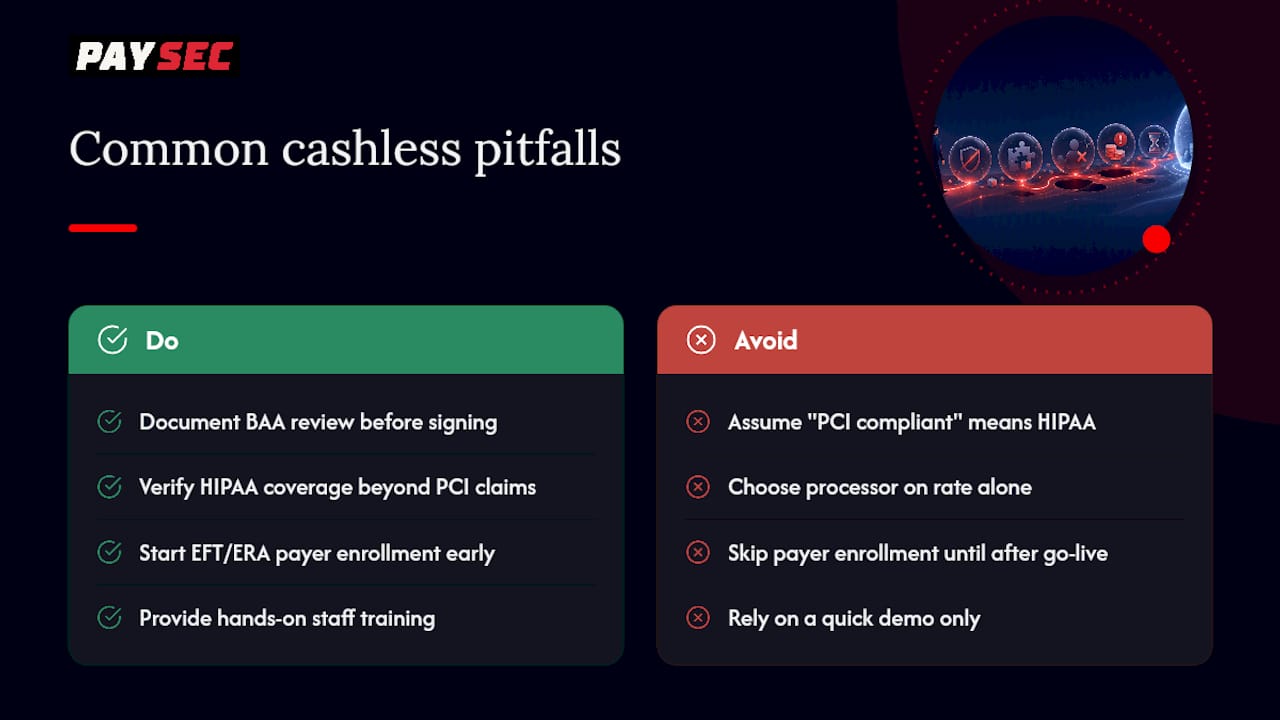
The most common pitfall isn't technical. It's assuming the vendor relationship ends at signature. Practices that skip a documented BAA review, or that assume "PCI compliant" automatically means "HIPAA compliant," often discover the gap during an actual audit rather than beforehand.
A second frequent mistake: underestimating payer enrollment timelines. Getting EFT and ERA enrollment approved with every payer you work with can take longer than the technology rollout itself, and practices that don't start this process early end up running a parallel paper workflow far longer than planned.
Staff resistance is real, particularly among long-tenured front-desk employees comfortable with cash handling. Skipping hands-on training in favor of a quick demo tends to backfire once the system goes live and questions pile up.
Finally, some organizations choose a processor based purely on rate without confirming BAA availability or native EHR integration, only to discover mid-implementation that PHI is flowing through a system with no signed agreement in place. Vetting that upfront, rather than after go-live, avoids a scramble that can stall the entire rollout. Layering in physical access controls at the front desk alongside the digital payment shift closes a gap many practices overlook entirely.
What Patients Actually Notice
Patients rarely think about EFT operating rules or TRN segments. What they notice is friction, or the lack of it.
A patient checking out after an appointment wants to tap a card or use a portal link and be done. Long waits at a cash register, confusion over paper statements, or having to call in a card number over the phone all create the kind of experience that shows up in patient satisfaction surveys, even when the clinical care was excellent. Contactless and portal-based payment options tend to align with what patients already expect from every other service they use, and cross-market analysis of digital payment adoption shows this preference holding steady across healthcare settings globally.
There's a quieter benefit too. When billing staff aren't buried in manual reconciliation work, they have more bandwidth for the phone calls and questions that actually need a human touch, like explaining a confusing insurance adjustment. That shift, from administrative burden to patient support, is part of what makes cashless adoption a genuine catalyst for better care, not just a back-office upgrade.
Why We Think Compliance Should Drive the Adoption Decision
Too many practices evaluate payment systems on speed or convenience alone and treat compliance as an afterthought bolted on later. That ordering is backwards. The compliance features, audit trails, standardized ERA/EFT matching, tokenization, are what actually produce the operational wins administrators want: faster collections, fewer denials, lower labor cost. We see compliance-first adoption scaling steadily across healthcare because the organizations getting the best financial results are the same ones that got the BAAs, the standards mapping, and the audit logging right from day one. Onboarding with a processor built for this from the ground up removes the guesswork entirely.
A Payment Partner Built for Healthcare Compliance
Most generic processors treat healthcare like any other vertical, leaving administrators to patch together BAAs, tokenization, and audit logging on their own. PaySec builds HIPAA-capable processing in from the start: signed Business Associate Agreements, tokenization that shrinks your PCI DSS scope, real-time reporting for audit documentation, and interchange transparency that shows exactly what you're paying and why.
Practices in SaaS-adjacent healthcare, restaurants, eCommerce, and high-risk retail already use PaySec's network offset pricing to keep more of every transaction while staying fully compliant, with no long-term contracts locking them in. If you're evaluating a vendor switch, start by reviewing PaySec's healthcare payment solutions or check current interchange-plus and network-offset pricing to see what a compliant setup actually costs.
Sources
- Understanding payment integrity — Conduent insights
- Transforming Healthcare: The Revolutionary Benefits of Cashless Healthcare Services — PMC
- HIPAA compliant payment processing: A practice guide | Pabau
FAQ
What are the benefits of cashless payments in healthcare?
Cashless payments create auditable transaction trails, speed collections, reduce cash-handling risk, and support standardized ERA/EFT reconciliation that cuts posting errors.
What are the benefits of a compliance program in a healthcare facility?
A strong compliance program reduces audit and enforcement exposure, protects revenue by catching claim discrepancies early, and builds documentation that satisfies payer and regulatory reviews.
What are the compliance requirements for medical payments?
Processors touching protected health information must sign a Business Associate Agreement, follow HIPAA Administrative Simplification standards, and support EFT/ERA operating rules including X12 835 formatting.
What are the three main areas of healthcare compliance?
Common frameworks group healthcare compliance into privacy and security (HIPAA), billing and claims accuracy, and operational standards like EFT/ERA and PCI DSS for payment handling.
How does PaySec support HIPAA-compliant payment processing?
PaySec signs Business Associate Agreements, tokenizes card data to reduce PCI DSS scope, and provides real-time reporting so practices can maintain audit-ready documentation.